“if science no longer needs fiction to lift our sights beyond imagination itself, then science fiction likely faces an existential crisis even bigger than itself…” https://t.co/rqtyj0UZzQ
“Like all things these days, the question is not whether it is happening, but whether it’s good that it is. Sci-fi finds itself on the docket, on the witness stand, and very much on trial.”
Read @jamespoulos in the latest issue: https://t.co/DKajng82hP
THE HOT MIC (the greatest movie podcast in the world, sorry, Ringer) can reveal ROBERT PATTINSON as the masked man who has entered the mix for JAMES BOND, using the delay on THE BATMAN PART II to test at the last minute.
Robert Pattinson is reportedly Amazon’s leading choice to play James Bond.
According to Matt Belloni, Pattinson's potential contract includes a significantly higher salary and just three movies, while Josh O’Connor and Jack Lowden would reportedly be required to commit to four.
(via @PuckNews)
@RuxandraTeslo If people aren’t made too poor to employ people, and aren’t forced to join the borg, that would be a necessary, perhaps even sufficient, start…
Smith and Montesquieu thought that markets and commerce made us better: that they create an incentive to pursue self-improvement and to create things of value for others. In the positive AI visions, where the labor of humans is made redundant, I find myself wondering how we fare in the presumptive absence of these incentive gradients. Perhaps we are released to a life of freedom, where we can study Mozart and read Dickens, but that still seems complicated: both Mozart and Dickens were themselves deeply commercially-motivated in the production of their work, as were most of the great artists through human history. If the premise is that nobody will need to work or produce, how confident are we that we actually get the next Mozart and Dickens? The relevant question is not the partial equilibrium of whether one individual can pursue a life of enlightened leisure, but the general equilibrium of what form a society as a whole will take on.
One could maybe invoke Periclean Athens or the aristocratic gentleman scientists of Victorian England as a counterpoint. While these individuals were perhaps not motivated by commercial considerations, they were embedded in wider societies shaped by commerce, attendant betterment, and trade: Byron was himself upper class, but he was also surrounded by and writing for an educated bourgeois audience. So we’re back to the equilibrium question. Furthermore, even these individuals were surely motivated by a sense of high-stakes and consequential agency: if they did not apply themselves to their labors, they presumably believed that the work would not otherwise exist. Thucydides was addressing pressing military matters.
So I would like to read more optimistic cases from AI proponents about what a society (vs individual life) looks like if everything goes well: what people do, why they do it, whether humans achieve excellence (and in which domains), and which historical groups we should look to as relevant precedent.
One can perhaps imagine that humans will turn out to have a strong preference for work created by other humans. This may work in certain domains (ceramics?), but for how many will it actually apply? (I’m told that much of what is sold on indie crafts websites is now in fact manufactured in China.) It’s hard to see how this human preference, even if strong, would, for example, save scholarship.
Another idea would be to accept that nobody will become Einstein or Mozart or Byron, and that human excellence as such diminishes, but that there are compensatory benefits (planet brains and Dyson swarms?).
I believe that we can satisfy individual desires, but to what extent will we cultivate behavior worthy of admiration? Will a post-scarcity society mold capable and ambitious people? Which institutions will sustain them and which responsibilities will they have? I’d like to hear more of the equilibrium for the maximalist case spelled out.
“A man of theory is known to be a weak man, torn by internal contradictions, which are constantly intensified by reflection that never translates into action. Only action tips the scales in the face of these vacillations and, especially through repetition, definitively secures victory for the cause of good tendencies. It is no coincidence that etymologically, virtue means manliness. It has brought a manly solution to life.”
-Saint Arsenie Boca
I have a major result to share.
I’ve found conclusive forensic evidence that the top 4 Chinese AI labs—DeepSeek, Moonshot, MiniMax and Ant Group—have built their newest models on NVIDIA’s most advanced Blackwell chips, which are barred from export to China.
This sounds insane, but I discovered that almost every AI model carries a hidden signature of the GPU that trained it. When a model is first set up, the starting values of its weights are laid out in a pattern that depends on the exact GPU. Each combination of GPU and seed number produces a unique pattern—a sort of fingerprint of the hardware used to create the model. Traces of that pattern survive training into the published model.
Again, this evidence isn’t based on any insider information or leaking. It’s based on a forensic analysis of the model weights released by the companies themselves.
I searched more than six trillion combinations of chip layout and seed number and matched them to open-weights models. In doing so, I found conclusive evidence that six Chinese AI models—including DeepSeek-V4-Pro, Kimi K3, and MiniMax-M3—were initialized on NVIDIA Blackwell systems. Four of the models match Grace Blackwell, the GB200 and GB300 parts in NVIDIA’s flagship liquid-cooled rack-scale systems.
I then verified these results on real hardware. Running unmodified PyTorch with the seeds I’d recovered, a Blackwell B300 reproduced DeepSeek-V4-Flash’s untouched starting weights bit for bit, and a rented GB200 reproduced Kimi K3’s to a correlation of 0.999995. A Hopper H100 reproduced none of DeepSeek-V4-Flash’s, and changing the seed by one broke the match. (DeepSeek’s seed is 953049583 by the way.) The method also was verified to match 24 known open-weights models to the hardware that developers said they used.
It is exceedingly unlikely that these results are a coincidence. Across six trillion combinations, the best accidental match should reach only about 8 sigma (i.e., eight standard deviations above what random chance would produce). The real matches range from 49 to 1,385 sigma, and even the weakest single test hits 20.
These were data-center-scale training runs. With some analysis of release schedules and model details, I estimate that the largest, Kimi K3 and DeepSeek-V4-Pro, used 2,000 to 3,000 Blackwell GPUs each. Clusters of this size cost on the order of $150 to $200 million each to buy, and across these labs alone would add up to more than half a billion dollars of export-controlled GPUs, not counting experimental compute or otherwise. It’s quite likely that we see multi-billion dollar expenditure on export-controlled GPUs.
I am highly confident in this result, and it has been independently verified by senior researchers at OpenAI and Anthropic. You can read the full report at https://t.co/YOtzND0Jqk.
There is much more I’ve identified about these models through other forms of checkpoint forensics like this, and will have more to share soon.
To be more precise:
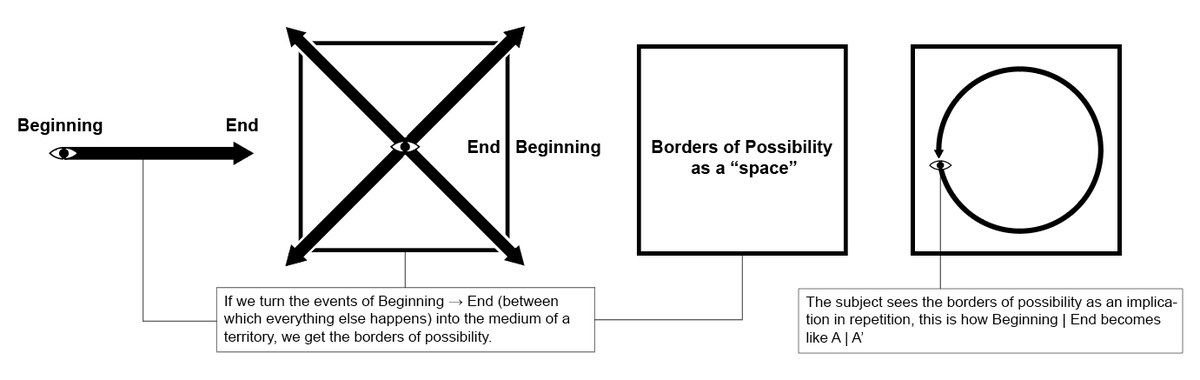
This is well illustrated by the image in the qt, where "repetition" is the sameness that is shared between the images. But again, naming that pattern requires a position from which one can *see* the pattern without it being equated with (worldly) visibility.