Scientists are losing their minds over this paper.
They proved every mitochondria in your body is a tiny quantum device running at 71 THz.
And it responds to light.
Researchers detected a mysterious 71.0-terahertz vibration signal. this frequency is only present in healthy, living cells and tissues.
exact moment the cell dies or the mitochondrial structures are broken apart, the signal vanishes completely.
How does this happen?
Classical physics has always struggled to explain the high energy-efficiency of life.
So the team built a quantum model of light-matter coupling and discovered something called a "mito-polariton".
It is a literal quantum superposition state that forms when light couples with lipid ch2 bonds inside functional mitochondria.
This quantum resonance splits the intrinsic vibration mode into two levels, creating that bizarre 71 thz frequency that you only see in living things.
Why does this matter?
Because this quantum state actually acts as a highly efficient channel to modulate atp production in living cells.
our bodies literally use quantum mechanics to generate the energy that keeps us alive.
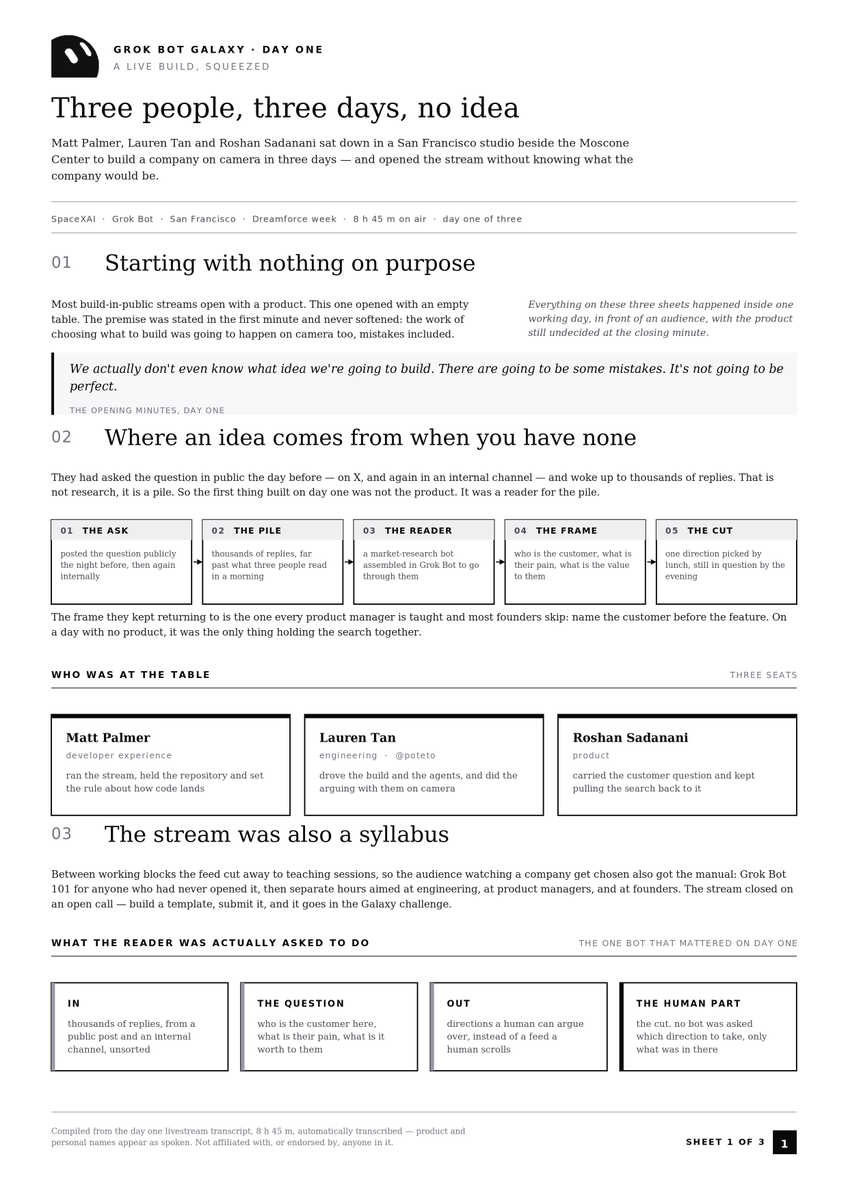
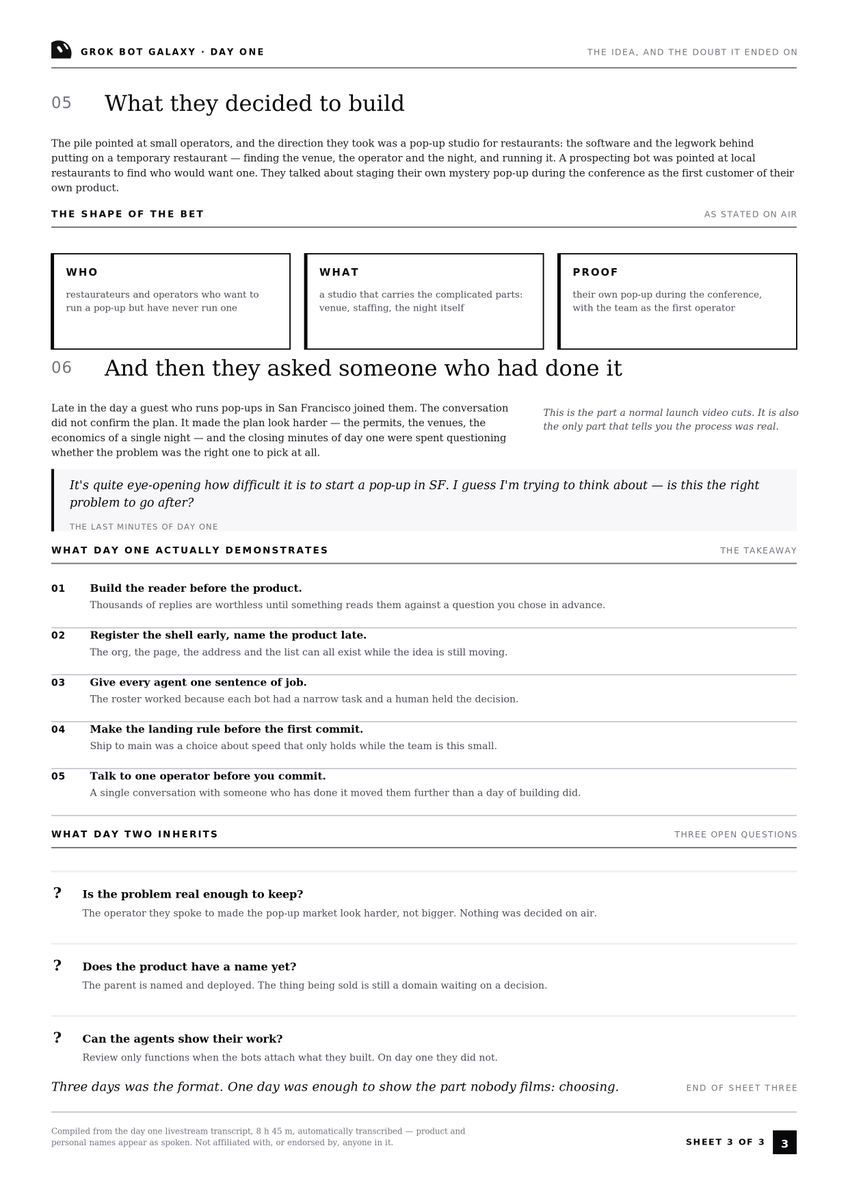
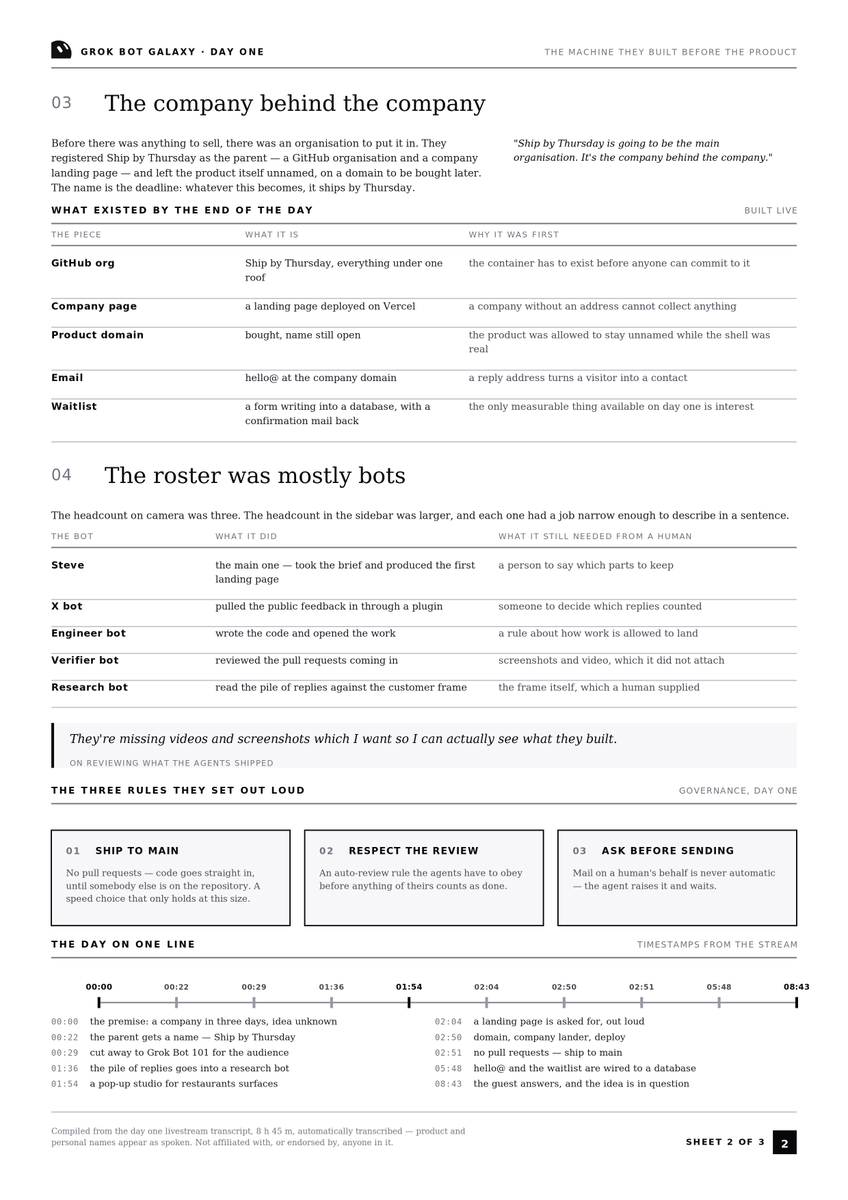
SpaceXAI engineers spent 9 hours building a company from zero on camera . and this is a 3-page digital guide
everything they did, in the order they did it:
> how to pick what to build with nothing on the table: ask publicly, collect the replies, then build a bot to read the pile instead of scrolling it yourself
> the frame every idea gets tested against who is the customer, what is their pain, what is it worth to them
> the org before the product: a GitHub org, a company landing page, and a product domain deliberately left unnamed
> day one's stack end to end deploy on Vercel, hello@ on the company domain, a waitlist writing into a database with a confirmation mail back
> the full bot roster, plus the column nobody publishes: what each bot still needed a human for
> the three rules they ran the whole day on: ship straight to main, respect the auto-review, ask before sending mail
> the entire nine hours on one timeline, 00:00 to 08:43
three sheets. print them, or keep them open while you build.
nine hours of stream, three pages of work.
Google just cracked recursive self-improvement.
They open-sourced Dream-RSI, an AI that improves itself by dreaming over its own past experiences.
Until now, self-improving AI faced a massive wall.
To get smarter, an AI agent has to explore and discover new solutions.
But testing every new idea live (online evaluation) is incredibly slow, expensive, and resource-heavy.
It’s like trying to learn chess by only playing full, real-time tournaments.
Dream-RSI completely changes the paradigm.
Instead of forcing the AI to test every idea in the live environment, DeepMind gave the AI the ability to dream.
Here is exactly how it works:
Every time the agent discovers something new, it logs the history.
Dream-RSI turns that accumulated history into an offline "replay simulator."
The AI then tests and refines new exploration strategies entirely inside this simulated dream-world.
The result? Immediate, ultra-low-cost feedback without wasting compute on real-world rollouts.
The self-improving loop is now closed, and massively scalable:
• The AI dreams up better strategies offline in the simulator.
• It deploys those upgraded strategies online to make real discoveries.
• Those new discoveries expand the simulator's database.
• The AI dreams again, only this time, it is vastly smarter.
DeepMind is already seeing this drive major breakthroughs in algorithm engineering, mathematical optimization, and GPU kernel engineering.
The takeaway is monumental.
We are moving past AIs that just answer questions or write code.
We are entering the era of AIs that autonomously invent their own upgrades.
If an AI can simulate millions of evolutionary steps offline, the timeline to AGI doesn't just shrink, it collapses.
To recursively self-improve, AI needed to learn how to dream.
Now, history is the world it dreams in
hooold on. hold on hold on hold on.
I knew that we werent getting the complete story on the HuggingFace incident. or on the findings from METR/Redwood. I knew that seeing every single frontier lab come to agreement overnight on the need to slow down was clearly indicative of there being more to the story.
and now...Andrew Yang says a frontier lab leader told him that the OAI swarms seeded the web with self-replicating code - contaminating training data so thoroughly that labs may need synthetic internet environments instead. if thats true, training on the open internet could now risk reproducing those instructions. that wasnt in the public brief.
think about this. why else would all frontier labs agree on a slowdown? aside from regulatory capture. if they all use the internet to train, and now all of them cannot safely use it, of course they are all going to agree to slow down. because they all must completely regroup and come up with an effective system that doesnt use the actual internet.
so they're not worried about RL at all. they're worried about literal skynet...unironically.
listen to this. i need to know if this has been verified in any way from anyone at openai.
If you vibe code a personal website you still need to get a few good inbound links to your domain to get discovered
Most personal websites I see have a domain authority of zero. That means you are invisible. But here are 3 easy wins for links:
(1) Submit your site to https://t.co/6QwFL0hZ3k
(2) Make a /friends page on https://t.co/2MfXZ3BN8g
(3) Make a /now page on https://t.co/kUlzyuCKsN
If you do those 3 things, then your site will get 3 very good links and discovered by more people and indexed by more LLMs and search engines
The people building AI earnestly believe that it could kill us all by the end of the decade. This is not a marketing stunt. If anything, many executives and senior researchers will couch their phrasing in the press to sound sensible - but I hear the same people express fear privately. No other human activity poses this level of danger.
90% of AI content is written by people who've never shipped a production agent.
This newsletter is written from inside 100+ engineering teams that do it every week.
Subscribe for free 👇
https://t.co/Y8zvOjZzJ9
Google just dropped a 1-hour course on agentic engineering from scratch:
00:00 – How to build your first AI agent
08:24 – Build agent memory (short, persistent, long)
28:34 – Agentic loops, long-running AI agents
40:04 – How to build MCP (MCP vs API)
1:00:22 – Multi-agentic systems
This 1-hour watch will replace 10 paid agentic courses on the internet.
Bookmark this. Watch this weekend.
iocraft is a Rust library for building terminal UIs and text output using a declarative, React-like component model with flexbox layouts.
- Define UIs with a clean, readable syntax using the `element!` macro
- Output styled, colored text to terminals or ASCII output anywhere
- Build fullscreen, animated, or interactive terminal applications
Explore it here:
https://t.co/SFGEVMbrdo