A Pedagogical Question:
The ratio of circles to stars in this picture is "2 to 3."
People say that this ratio can also be expressed 2:3 or as 2/3.
Umm. Where exactly is the fraction 2/3 in this picture?
In what sense, exactly, is a fraction a ratio?
Gotta love AI!
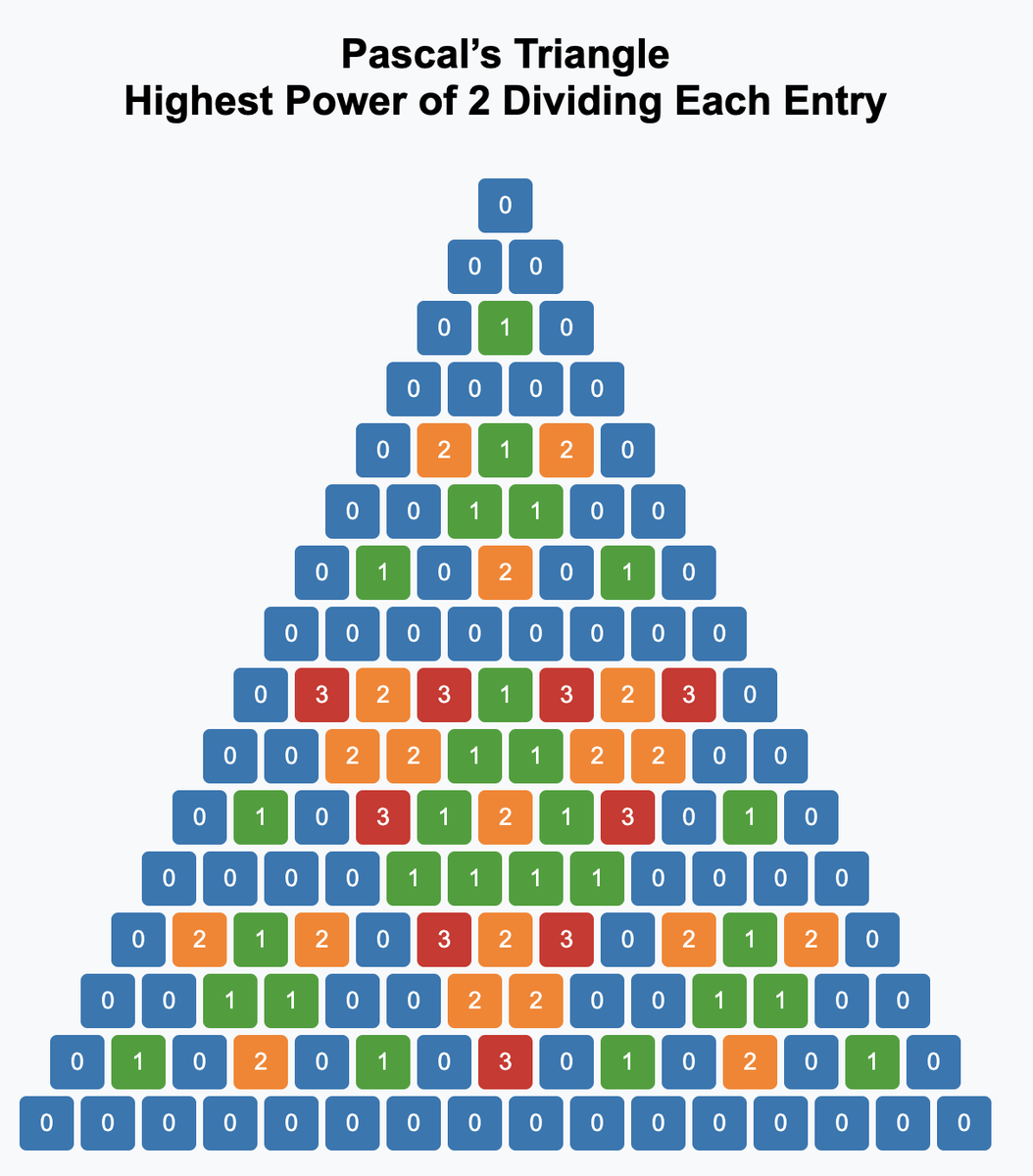
Here are the highest powers of two that divide each entry of the famous arithmetic triangle.
Just a vague question today: Are you surprised by the fractal pattern given our discussion all week?
We've shown this week that if a and b have no 1s in the same column of their binary representations, then (a+b)!/(a!b!) is odd.
What if they share precisely one 1 in the same column? What can we say about the value of (a+b)!/(a!b!)?
Share two 1s in the same column? Three?
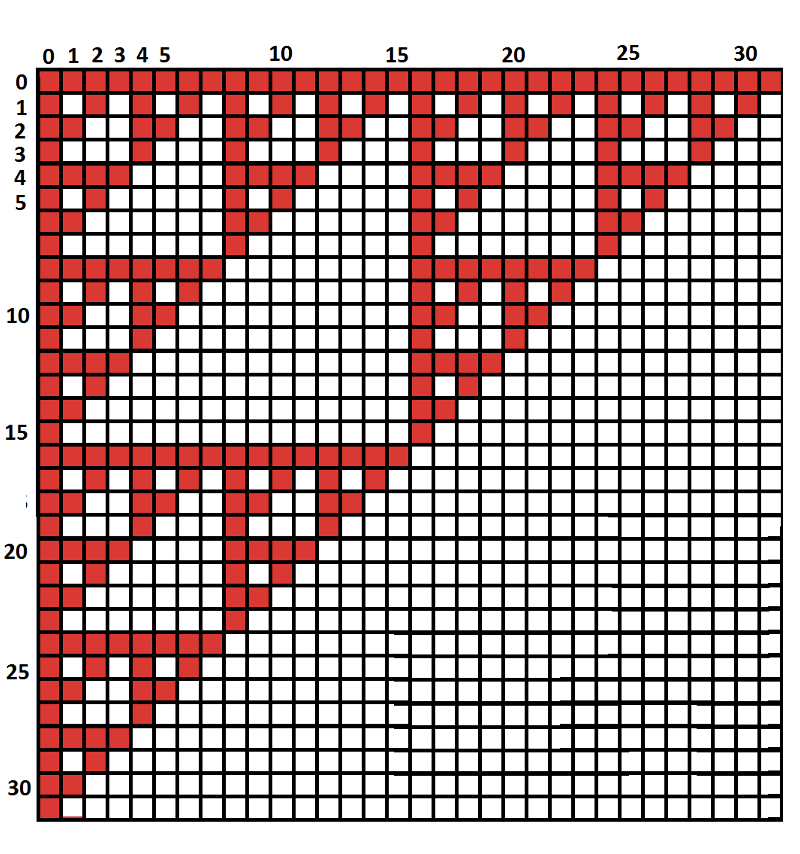
Two numbers are "base-b disjoint" if, when written in base b, the numbers don't ever have a non-zero digit in the same column. E.g. 201 (nineteen) and 10 (three) are disjoint in base b 3.
The picture shows all the base-2 disjoint numbers (red cells). Picture for base 3?
Classic:
Two counting numbers are binary disjoint if no 1s appear in the same column in their binary representations. (e.g. eight=1000 and five=101 are disjoint.)
Prove a & b are binary disjoint precisely when (a+b)!/(a!b!) is odd.
(This explains the pattern of two days ago.)
Two counting numbers are "binary disjoint" if no two 1s appear in the same column of their binary representations. (e.g four=100 and two=10 are disjoint.)
Set <a,b> = 1 is a & b are disjoint, 0 otherwise.
Prove
<a,b> = <a-1,b> + <a, b-1>
(using the convention that 1 + 1 = 0).
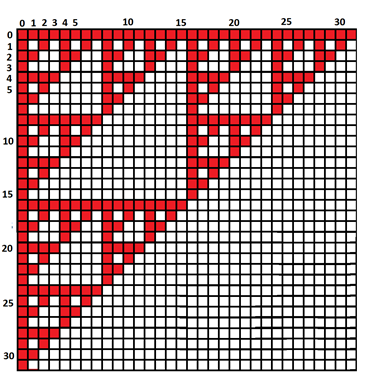
Let's say two natural numbers are "binary disjoint" if their binary representations don't share the digit 1 in the same column. (E.g. twenty=10100 and nine=1001 are binary disjoint.)
In this picture, cell (a,b) is red if a and b are binary disjoint.
Is this picture surprising?
A={a,b,c,d,...} is a subset of the counting numbers.
E(n)=the number of elements of A that are less than or equal to n.
If E(n)/n --> 0 as n grows, does that mean that the infinite sum 1/a + 1/b + 1/c + 1/d + ... converges?
That is, does "sparsity imply convergence"?
A={a,b,c,d,...} is a subset of the counting numbers.
E(n)=the number of elements of A that are less than or equal to n.
If the infinite sum 1/a +1/b +1/c +1/d +... converges, does that mean E(n)/n --> 0 as n grows.
That is, "convergences requires the elements to be sparse."
A={a,b,c,d,...} is a subset of counting numbers.
Let F(n)=number of factors of n that are in A.
If the infinite sum 1/a + 1/b + 1/c + ... converges to a value m, does that mean (F(1)+F(2)+...+(Fn))/n converges to m too as n grows?
"Each number has on average m factors from A."
On average, how many square number factors does each number possess?
That is, if
F(n) = the number of square factors of n
what is the value of
[F(1)+F(2)+...+F(n)]/n
as n grows?
Prove that, on average, each number has 2 triangular numbers as factors.
[To be precise, let
F(n) = number of triangular factors of n
and examine
(F(1)+F(2)+...+F(n))/n
as n grows.]
Prove, that on average, a number has ln(2)~0.69 more odd factors than even factors!
(To be precise:
Let F(n) = |odd factors of n| - |even factors of n|.
Compute limit (F(1)+F(2)+...+F(n))/n as n grows.)
@_Manuel_Ruiz_ Yeah .... I should clarify.
Let F(n)=|odd factors| - |even factors|
Is limit (F(1)+F(2)+. ... + F(n))/n as n grows positive, negative, or zero?
If N is odd, then
* N has zero even factors.
* 2N has just as many even factors as odd.
* 4N has thrice as many even factors as odd.
* 8N has four times as many even factors as odd.
Etc.
Which wins out? On average, does a number have more even factors than odd?
The number 30 has an equal number of even and odd factors. So too do the numbers 6, 58, and 110.
Describe the set of all numbers that have this property.










![jamestanton's tweet photo. On average, how many square number factors does each number possess?
That is, if
F(n) = the number of square factors of n
what is the value of
[F(1)+F(2)+...+F(n)]/n
as n grows? https://t.co/ujSnbtZ1wk](https://pbs.twimg.com/media/HK8N-6maUAAa6dX.jpg)
![jamestanton's tweet photo. Prove that, on average, each number has 2 triangular numbers as factors.
[To be precise, let
F(n) = number of triangular factors of n
and examine
(F(1)+F(2)+...+F(n))/n
as n grows.] https://t.co/MLj3OarwNV](https://pbs.twimg.com/media/HK8McxWa8AA0pys.jpg)


