This one is curious:
If you want to define a multiplication on points (a,b) in two-dimensional space that respects distances in the sense that || (a,b) x (c,d) || = ||(a,b)|| x ||(c,d)||, then you are forced to set (0,1) x (0,1) = (-1, 0). That's counter-clockwise with our standard x- and y-axes.
Return to a favourite:
Here's the clock of the Ferry building in San Francisco.
Look at it closely. What do you notice that is unexpected about the clock face?
The majority of clocks with Roman numerals exhibit this oddity. What is the historical origin of it?
In the classic puzzle of moving all M green dots right and N purple dots left with slides (slide a dot one square over into the space) and jumps (jump one dot over another into the space), must the empty square "appear" in each cell at least once? Some cells multiple times?
Goal:
Rearrange the pink and orange dots as shown.
Moves: Slide a dot one space over to the empty square or jump a dot over one other into the empty square. V and H moves.
Doable?
(One answer: Just sit the other side of the board and view it upside down! Less cheeky answer?)
M green dots left, N purple dots right, one space.
Goal: Move all the greens right by sliding one square into an empty space or jumping rightward over one purple to an empty space-- and similarly move all the purples left.
Doable? If so, how many slides? How many jumps?
Classic: 3 green and 3 purple dots arranged as so.
Goal: Swap the placements of the colored dots.
Moves:
*Slide a green dot one space to right (if empty).
*Slide a purple dot one place lefty (if empty).
*Jump a green dot right over one purple dot to land in a empty space.
*Jump a purple dot left over one green dot to land in a empty space.
This puzzle can be solved.
Without solving: How many jumps will there be? How many slides will there be?
Place dots in an MxN grid so that each 2x2 sub-square contains exactly one dot.
The minimum number of dots possible is: floor(M/2)xfloor(N/2)
the max is:
ceiling(M/2)xceiling(N/2)
and every count between these values is realizable.
What is the 3D version of this result?
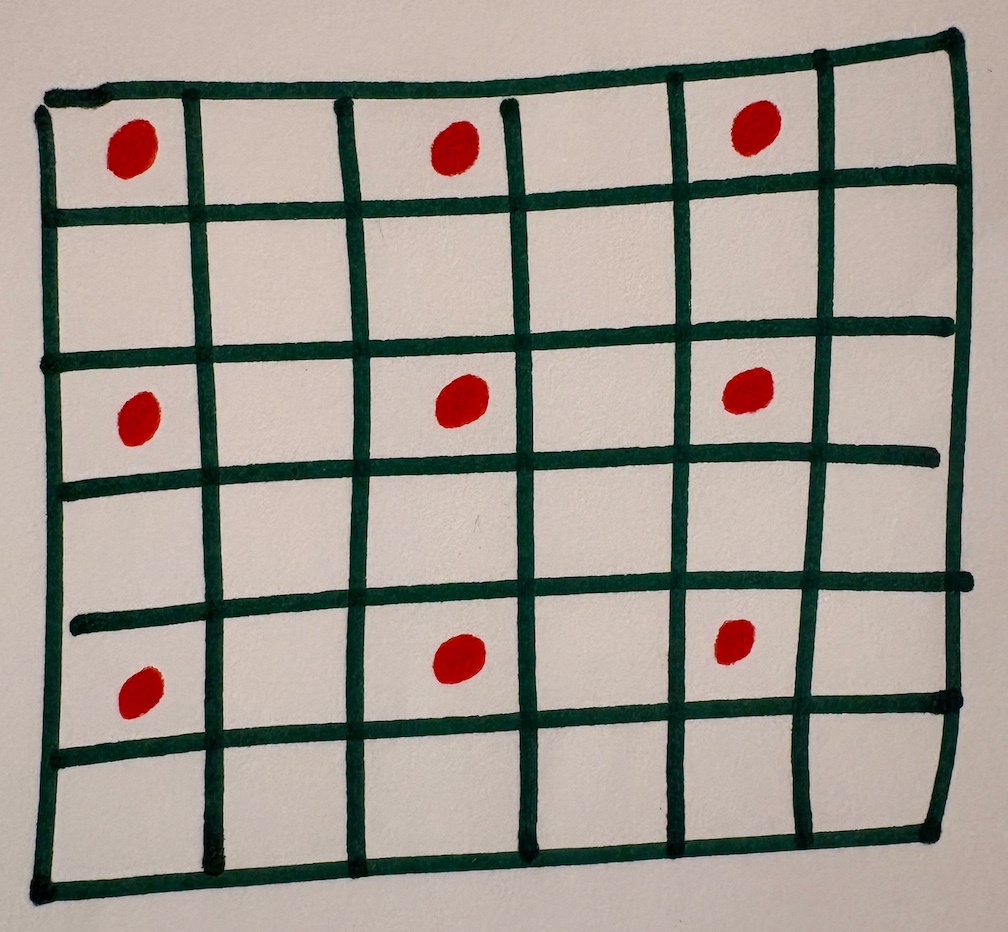
Precisely nine dots can be placed in a 6-by-6 grid so that each 2-by-2 sub-square contains exactly one dot.
How many different arrangements of those nine dots work? (Don't count reflections and rotations of an arrangement as distinct solutions.)
Place dots in an N-by-N grid so that every 2-by-2 subsquare has exactly one dot.
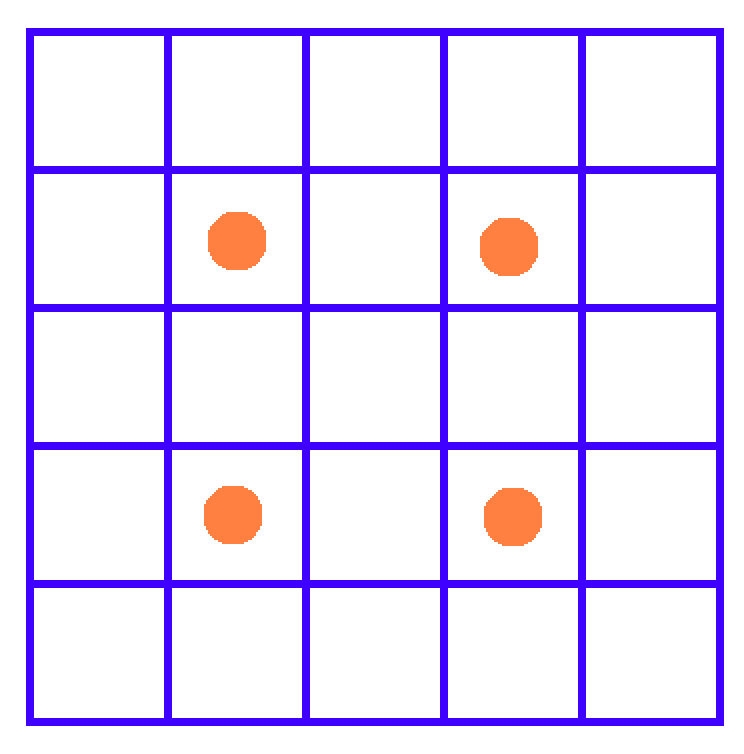
N= 5: The count of dots possible is 4, 5, 6, 7, 8, or 9. (A slew of options.)
N = 6: Only 9 dots are possible. (More space, less options!)
What counts are possible for N = 7? N = 8? N = 100?
It is possible to fit 4 dots into a five-by-five grid of squares so that each 2x2 sub-square contains exactly one dot. Can you fit 5 in dots this way? 6? 7?
Which counts of dots work?