I help Pharmaceutical Sales professionals reach their career goals by leveling up their English communication skills through the PharmaSpeak English Program
Interested in English learning, teaching English, or health and wellness?
Over the next 30 days, I'll be writing 30 Atomic Essays.
Follow my Social Blog on @typeshare_co:
https://t.co/TPJQmz3tVZ
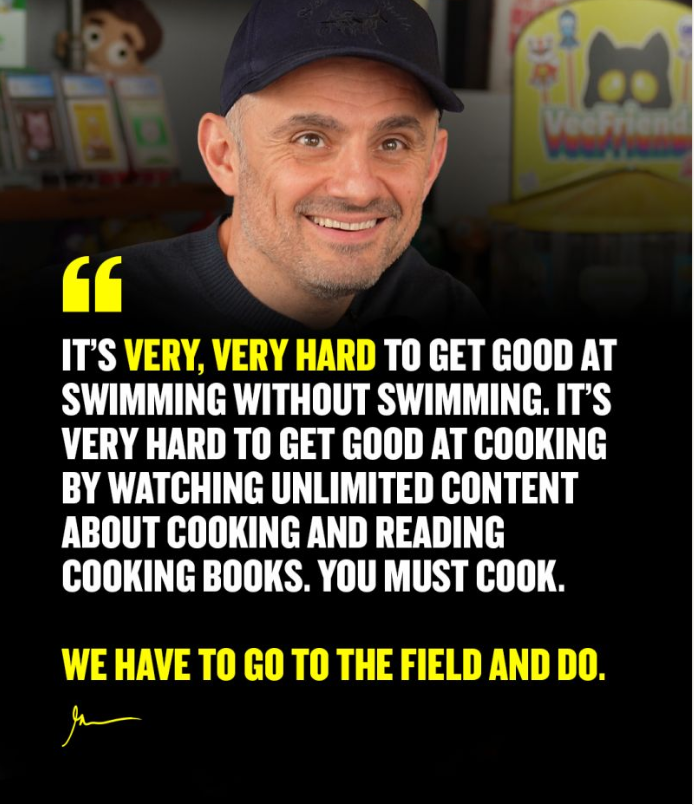
Great message from @garyvee.
It's also very difficult to get good at speaking English without speaking English.
That is why you should try the "5 for 30" challenge:
1. Speak English to yourself in the mirror for 5 minutes daily for 30 days.
2. Set your timer and speak without stopping until you hear the alarm sound.
3. Don't focus on being perfect, but on practicing and building the habit of speaking English.
Follow for more exciting news about the "5 for 30" challenge coming soon!
https://t.co/5Fw2Fo7TY0
How English for Business Purposes Can Help Non-Native English Speaking Business Professionals Excel in the Global Market
What is English for Special Purposes?
English for Special Purposes (ESP) is tailored language instruction designed to meet the unique communication needs of different professions.
ESP focuses on specialized vocabulary, grammar, and communication skills related to your profession.
While studying an ESP course, you might self-study materials, work with a tutor, or do a combination of both. Classes typically include real-world situations or role-plays.
ESP is especially useful if your English language needs are specifically linked to your professional or academic needs.
Who Can Benefit From English For Special Purposes?
You will benefit from ESP if:
1. You are a professional in a specialized field like healthcare, IT, engineering, finance, or law, and you want to expand your business into the international market.
2. You are a non-native English speaker working in an English environment needing to improve your English for communicating with colleagues, clients, or customers.
3. You are preparing for international job opportunities and need to develop resume-writing or interview skills in English.
How Can I Get Started with Studying ESP?
Ok, so you want to start a course in ESP, here's what you do:
1. Clarify your specific needs (This will help you decide what type of ESP course is best for you).
2. Find a suitable ESP provider (There are online and offline, as well as teacher-led, or self-directed learning options).
3. Set realistic goals and get started.
Finding a reputable and committed ESP partner can save you time and have you reaching your goals sooner than you think!
If you are thinking of diving into the world of English for Special Purposes, let's connect for a free consultation and English level assessment.
Cheat Sheet For Finding Your Ideal English Learning Method
You want to improve your English, but there are so many options:
1. Take a physical English course
2. Join an online tutoring platform
3. Find a private online tutor
4. Study alone using paid resources
5. Study alone using free resources
How do you choose?
Here are the pros and cons of each to help you decide:
1. Take a physical English course
Pros:
-High accountability
-face-to-face interaction
-personalized feedback
Cons:
-Can be expensive
-Time-consuming
Best for learners who:
-Have time and can afford to pay higher rates but need to improve quickly.
-Work better with the accountability of face-to-face instruction.
2. Join an online tutoring platform
Pros:
-Affordable
-Flexible
Cons:
-Less personalized
-Tutors come and go, less consistent
Best for learners who:
-Are on a lower budget but need more guidance in their learning.
-Don't have an urgent need to improve quickly and can take their time to improve over a few months.
3. Find a private online tutor
Pros:
-Highly personalized
-Quick progress
Cons:
-Can be expensive
-Less flexible
Best for learners who:
-Need to improve quickly for job interviews or exam preparation.
-Have the budget to pay more and want more personalized learning and attention from their tutor.
4. Study alone using paid resources:
Pros:
-Variety of available resources
-Flexible
Cons:
-Can be expensive
-No accountability
Best for learners who:
-Are able to work independently but still want the best educational resources.
-Want to avoid having to search for the best materials.
5. Study alone using free resources
Pros:
-Free
-flexible
Cons:
-Time-consuming to find good materials
-May not be as effective as paid materials
Best for learners who:
-Are able to work independently but lack the finances to purchase paid resources.
-Have time to go through a lot of material to find good resources for self-learning.
Conclusion:
All of these options can be effective in helping you improve your English, and the best one for you depends on various factors.
In the end, you need to take action.
Consider the pros and cons and your own circumstances and jump in.
The only sure way to NOT make progress is to not take action!
▶️Contact me for a free 25-minute consultation about which option is best for you.
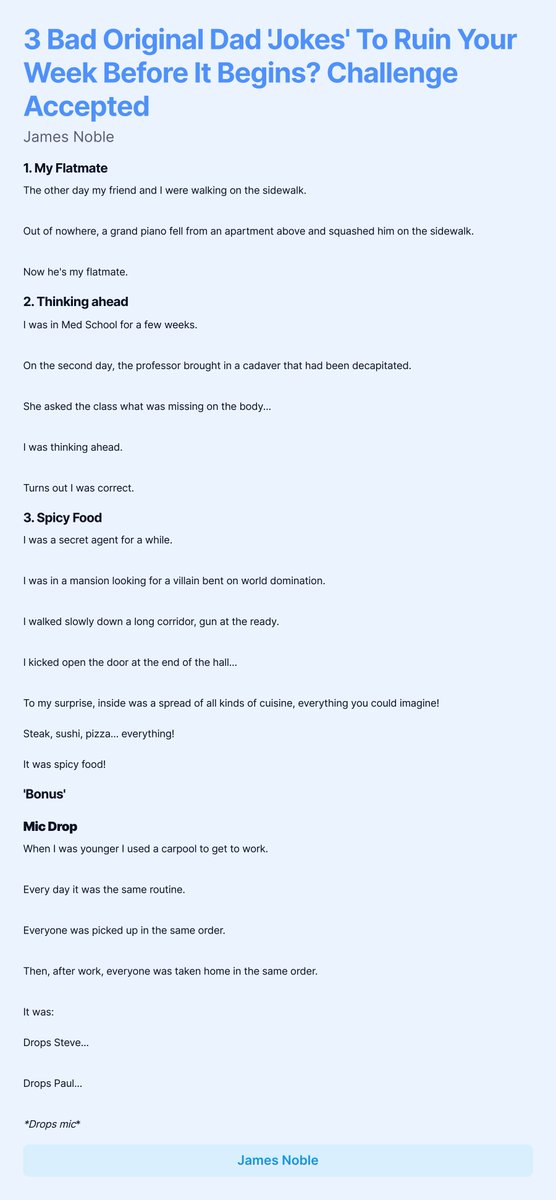
I just realized it's barely readable!
Here is the text
1. My Flatmate
The other day my friend and I were walking on the sidewalk.
Out of nowhere, a grand piano fell from an apartment above and squashed him on the sidewalk.
Now he's my flatmate.
2. Thinking ahead
I was in Med School for a few weeks.
On the second day, the professor brought in a cadaver that had been decapitated.
She asked the class what was missing on the body...
I was thinking ahead.
Turns out I was correct.
3. Spicy Food
I was a secret agent for a while.
I was in a mansion looking for a villain bent on world domination.
I walked slowly down a long corridor, gun at the ready.
I kicked open the door at the end of the hall...
To my surprise, inside was a spread of all kinds of cuisine, everything you could imagine!
Steak, sushi, pizza... everything!
It was spicy food!
'Bonus'
Mic Drop
When I was younger I used a carpool to get to work.
Every day it was the same routine.
Everyone was picked up in the same order.
Then, after work, everyone was taken home in the same order.
It was:
Drops Steve...
Drops Paul...
*Drops mic*