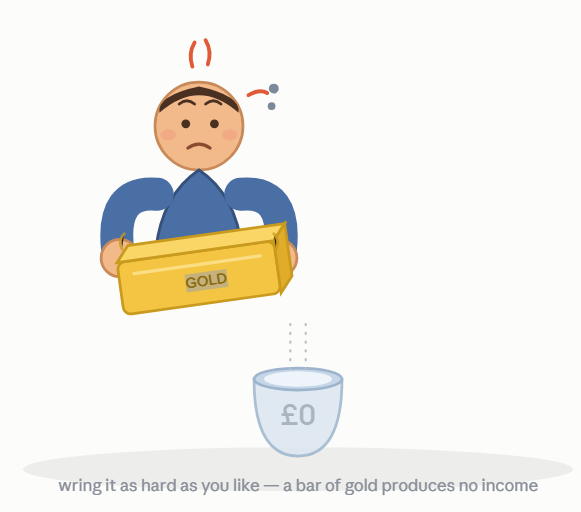
🧵 Why a wealth tax can leave everyone poorer — explained with one bar of gold 👇
A wealth tax charges you every year just for owning things, not for earning from them. Here's why that quietly breaks an economy 🪙
You cannot force women to have kids young. And encouraging freezing eggs or embryos is a case of better late than never. If they didn't do that and did not have kids the fertility rate would be even low.
Also it's not entirely womens fault. Male sperm counts have gone down massively in the last 50 years.
They do get taxed on income more than anyone else.
If you're talking about a wealth tax it has been tried and tested and it has been proven beyong reasonable doubt it doesn't work.
So when you say just tax the rich it actually is not that simple. Burnham and all the economic advisors will know this and this why protesting from people like you won't change anything.
White people have been around a lot longer in this country so it makes sense that there is a higher percentage in these positions as white people have had longer to build here, especially as immigration has rocketed in recent years, so these stats are not relevant really.
Regarding the anti-white racism which is a separate point. There has been plenty of evidence including the most recent example in Henry Novak, is that not evidence enough?
🚨 "Just tax wealth!" they say. Here's a fun fact they never mention:
In 1990, 12 rich countries had a wealth tax.
Today? 3. 💀
The others all scrapped it. Not because of lobbying. Because it FAILED. Here's the body count 🧵👇
@garyseconomics have you heard of corporation tax, income tax and dividend tax?
If they're making a million pounds a week and their asset is in a limited company (most typical structure with that wealth) then they'll be paying 25% corp tax which is £250k. Then if they want to take the money out via a dividend then it's abour 40% which is another £300k. So that is £550k a week tax paid.
So we don't say 'we can't tax them' as Gary puts it. We can and do tax them.
@narindertweets I don't think too many people are concerned that churches are closing because like you say they don't go. But I do think more are concerned with the amount of new mosques as it's a religion that people feel is not compatible with our way of life, which, is based on Christianity.
If you're talking about not taking income due to it being left in the limited company, it is correct that it shouldn't be taxed as it is the company's money but can only be used for business expense. But if it's the case that the director(s) will take it eventually, then it will be taxed whenever they do take it. You can't really get around this as far as I'm aware.
Or if you're talking about the popular wealth tax on unrealised gains, then there is no money there to be taxed, it's just the perceived value of something which would go down if a wealth tax was introduced.
Debt is a tricky one. As an investor I know you can use debt to your advantage. We'd have to distinguish between which debt is actually good for the economy and which isn't. They've already made it so you cannot offset mortgage payments from rental income. They could do the same for other debt, but at the same time we don't want to stop UK companies from growing as that is generally good for the economy and if we did that they'd just move somewhere that does let them use debt to grow.
What I have actually found is the UK government have closed most loopholes and the reason a wealth tax and some of these other taxes haven't been done is because they are a combination of very difficult and not very effective. I have done a lot of research on this and that is the conclusion I come to. However, I do believe there are some loopholes and things that could be done to improve the situation.
The problem with that logic is that 6% typical gain is not a monetary gain, it is just the perceived value of something going up. Because it's not a monetary gain, that money has to be found from somewhere else, it is not the same as every other tax which is money is exchanged and government takes a cut.
So how do you raise the money if it cannot be found from elsewhere? You could sell some of it? But no investor would buy it to then be subject to the same wealth tax when they could just buy abroad.
The other issue is, if a wealth tax was introduced, assets would be worth less any way, so there would be arguments and court cases over the values because if the valuator based it on pre wealth tax valuations, that would not be valid as no investor is going to pay the pre-wealth tax evaluations for UK assets anymore. So forget about that 6% increase a year, it'll more likely go the other way and be -6% a year.
Also, if you understand how businesses raise money, you could come up with a great idea and an investor wants to buy 5% of your company for £5m. So you are now worth £95 million on paper but in the bank you actually have around £3.8 million (after you've paid capital gains tax on the sale). If my calculations are correct you now have to pay £850k every single year as a wealth tax no matter how well the company is doing. Any money you make from your company you will have already paid around 45% tax on. But the problem with the wealth tax is it does not care how much money the company makes on a year to year basis, you have to pay this large amount of money every year. So what's going to happen? Companies moving abroad, bankrupcies, no money raised for public sector.
The problem with that logic is that 6% typical gain is not a monetary gain, it is just the perceived value of something going up. Because it's not a monetary gain, that money has to be found from somewhere else, it is not the same as every other tax which is money is exchanged and government takes a cut.
So how do you raise the money if it cannot be found from elsewhere? You could sell some of it? But no investor would buy it to then be subject to the same wealth tax when they could just buy abroad.
The other issue is, if a wealth tax was introduced, assets would be worth less any way, so there would be arguments and court cases over the values because if the valuator based it on pre wealth tax valuations, that would not be valid as no investor is going to pay the pre-wealth tax evaluations for UK assets anymore. So forget about that 6% increase a year, it'll more likely go the other way and be -6% a year.
Also, if you understand how businesses raise money, you could come up with a great idea and an investor wants to buy 5% of your company for £5m. So you are now worth £95 million on paper but in the bank you actually have around £3.8 million (after you've paid capital gains tax on the sale). If my calculations are correct you now have to pay £850k every single year as a wealth tax no matter how well the company is doing. Any money you make from your company you will have already paid around 45% tax on. But the problem with the wealth tax is it does not care how much money the company makes on a year to year basis, you have to pay this large amount of money every year. So what's going to happen? Companies moving abroad, bankrupcies, no money raised for public sector.
@lukepbeasley I'm sure people will use the classic socialist argument that it wasn't done properly last time but it will be this time. Lets wait and see 😅
I suspect Trump hasn't done the above because he thinks it's a bad idea.
City owned grocery stores have been tried before and generally fail. These cheaper groceries either are paid for by tax payers and/or stock often runs out because there's no profit incentive for the supplier.
@rw_jospeh@DemzDeliver Yes of course they will and I don't blame them.
MAGA folks may disagree with the idea but the fact is, it's there whether they like it or not and their taxes are paying for it indirectly whether they use it or not. So may as well use it.
@Kevin_Cave@elonmusk If you don't trust AI to write binary directly, why do you trust a compiler to translate your high-level code into binary you've never read?