Let’s take this gentleman’s argument at face value that anyone can throw money at rockets and get something like Starship, Falcon or Dragon.
Perhaps he can explain to everyone how SpaceX is able to catch giant starships from orbit with chopsticks and deliver 85% of all Earth payload to orbit with Falcon, while Blue Origin, which started before SpaceX and was funded by the immensely wealthy Jeff Bezos, is not yet able to launch reliably?
Also, why is it that Boeing and Lockheed received several times what SpaceX did from the government for development of their rockets and spacecraft, but the Boeing capsule is still not operational and ULA delivers less than 5% of SpaceX payload to orbit?
I am genuinely curious about these questions.
People keep saying “how much taxpayer money did Elon get”
Not enough people are asking “how much value has Elon given the taxpayer”
I would rather my tax money go to Elon helping the blind see, the paralyzed move, humanity flying to space, rescuing astronauts on the ISS, connecting the world and saving lives with Starlink…than another dime going to a learing center.
Elon creates value for the individual. Even his haters can’t deny that.
Tesla and SpaceX have created meaningful wealth for hundreds of thousands of employees over time and improved the retirement savings of hundreds of millions of people
When brilliant people like Elon have a couple billion lying around they do this. What would the government do if they could get their hands on all of it? You see them being productive? More NGOs and secure their power, it's all they know how to do.
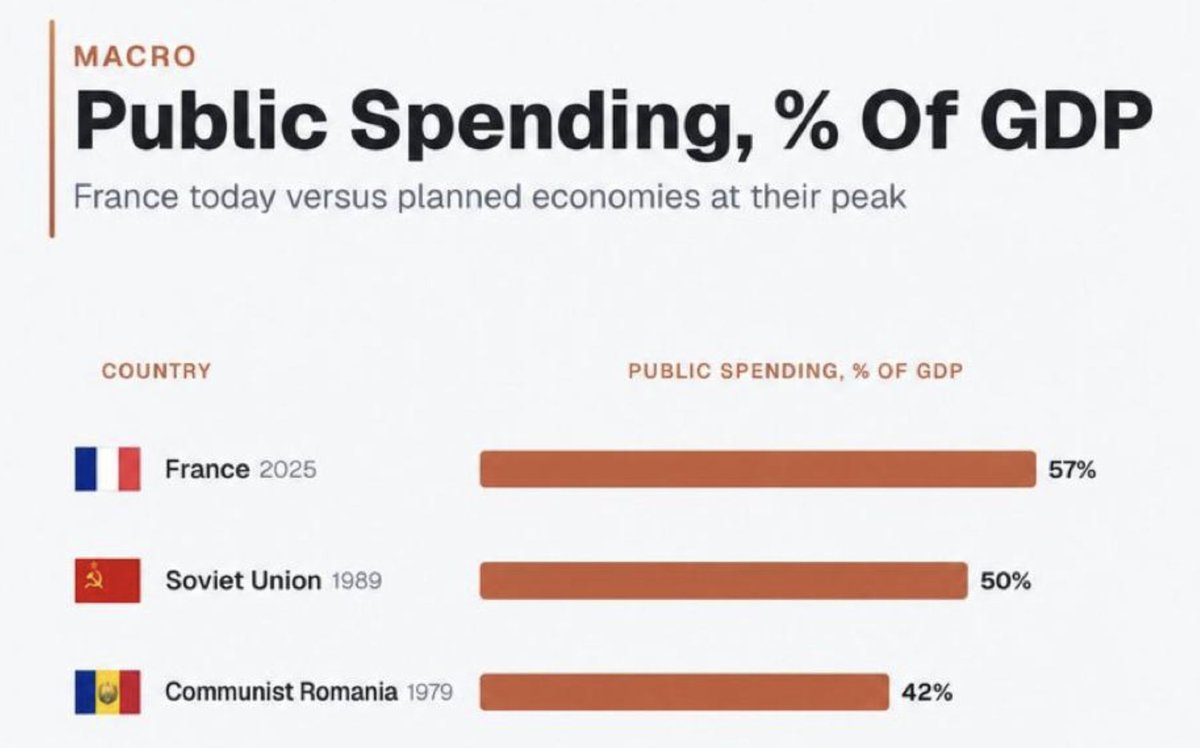
A French protester just said the quiet part out loud. "We are socialists, we are communists, we are anticapitalists... the whole system must go!"
This isn't about school books, pensions or prices. It's about tearing down the system that built the West's wealth. Europe today, the US tomorrow. Wake up.
Marxism doesn't announce itself with tanks. It comes with protests, rent controls and wealth taxes, until there's nothing left to tax.
Note also Soviet Union collapsed at 50%. France is already beyond tipping pt.
If Elon Musk ever loses control of SpaceX, SpaceX dies.
Not overnight. The rockets will keep flying for a few years on momentum. But the company that cut the cost of reaching orbit by more than 10x will become just another government agency.
Here's the proof.
First: a private monopoly is healthy.
Peter Thiel lays it out in Zero to One. Competition is for losers. A company in perfect competition fights to survive the next quarter. Its margins trend toward zero. It has neither the time nor the money to think 20 years ahead. A monopoly can afford to dream. Google funds moonshots. SpaceX funds Starship.
But there's a nuance almost everyone misses. SpaceX didn't get its position by decree. No law protects it. It earned it by being 10x better than everyone else, and any competitor is free to do better tomorrow. That's the difference between a monopoly of creation and a monopoly of the state. The first has to be earned every morning. The second is protected by force.
Second: the founder must stay king.
Founders Fund, Thiel's fund, was SpaceX's first institutional investor. Its doctrine is well known: never fire a founder, never vote against one. Back then, Silicon Valley did the opposite. You found a technical genius, then replaced him with a "professional manager" as soon as the company grew.
Thiel understood something simple. The value of a breakthrough company lives in its founder's head. The day you replace him with an administrator, you keep the chassis and throw away the engine.
That's exactly why SpaceX went public this year with super-voting shares. Elon owns about 42% of the equity but holds the overwhelming majority of the votes. The market signed anyway, eyes wide open, because the market knows where the value is.
Third: why Elon is irreplaceable.
Karpathy worked directly with him for five years at Tesla, and he has described his method. Small, deeply technical teams. No middle management. Low performers removed by default. Big useless meetings banned. He talks directly to engineers, and if the same bottleneck gets flagged to him twice, he blows it up on the spot.
In plain terms: Elon is one of the only humans alive who can run a giant like a startup.
Every organization that grows naturally secretes bureaucracy. Processes, committees, sign-offs, layers. That's entropy. Elon spends his life fighting it. He deletes, simplifies, cuts. The best part is no part.
Remove the man, and entropy wins. Mechanically.
Fourth: what happens when the state takes over.
A government official is never rewarded for success but is punished for every failure. So he minimizes risk. So he never does anything bold. It's not a question of intelligence. It's a question of incentives.
SpaceX built its entire method on failing fast. Launch it, watch it explode, learn, launch again. In a nationalized SpaceX, every Starship explosion becomes a congressional hearing. Every contract gets allocated by congressional district. Every decision goes to committee, and a committee seeks consensus. Consensus is the average. And the average doesn't go to Mars.
We already have the counterexample in front of us. The Space Shuttle, a public program, cost roughly $1.5 billion per flight over its lifetime. NASA's SLS costs over $4 billion per launch according to NASA's own Inspector General. A Falcon 9 costs around $70 million, and the booster lands itself.
Fifth: you need a madman with a vision.
In 2008, after three Falcon 1 failures in a row, Elon puts his last dollars into a fourth launch. If it fails, SpaceX is dead. It succeeds. A few months later, NASA signs.
Reusable boosters? The whole industry said it was impossible or uneconomical. No committee would have approved that bet. No bureaucrat would have put his career on the line for it. It took someone willing to be publicly wrong for years.
That can't be nationalized. You can seize the factories, the patents, the launch pads. You can't seize the will.
Conclusion.
Calls to nationalize SpaceX come from everywhere. From the radical left, but also from Steve Bannon in 2025. That tells you something. When a private company becomes more competent than the state, the political reflex isn't to learn from it. It's to capture it.
I believe we'll eventually move toward a separation of state and economy, the same way we separated church and state. For the same reason: when two powers mix, the more mediocre one contaminates the other. Politicians think in election cycles, entrepreneurs think in decades. Politicians seek consensus, entrepreneurs seek truth. Mixing the two is what rots everything.
The state should set the rules of the game. Not play it.
Donates over $300M to save America in the midterms
Gives away $10B of his own stocks for America's children
Creates the first legitimate flying car
Lands reusable rockets
His companies employ over 150,000 people so they can provide for their families
Starlink, connecting rural America, disaster zones and war zones to the internet
Saves free speech by buying Twitter and turning it into X
No wonder the left hates him. Thank you, Elon! 🇺🇸
General Motors spent roughly $3 billion on advertising in 2025. Ford, around $2.7 billion. Toyota and Volkswagen, about $2 billion each.
Tesla spends close to nothing.
My rough estimate for what Tesla spent developing the new Roadster: about $3 billion. Could be $2 billion, could be $4 billion. Call it one year of GM’s ad budget.
Now compare what each buys.
GM gets a year of commercials people skip. Tesla gets a car lifting off the ground in front of a live audience, footage that runs everywhere for free, and a product people actually talk about.
Ask which one makes you more likely to buy a Model Y.
The Roadster may never be a big business. As marketing, it might be the most efficient spend in the industry.
$TSLA