@ivan_8848 If people are gullible, they tend to accept all sorts of propaganda that's promoted even when they're falsehoods. This is why critical thinking is so crucial and it's the responsibility not only of schools but more importantly, parents to develop these life skills.
The Nasdaq broke decisively below key support at its 50-day SMA and 65-day EMA on heavy volume Friday afternoon. The S&P 500 held up somewhat better, closing below its 50-day SMA but above its 65-day EMA. Small caps continued to lead the market lower, with the Russell 2000 closing at yet another lower low to end the week. The Dow held up best among the four major indexes, but its relative strength matters less given the broader deterioration.
Breadth continued to weaken, with 143 new highs versus 460 new lows on Friday. Not only did the major indexes finally break down, but many leaders across traditional growth sectors also succumbed to selling pressure late last week.
Defensive groups—including oil and gas, miners, and utilities—led the market Friday. A smaller group of leaders in biotech, restaurants, insurance, and specialty retail continues to show relative strength. However, if selling pressure persists across traditional growth leadership, the major indexes will likely face further downside pressure next week.
I was finally forced back to cash and will remain there until the market provides sufficient evidence that taking long exposure is warranted again. No one knows how long that will take, so there’s no reason to rush.
For now, cash is king. Keep running your screens, maintain your watch lists, and stay prepared. When the market begins to improve, you want to be ready—not scrambling to catch up.
I’ve used the same 4 EMAs for years.
Not because they predict where a stock will go, but because they help me read momentum, trend, and where a trade may be changing character.
Here’s how I use them:
1. EMA 8 & 21 — Short-term momentum. When a leader consistently respects both, I want to give it room.
2. EMA 65 — My intermediate trend line. A break can signal that the character of the move is changing.
3. EMA 200 — Long-term trend. I rarely want to own growth stocks trading below it.
But I don’t look at each EMA in isolation.
I pay attention when several EMAs cluster together. Those areas can become important decision zones as price compresses.
I also watch how often a stock tests an EMA. After repeated tests, especially the 3rd or 4th touch, I become more cautious. Support gets less meaningful when it has already been tested several times.
And I never add simply because price touches an EMA. I want to see the stock prove itself again through price action and volume.
These rules helped me stay with winners like $OPEN and $AEVA longer instead of letting normal volatility shake me out.
The EMA itself isn’t the edge.
Knowing how a strong stock should behave around it is.
21 short pieces of advice from 20+ years of trading 👇
1. Protect your capital first. You cannot compound money you no longer have.
2. Master one system before searching for another one.
3. Trade less when the market is weak. A great setup does not exist in isolation.
4. Stop trying to avoid losses. Learn to keep them small.
5. Your best trades should make multiples of what your average losing trade costs you.
6. Study your winners as deeply as your losers. You need to understand what you did right.
7. Judge the quality of your decision separately from the outcome. A good trade can lose money. A bad trade can make money.
8. Become extremely selective. "Tradable" and "worth trading" are two completely different standards.
9. Focus on genuine market leaders. Average stocks rarely produce exceptional results.
10. Look at what happened before the setup. The prior move and price action matter as much as the breakout itself.
11. Never chase a stock because you are afraid of missing it. There will always be another trade.
12. Decide your entry, position size and risk before you buy.
13. Let the market determine your exposure. You don't need the same level of aggression in every environment.
14. Learn to sit in cash without feeling that something is wrong. No position can be the correct position.
15. Don't confuse activity with progress. More trades can simply mean more opportunities to make mistakes.
16. Give your strongest winners enough time and room to become meaningful winners.
17. Keep your watchlist small enough that you actually know the stocks on it.
18. Review your trades regularly. Your own trading history can teach you more about your weaknesses than another trading book.
19. Stop judging yourself by a few trades. Think in samples of dozens or hundreds of decisions.
20. Build confidence from evidence, not from your recent P&L. Know why you trust your rules.
21. Never stop improving your process. I still review, test and question my own trading after more than 20 years.
The biggest change experience made to my trading wasn't adding more.
It was learning what I could remove.
The more you learn about the AI bubble, the more ridiculous it gets:
The AI industry needs to generate $6 TRILLION in revenue by 2031 to sustain its ongoing infrastructure build-out.
But it's only estimated to make $1.8 trillion at most, leaving a shortfall of $4.2 TRILLION.
Source: https://t.co/SIpg0uxQaS
@angeloinchina Blaming China is a lot less painful than trying to solve the underlying issues that hurt every stakeholder in the ecosystem. It takes guts to swallow the poison pill but unless they recognise short term pain is better than long term suffering, nothing's going to change.
The AI bubble is so ridiculous.
Anthropic is a cash incinerator: it lost $42 billion in 2025, with just $4.6 billion in revenue.
But Anthropic is going full steam ahead with its IPO, and wants a ridiculous $2 TRILLION valuation. Insiders hope to cash out before the bubble pops.
Meanwhile, analysts say Anthropic should really only be worth $150 billion, calling this the "most ridiculous IPO of 2026" and an "unprecedented test of investor gullibility".
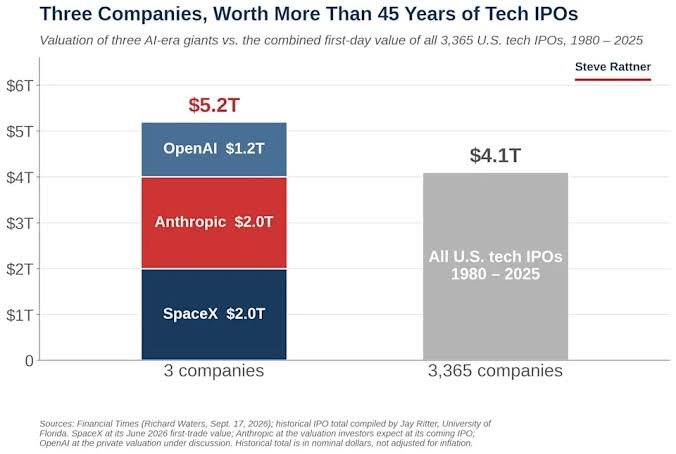
The AI bubble is so bonkers that the IPOs of Anthropic, OpenAI, and SpaceX are estimated to be worth $5.2 trillion, which is more than 45 years of past tech IPOs COMBINED, including the IPOs of Google, Microsoft, Amazon, Facebook, etc.
$FSLY
DEEP Weekend Thoughts
I don't know what happens Monday.
Neither do you. Neither does anyone.
Nor we need to know that.
Took me years to really accept that.
Every setup is just an edge, not a promise. The flag breakout can fail. The "ugly" chart can rip. Any single trade is basically a coin flip with a slight tilt in your favor. The edge only shows up over many trades.
The trouble starts when I *decide* what the market will do:
→ I hold a loser because "it has to bounce"
→ I skip the clean setup because "the last 3 failed"
→ I add size because "this one's a sure thing"
That isn't analysis. It's ego.
Mark Douglas said it best: the best traders think in probabilities. They don't need to be right. They just need to follow their edge, take the stop, and move on.
So this weekend I'm not predicting anything.
I mark my levels. I write my plan. I accept the risk before I enter.
Then I let the market show me.
No bias. No story. Just react.
Not advice, just how I think about it.
Ride the Vertical. Short the Blowoff.
Q showing what a Momentum Market looks like.
"A momentum market is when the 10 and the 20 day moving averages, like I use the Nasdaq for me the Nasdaq is the market. like 90 percent of the stocks I trade are Nasdaq stocks.
I couldn't care less about S&P500 or NYSE. like for me the market is the Nasdaq"
"So when the 10 day is rising and the 20 days is rising and when the 10 day is above the 20 day, that's the momentum market.
Something like this, okay, you don't have to catch any lows after the market bottoms you just have to catch the meat in the middle this is the momentum market.
I have had a huge run I'm up over 200 percent in the past four months okay just this is not a good swing trading market on the long side this you know if you get any breakouts when the 10 day moving average is sloping down when the 20 is day sloping down and 10 days below the 20 day there's a high fail rate. okay you probably shouldn't swing trade on the long side this is a good swing trading market very good this one you know these can be a little bit tricky like this was a good period this was not a good period and just a sideways chop this was also incredibly good swing trading market this wasn't that much I mean you can get select stocks that move higher and have nice breakouts and follow through but the fail rate is just so much higher this was a good one so there are good and bad markets right now we are in an extremely good market."
@Eng_china5 With such support and encouragement from the community, how can they not give back to the community when they become successful in their endeavors? All the best and "add oil".
𝗜𝗴𝗻𝗼𝗿𝗲 𝘁𝗵𝗲 𝘄𝗲𝗮𝗸. 𝗢𝘄𝗻 𝘁𝗵𝗲 𝘀𝘁𝗿𝗼𝗻𝗴.
ROKU... look, guys, these kinds of stocks, it's a weak stock, ignore these, ignore these. Focus on the strong ones. There's a lot of random stocks, ignore all of these. Focus on the ones that are in uptrends and that have been holding up really well during the correction. Focus on those ones, that's where the big money is. ROKU is literally inside of a range right now. This thing has no upside.
Look at stuff like DDOG, look at stuff which I passed on, look at stuff like WORK, which I'm long. These are the types of stocks you wanna own. These are the types of stocks you wanna own. Look at this! DDOG also, this one I didn't think it was gonna go. I saw it breaking out early, but I passed on it. But they just can't hold it down and as soon as the market selling eased, these things exploded, all of these. Don't look at these weak stocks, ignore them. Yes!