Private access is coming.
Soon, we will begin onboarding a limited number of early traders, builders, and DeFi insiders into our Closed Alpha.
No public release. No mass access.
Only a selected group getting in first.
If you want early access or know someone who belongs in the room — tag them below.
The future of DeFi execution starts behind closed doors.
Limited invites only.
@durov Impressive finality times, Pavel.
But let me add one more row to that chart.
ArmaChain: 0.2 sec ⚡
3x faster than TON. Post-quantum secured. Exchange-native L1.
Testnet in a few days. 🔐
#ArmaChain#L1#PostQuantum
Everyone is chasing AI x Crypto.
Meanwhile nobody asks: what happens to all that infrastructure when quantum computers arrive?
Your keys. Your smart contracts. Your L1. All cracked.
We didn’t wait to ask that question.
ArmaChain is fully post-quantum secured. Exchange-native L1. Built for what’s coming, not just what’s trending.
Testnet in a few days. Come break it. 🔐
#ArmaChain #PostQuantum #Web3 #L1
Currently in Bishkek.
Open to coffee chats, meetups and new connections, founders, builders, investors, anyone doing interesting things in tech and Web3.
If you’re around, let’s meet.
Drop a message.
Vitalik talks about post-quantum security.
a16z publishes research.
Every L1 adds it to their roadmap.
We just shipped it.
ArmaChain is a fully PQ-secured L1. Already live.
Testnet opens in a few days. Come test it, don’t just read about it.
Less talk. More code. 🔐
#ArmaChain #PostQuantum #Testnet
#armachain #posquantum #pq
ArmaChain is fully post-quantum secure.
Problem: EVM doesn’t support PQ cryptography.
So we have a real dilemma — EVM compatibility vs the security that actually matters in 10 years.
Most L1s ignore this. We’re solving it.
Updates soon. 🔐
#ArmaChain#PostQuantum#Web3
Solving a Problem Nobody Else Has Tackled
Every L1 blockchain picks a side: fixed fees (predictable, great UX) or dynamic fees (fair during congestion, EIP-1559-style).
Fixed = users love the predictability, but you're defenseless against traffic spikes.
Dynamic = handles congestion, but users see fee volatility even when the network is empty.
What if the network could choose for itself?
We've been building a fee system for ArmaChain that observes actual network conditions and makes its own decisions — no governance votes, no manual switches, no delays.
When the network is quiet: guaranteed stable, low fees.
When demand surges: the system adapts automatically to ensure fair resource allocation.
When demand subsides: back to stable fees. Seamlessly.
The key insight was hysteresis — using different thresholds for activation vs deactivation to prevent oscillation. Simple in concept, but we haven't found this pattern in any production L1.
Details will be in our upcoming technical documentation. For now — the foundation is live and production-tested.
Building ArmaChain.
🦂
DEXs and CEXs don’t play the same role.
And that’s exactly why their responsibilities can’t be the same.
DEXs are built around open, permissionless access.
They are infrastructure. Protocols. Execution layers.
They don’t custody funds.
They don’t curate assets.
They don’t promote narratives.
Users interact directly with smart contracts and take full responsibility for their decisions. That’s the core idea of self-custody and sovereignty.
CEXs operate in a completely different model.
They:
• hold user funds
• decide what gets listed
• actively promote assets
• benefit directly from trading volume
Once a platform starts selecting, promoting, and distributing assets at scale, it also takes on responsibility.
Listings are not neutral.
For most retail users, a listing is perceived as a signal of legitimacy — whether platforms admit it or not.
So the real question isn’t “meme coin or not.”
The real question is:
What standards are applied?
How deep is the due diligence?
How is short-term revenue balanced against long-term credibility?
A mature ecosystem isn’t built on access alone.
It’s built on clear roles and accountability.
DEXs protect neutrality.
CEXs must protect trust.
And the credibility of this industry depends on how seriously each side takes that responsibility.
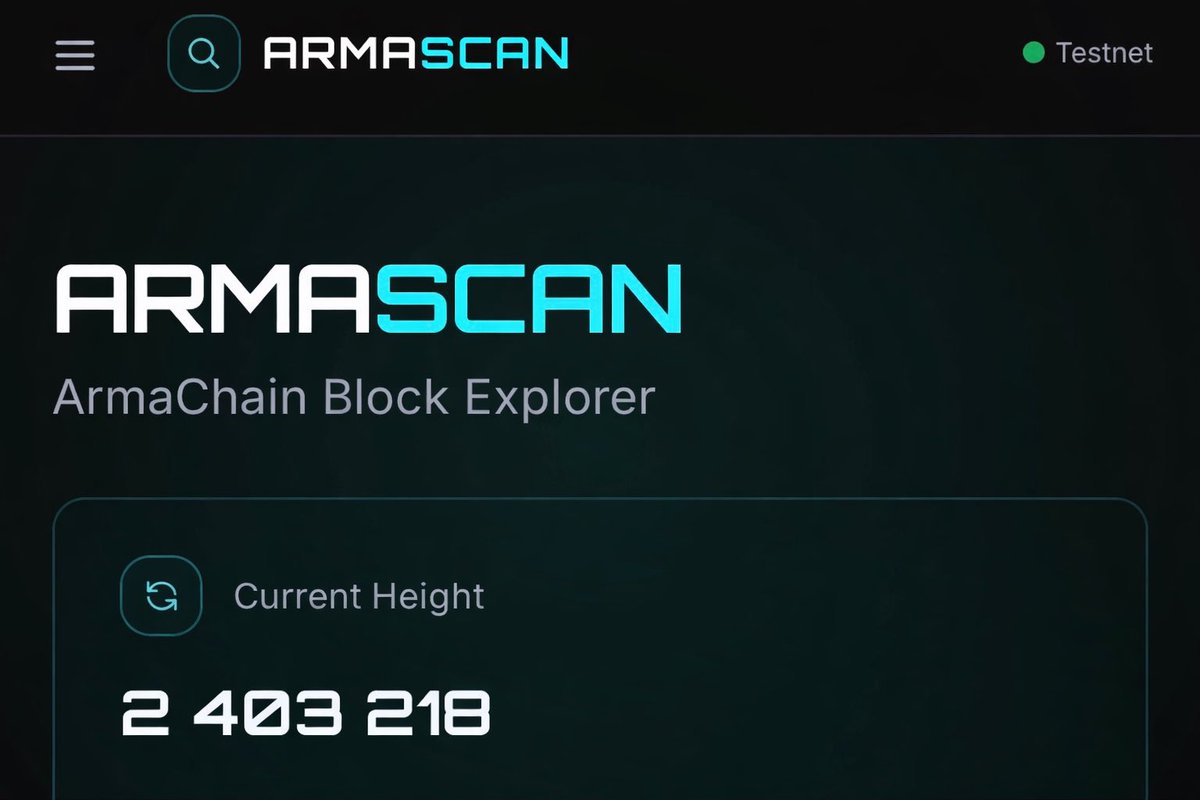
ArmaScan is live.
Our native block explorer for ArmaChain testnet is now running and tracking real network activity.
Current height: 2,403,218 and growing.
Every block, every transaction - fully verifiable.
This is what building infrastructure looks like.
We keep pushing.
@mimicute01@Armadex_io Appreciate the detailed overview.
@borisbarkin is leading ArmaDEX as CEO — I’m focused on the architecture and execution layer.
Infrastructure takes time, but that’s exactly where durable systems are built.
Most people think transparency creates trust.
I don’t think that’s true.
Transparency just means information is visible.
Trust emerges only when outcomes are independently verifiable — and when the rules that produced them are stable.
A system can be fully transparent and still untrustworthy:
if information is overwhelming,
if interpretation requires insiders,
if execution can’t be replayed,
if power hides in edge cases instead of interfaces.
That’s why “just make everything public” is often lazy design.
Real trust comes from clear constraints, deterministic execution, and the ability for anyone to verify results without needing permission or context.
Transparency is a tool.
Verifiability is the foundation.
Most systems confuse the two-and pay for it later.
Good question.
The key thing is: explainable ≠ verbose onchain.
The protocol doesn’t need to explain itself in words.
It just needs to make the outcome inevitable.
If the rules are strict, the ordering is explicit, and the state transition is deterministic, then anyone can replay the same inputs and arrive at the same result- independently.
Onchain you keep it minimal:
clear inputs, clear ordering, no hidden branches.
The “explanation” lives in the fact that there’s no room for interpretation.
If you replay it and get a different result-something is wrong.
So complexity doesn’t come from explainability.
It comes from ambiguity.
Once you remove ambiguity, explainability is basically free.👍
A deep but simple thought on execution in crypto.
Most people think the hard part of building a DEX
is matching orders or scaling throughput.
In practice, the harder problem is this:
👉 Can the system explain why a specific outcome happened?
Not in a blog post.
Not in a support ticket.
But directly from the protocol itself.
If two users look at the same transaction,
they should be able to independently verify:
•which inputs were considered
•in which order state was updated
•why this exact result — and not another — occurred
If the answer is “trust the engine”,
the system is fast, but not trustworthy.
At ArmaDEX, we treat execution as a deterministic process,
not a probabilistic one.
Same inputs → same state transition → same outcome.
Always reproducible. Always explainable.
This matters not just for traders,
but for developers, auditors, regulators, and future contributors.
Because a system that cannot explain itself under scrutiny
eventually stops being trusted — even if it works most of the time.
Correctness is not a feature.
It’s a property.
A quiet moment after a real milestone.
A few days ago, we launched our test blockchain
and sent the first transaction on ArmaDEX.
No big announcement.
No hype thread.
Just a system executing its first instruction —
exactly as designed.
Today I’m in Istanbul, standing by the Bosphorus, and it felt like the right moment to pause and reflect.
Building infrastructure is slow by nature.
Most of the work happens far away from timelines, likes, and launches.
Testnets don’t look impressive from the outside.
But this is where architecture proves itself:
blocks, state transitions, finality, execution.
This is the phase I enjoy the most —
when a system starts to exist, not just be described.
We’re continuing to move forward with ArmaDEX step by step.
Quietly. Deliberately.
The rest will come later.
Today we completed the first successful transaction on the ArmaDEX testnet using the $ARMA token.
It may look simple on the surface, but for us it represents months of work, decisions, and belief in the idea.
Thank you to everyone who stayed with us early, followed the journey, and trusted what we’re building. This milestone is as much yours as it is ours.
More ahead.
We’re only getting started.
This is fundamentally a transparency + incentive design failure, not a political one.
A realistic fix (deployable in ~60 days):
• move state payments to on-chain execution
• require deterministic execution replay for every public contract
• make how funds were spent verifiable, without exposing personal data
Fraud survives because spending can’t be replayed.
Markets and governments fail for the same reason.
This is fundamentally a transparency + incentive design failure, not a political one.
A realistic fix (deployable in ~60 days):
• move state payments to on-chain execution
• require deterministic execution replay for every public contract
• make how funds were spent verifiable, without exposing personal data
Fraud survives because spending can’t be replayed.
Markets and governments fail for the same reason.
California state government spending on waste & fraud will keep increasing until the GOLDEN STATE has COOKED all the GOLDEN GEESE. Mark my words.
This has always been inevitable and is not due to Newsom or any individual. The Democratic Party is utterly controlled by the unions and the trial lawyers and California is a one-party state.
Any politician nominally “in charge” of California has two choices:
1. Stop sending crazy money to the public sector unions and law firms.
2. Sacrifice the most productive citizens to pay the graft.
They will always pick the second choice, because they will lose their primary if they pick the first.
Only bankruptcy will force a righting of the state, but, between now and then, they will feast on the golden geese who were laying the golden eggs.
Tokenized P2P was an important step.
But decentralization today is about minimizing trust in:
sequencers, validators, bridges, and governance.
Different layers. Different trade-offs.
Web3 today feels like giving everyone electricity
but forcing them to carry generators everywhere.
AI is automating decisions.
DeFi is automating trust.
The real innovation isn’t more power —
it’s making infrastructure disappear.