Call you old fashioned? Alright, old-fashioned, @PatrickChristys, let us go through the decades you prefer.
The 1960s: Ian Brady and Myra Hindley tortured and murdered five children, buried them on Saddleworth Moor, and recorded their screams on tape.
The 1970s: Peter Sutcliffe murdered 13 women with hammers and screwdrivers across Yorkshire.
Dennis Nilsen began strangling young men in his London flat, dismembering them, boiling their skulls on his stove, and flushing the remains down the drains.
The 1980s: Michael Ryan shot 16 people dead in Hungerford. Fred and Rose West were raping, torturing, and dismembering women and girls and burying them under their house in Gloucester. Their own daughter among them.
The 1990s: Two 10-year-old boys abducted a toddler from a shopping centre in Liverpool, tortured him, and bludgeoned him to death with bricks and an iron bar.
Thomas Hamilton walked into a primary school in Dunblane and shot 16 five-year-olds and their teacher. Harold Shipman was murdering his patients by the hundred.
The 2000s: James Watt and his family enslaved a man for a decade, tortured him with baseball bats, air pistols, boiling water, and pit bull attacks, then decapitated him and dumped his body in a lake.
Mathew Hardman, 17, murdered a 90-year-old woman, cut out her heart, placed it on a silver platter, and drank her blood.
The 2010s: Derrick Bird shot 12 people dead across Cumbria.
Thomas Mair shot and stabbed an MP in the street while shouting "Britain first".
The 2020s: Jemma Mitchell decapitated her friend, stored the body for two weeks, and drove 200 miles to dump it.
Those are the decades you prefer. And for each decade there are 20 other equally horrific incidents.
And here is the thing, old fashioned Patrick. According to the Crime Survey for England and Wales, violence, burglary, and car crime have fallen by close to 90% since the mid-1990s. The ONS confirms that violent crime is two-thirds lower now than in the 1990s.
The country you live in today is measurably, statistically, dramatically safer than the one you are nostalgic for. That's not an opinion, it's a fact.
And I am not even touching Glasgow and its past knife crime epidemic.
So, which decade was better, Patrick? Tell us.
"Dear Diary,
JD Vance waded in on the Henry Nowak murder. It feels good to be on the same page as someone who works for a demented rapist paedophile and whose idea of a 'civilised' country is one where over 40,000 people a year die from gun related incidents and many thousands more go bankrupt or die prematurely because they can't afford healthcare. Certainly something to aim for..."
I was a prison officer, Nick. You can't preach "tough on crime." Your lot cut nearly 7,000 prison officers since 2010 and handed our jails to G4S and Serco. You broke the system, then act shocked it doesn't work.
You know what actually works? Lads out on licence getting their track tickets, learning a trade, coming home as taxpayers instead of reoffenders. That's using human capital, not warehousing it. A lad sat in a cell doing nothing helps nobody.
And funny how quiet you all go on the tax dodgers and the oligarchs bankrolling Putin's war. Boris took a Russian ex-KGB man's hospitality at his Italian villa, dodged his own officials, then made the son a Lord. Where's your "lock them up" energy for that?
The Prison Van That Never Showed Up… Again!
With the Crown Court backlog now sitting at over 80,000 cases, you’d think getting defendants to court on time would be an absolute priority.
Think again!
It’s the first day of trial. You arrive early, conference notes ready, evidence digested, arguments sharpened. You waste 5–10 minutes just getting through security into the cells, and another 5–10 minutes getting out. Then you discover the defendant hasn’t even arrived.
The 30-minute conference you planned for 9:30am slowly evaporates.
By 10:00am the case is called. The judge and advocates are left asking the obvious question. The suggestion that the defendant has “refused” is met with visible scepticism.
By 11:30am it’s clear: the prison van still hasn’t shown up. The case is stood out or adjourned. Another ineffective hearing. Another day lost.
This isn’t a rare glitch. It’s becoming routine. A report in The Times this week described late (or non-existent) prisoner delivery by the private escort contractors as a “significant cause” of court delays across the country.
The human and financial cost is staggering:
• Defendants left in holding cells for hours longer than necessary
• Victims and witnesses left hanging yet again
• Court time and public money burned
• Barristers and solicitors sitting around unpaid and unproductive
We’re already fighting a record backlog. When the vans don’t turn up, the entire system grinds even slower.
The judges, court staff and advocates are doing their best with the resources they’re given. The real failure lies with the Ministry of Justice’s continued acceptance of this level of service from the outsourced Prisoner Escort and Custody Service (PECS) contractors - principally Serco and GEOAmey.
No government has been properly transparent about the commercial contracts. What exactly do these multi-billion-pound deals actually require of the providers when it comes to timely delivery?What are the real penalties for repeated failure?
MPs and journalists need to keep hammering this issue. The public should be outraged - because it’s our money being wasted.
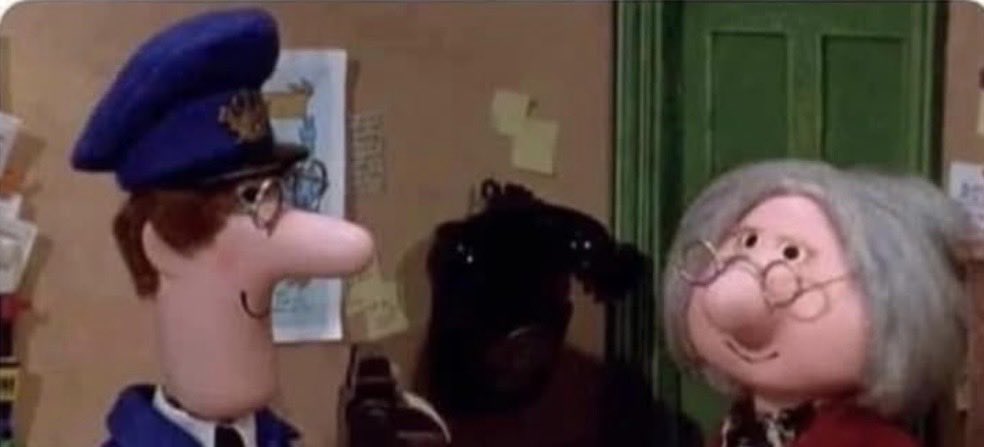
"Good Morning Mrs Goggins, is everything OK?"
"No it isn't Pat... The Doctor has put me on some sort of steroids and I've started to grow a penis"
"Anabolic ?"
"No, just a penis Pat"
The level of personal hostility directed at Keir Starmer over the last week deserves scrutiny in its own right. Not because he should be immune from criticism, but because the tone and intensity of the attacks tell us something unhealthy about the state of democratic politics.
1. Starmer is a conventional political figure. Cautious, legalistic, incremental. He frustrates people precisely because he is managerial rather than messianic. Yet the reaction to him often goes far beyond disagreement, tipping into visceral hatred more commonly reserved for authoritarians or demagogues.
2. Much of this hostility is disconnected from concrete policy. It is not about specific votes, proposals or outcomes, but about projection. A belief that Starmer embodies betrayal, bad faith or hidden malice. That kind of politics runs on suspicion rather than evidence.
3. This matters because democracy depends on the assumption of good faith among opponents. You can think a leader is wrong, timid, or misguided without believing they are fundamentally illegitimate. Once politics becomes moralised to the point of demonisation, compromise is reframed as treachery and pluralism as weakness.
4. The pattern is familiar. In fragmented, polarised systems, anger concentrates not on extremists, whose intentions are clear, but on moderates, who disappoint maximalists on all sides. The centre becomes the lightning rod precisely because it resists totalising narratives.
5. There is also a media and online dynamic at work. Incentives reward outrage, not proportionality. Algorithms favour contempt over analysis. Over time, this creates a political culture in which relentless personal attack feels normal, even virtuous, rather than disgusting.
6. None of this is a defence of Starmer’s decisions, instincts or record. Those should be argued over robustly as you do in a democracy. The problem is the substitution of critique with hostility and the quiet erosion of democratic norms that follows when political opponents are treated as enemies rather than rivals.
7. A democracy cannot function if every election is framed as an existential struggle against internal evil. At some point, the target may change, but the damage to trust, restraint and culture remains.
"Dear Diary,
I asked my lawyers if I could sue Ben Habib for saying I was paid £1m to throw an election. They said of course - as long as he's lying.
Bollocks - back to the drawing board...."
🚨BREAKING🚨
Keir Starmer once reclined his seat on a short-haul flight.
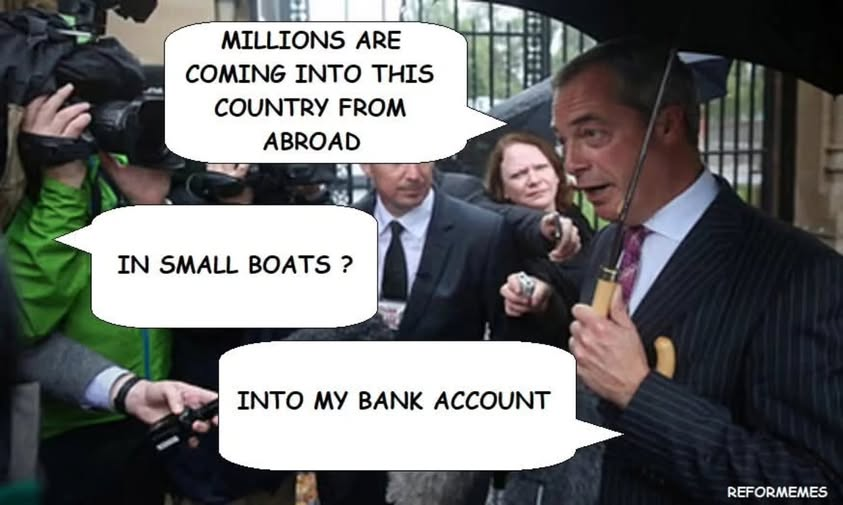
In other news Nigel Farage has received a £5m gift, a house, helicopter flights, a Maldives trip and been accused of throwing an election for £1m.
Here's Sam Coates with more on the reclined seat scandal.
This is the choice. A highly regarded and admired former Director of Public Prosecutions and head of the Crown Prosecution Service, fully vetted by the Security Service or a lying, corrupt, chancer with no political experience who sold Britain out and is probably a Russian asset