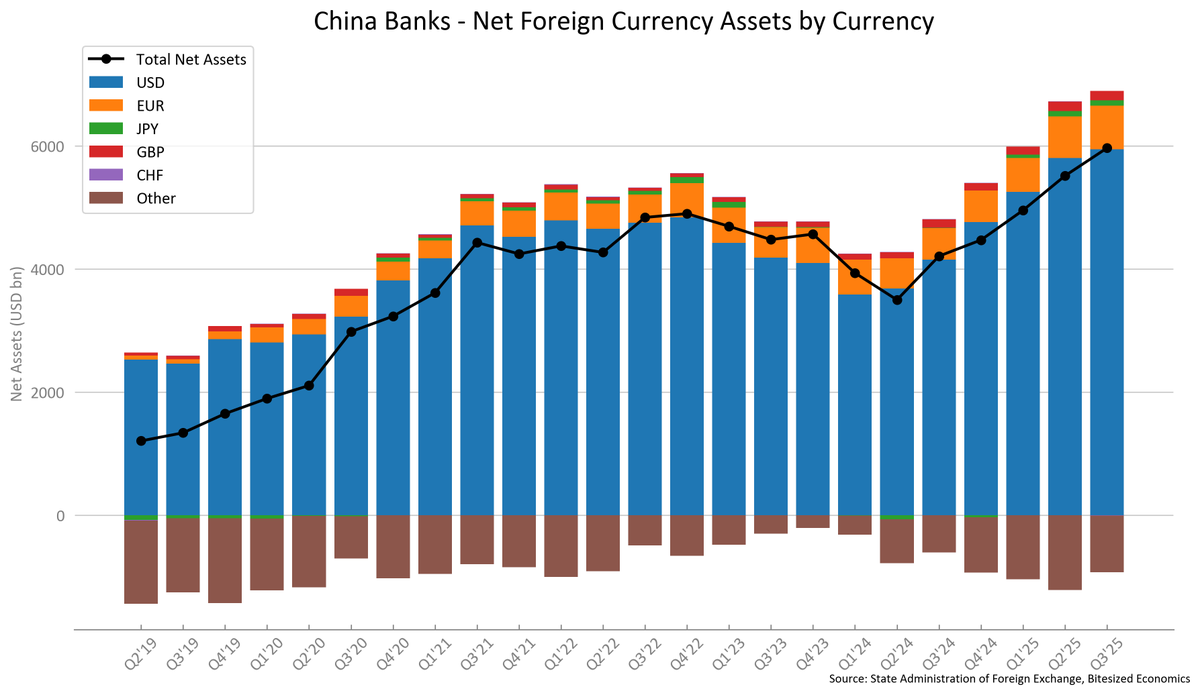
@ShanghaiMacro Data is actually showing that bank net foreign assets are increasing their holdings of USD not decreasing. As long as China continues to manage the RMB, they need to keep buying USD.
@michaelxpettis I think it became clear that Trump wanted to use tariffs more to gain leverage as a negotiating tool, and less to actually correct trade imbalances.
@michaelxpettis This had me pull out the official data on China Banks net foreign currency assets AND their breakdown by currency. Just to drive home the point!
@ShanghaiMacro China reducing its surplus and rebalancing towards households was always going to be a bigger win for the Chinese.
But no one does industrial policy like China atm.
@michaelxpettis@FT Authorities don’t seem keen to let growth targets to go below 4%. So the question is, where will they divert investment spending to now? Maybe back to big infrastructure projects? Investment in AI and new technologies is not likely to be enough…
Anyone notice how much FX and bond markets moved BEFORE the non-farm payrolls came out? Either there are a lot of really clever punters out there or this smells like data leakage.
@ShanghaiMacro China’s foreign reserves and holdings of usts are a direct consequence china’s large trade surplus. TBH it’s hard to see that go away unless China dramatically changes its own policies.
@ShanghaiMacro If the goal is to reduce the us current account deficit, then coordinated intervention to bring down the usd could be the best option. It would increase the effectiveness of tariffs. Japan is already intervening and cny is managed. Only problem is fx flows are much larger today
The sky high expectations for China's fiscal stimulus was bound to be disappointed. But large scale fiscal stimulus of the past, especially through infrastructure spending, isn't the kind of stimulus that China probably needs right now @Janu_Chan https://t.co/IBqKEsNhDH
@adamkwolfe It's because of a low starting point and it's symbolic. Investors were skeptical that Chinese authorities would do anything at all. At least the stimulus is a step to taking action, and an acknowledgement of the economic challenges.
@jasonfurman Interesting chart. The discrepancy could be explained by more people taking on secondary jobs. NFP measures jobs. The household survey measures employed people. Alternatively it’s statistical noise and they will converge over time.
@ShanghaiMacro Really just a result of the policy priorities of authorities. Still geared towards investment and production. The difference is now, post pandemic, the benefits are not likely to flow through to the household sector.