The Anglo-Scottish Enlightenment – the real antidote to Rousseau and Voltaire
The French Enlightenment and the Anglo-Scottish Enlightenment happened simultaneously, in the same century, reading the same books, arguing about the same questions. They reached completely opposite conclusions. One produced the Declaration of Independence and the American Constitution. The other produced the guillotine. This is the most important civilizational fork in modern history.
1. The French Enlightenment begins with the assumption that human beings can be improved by reason – that if you strip away the corrupting institutions of Church, tradition, and inherited authority, the natural goodness underneath will organize itself into a just society. This sounds like progress. It is a fantasy with a body count. Every attempt to implement it has required, at some point, a Committee of Public Safety to handle the people who turned out not to be naturally good enough.
2. The Anglo-Scottish Enlightenment begins with the opposite assumption: human beings are what they are, not what they could be if properly enlightened. Hume grounds morality in human nature as it actually operates – sympathy, habit, sentiment, the slow accumulation of social trust. Smith shows that self-interest, properly channeled, produces collective benefit without a planner. Neither man is building a utopia. Both are building with the actual material available.
3. Burke is the direct refutation, written in real time. He published Reflections on the Revolution in France in 1790 – before the Terror, predicting it precisely – because he understood that institutions are not obstacles to human flourishing, they are its precondition. They contain accumulated wisdom — the knowledge of the dead — that cannot be recovered once destroyed. Pull society apart to improve it and you don’t get the General Will. You get Robespierre.
4. The American founders read Burke, Hume, Smith, and Montesquieu – the Frenchman who looked at England and understood what France was missing. They built a system that takes human nature as given — self-interested, power-hungry, tribal — and constructs institutions to contain those tendencies rather than assume they disappear once the right people are in charge. Checks and balances are not a design flaw. They are what you build when you don’t believe in philosopher-kings.
5. 1776 versus 1789. Same Enlightenment, same century, same vocabulary of liberty and reason. One produces a constitutional republic that has survived two and a half centuries of stress, civil war, and upheaval. The other produces, in sequence: the Terror, Napoleon, 1848, the Commune, and eventually — via Marx, who was a Frenchman in spirit if not in birth — the entire catastrophe of the twentieth century. The difference was not intelligence or intention. It was the starting assumption about human nature. Get that wrong and everything that follows is wrong with it.
6. The guillotine is not the Revolution’s failure. It is its logical conclusion. If man is naturally good and the system is corrupt, then whoever seizes the system in the name of natural goodness is licensed to do anything. The General Will cannot be wrong. Those who resist it are not opponents – they are enemies of nature itself.
7. The real antidote to Rousseau and Voltaire was never a better French philosopher. It was a different civilizational tradition – one that builds with human beings as they are; that treats inherited institutions as repositories of wisdom rather than obstacles to progress; that distributes power rather than concentrating it in whoever currently claims to know the General Will. That tradition was built in Edinburgh, London, and Philadelphia. It is currently under sustained assault — from exactly the same ideas, in exactly the same form, with exactly the same confidence — that Burke watched demolish France in 1789. He was right then. He is right now.
The USS Constitution, aka Old Ironsides, is the world’s oldest commissioned war ship still afloat!
She was launched in 1797, one of six original frigates authorized for construction by the Naval Act of 1794 and the third constructed. The name “Constitution” was among ten names submitted to President George Washington by Secretary of War Timothy Pickering in March or May for the frigates that were to be constructed.
Happy Independence Day America! 🇺🇸🫡
#america250 #america #independenceday #july4th
“The time is now near at hand which must probably determine whether Americans are to be Freemen, or Slaves; whether they are to have any property they can call their own; whether their Houses, and Farms, are to be pillaged and destroyed, and they consigned to a State of Wretchedness from which no human efforts will probably deliver them.
"The fate of unborn Millions will now depend, under God, on the Courage and Conduct of this army. Our cruel and unrelenting Enemy leaves us no choice but a brave resistance, or the most abject submission; this is all we can expect. We have therefore to resolve to conquer or die. Our own Country’s Honor, all call upon us for a vigorous and manly exertion, and if we now shamefully fail, we shall become infamous to the whole world.”
“Let us therefore rely upon the goodness of the Cause, and the aid of the supreme Being, in whose hands Victory is, to animate and encourage us to great and noble Actions—The Eyes of all our Countrymen are now upon us, and we shall have their blessings, and praises, if happily we are the instruments of saving them from the Tyranny meditated against them. Let us therefore animate and encourage each other, and shew the whole world, that a Freeman contending for Liberty on his own ground is superior to any slavish mercenary on earth.”
- George Washington, July 2nd, 1776, before the Battle of Long Island.
To the Americans:
I've travelled all over the world. I've familiarized myself with many places, and met many people. And I'm a Canadian, although I’m privileged to reside once again in the States.
And here's something I've noticed, and it’s a key element of America's continuing greatness:
You bloody Americans value success, and you believe in its existence.
This is something that doesn't really happen anywhere else in the world. Even in other free democracies—the United Kingdom; Finland, Sweden, and Norway; Australia, New Zealand and Canada; Germany, France, and the Netherlands (great countries all)—a counterproductive cynicism too often reigns.
Success is equated with exploitation.
Ambition is looked upon with contempt.
This happens sometimes in the United States too—particularly among the miserable progressives, who confuse their resentment, ingratitude and unearned skepticism with wisdom.
But in your great country, by and large, striving is admired and success celebrated.
This means that more people strive and succeed in the US than anywhere else. And it's increasingly obvious. You remain stunningly more innovative and productive than any people anywhere else on the planet.
And so I say, as all should who are fortunate enough to live in the western world, let alone America:
Thank God for the United States.
Thank God for the wisdom of its founders.
Thank God for its faith in the free market and in the natural rights of man.
Happy birthday, you damn Yankees and Southerners.
Long may your admirable country dominate the world.
Long may your freedom and hope provide an example to those suffering everywhere at the hands of their malevolent states.
May your two and a half centuries of unparallelled success be just the beginning.
Your country is the light of the world, and the city on the hill.
Thank God for the USA.
Happy 250th.
Dr. Jordan B. Peterson
If anyone doubts that Ben Franklin was a man of faith at the end of his life, read what he said at the close of the Constitutional Convention in 1787. GOD BLESS AMERICA!
“The manner in which the whole of this business had been conducted was such a miracle in human affairs, that if I had not been in the midst of it, and seen all the movements, I could not have comprehended how it was effected. I had no doubt of our finally succeeding in this war by the blessing of God. This is the greatest revolution the world has ever seen....I have lived a long time; and the longer I live, the more convincing proofs I see of this truth, that God governs in the affairs of men! If it had not been for the justice of our cause, and the consequent interposition of Providence in which we had faith, we must have been ruined. If I had ever before been an atheist, I should now have been convinced of the being and government of a Deity. It is He who abases the proud and favors the humble! May we never forget his goodness to us, and may our future conduct manifest our gratitude.” --Benjamin Franklin
Today on America 250 we should echo the words of George Washington’s prayer:
“Almighty God, who has given us this good land for our heritage, we humbly beseech Thee that we may always prove ourselves a people mindful of Thy favor and glad to do Thy will.
Bless our land with honorable industry, sound learning and pure manners.
“
Save us from violence, discord and confusion; from pride and arrogance, and from every evil way.
Defend our liberties, and fashion into one united people the multitudes brought out of many kindreds and tongues.
Endue with the spirit of wisdom those whom in Thy name we entrust the authority of government, that there may be peace and justice at home, and that through obedience to Thy law, we may show forth Thy praise among the nations of the earth.
In the time of prosperity, fill our hearts with thankfulness, and in the day of trouble, suffer not our trust in Thee to fail.
All of which we ask through Jesus Christ, our Lord. Amen.”
While today’s politicians pledge nothing and risk even less…
56 men in 1776 pledged their lives, their fortunes, and their sacred honor.
And they delivered.
No empty virtue signals.
No safe spaces or excuses
Just raw courage and total commitment.
Zero defectors.
That’s how freedom was purchased.
We owe them everything. Never forget. 🇺🇸🇺🇸🇺🇸🇺🇸
You've probably heard this before, but it's always worth repeating. Something extremely cool about the "Star-spangled Banner," the American national anthem, is that it asks a question, and it's the question at the heart of everything in the American worldview.
"Oh, say, can you see
By the dawn's early light
What so proudly we hailed
At the twilight's last gleaming..."
So the anthem begins with a question and a scene. One man, a patriot, is asking another man, another patriot, "can you see it?" at sunrise after a long, dangerous night.
The "it" in question is going to be revealed to be the flag, our "star-spangled banner," which they had last fully recognized and honored as the sun set, daylight failed, and night crept over them the evening before.
Can you see it? Say! Can you see it?!
IS IT STILL THERE?!
"Whose broad stripes and bright stars
Through the perilous fight
O'er the ramparts we watched
Were so gallantly streaming..."
Here we find that the "it" is in fact the flag, our star-spangled banner, and we learn why the question is being asked.
The flag is described as having flown and streamed gallantly over ramparts of war through a perilous fight. All could have been lost. The flag, and even the fledgling country for which it stands, one nation under God and indivisible.
Say! Can you see it? Now that the light is back?
IS IT STILL THERE?!
"--And the rockets' red glare,
The bombs bursting in air,
Gave proof through the night
That our flag was still there!--"
They could see it through the battle in the light of the rockets and bombs that threatened them, here and there in quick glimpses. But it was still there throughout! But now? At dawn?
Say! Can you see?
IS IT STILL THERE?!
"Oh, say, does that star-spangled banner yet wave
O'er the land of the free
And the home of the brave?"
The urgency is palpable with every refrain. They have to know. It's the first thing they must know as the sun begins to light the sky, even before it rises.
IS IT STILL THERE?!
Say! Say!! Can you see? Can you see it?!
At the heart of every American beats the fundamental truth and reality that what we have here is precious, that it's worth fighting for, to the death if necessary, and that it's fragile. That at any moment it can be lost. That we have to remember to look for it because last night might have been the night in which it failed.
Every day, every year, every generation.
The American fight for freedom, to live in self-governance within ordered liberty, is ongoing and never-ending. The price of the land of the free is that it must be the home of the brave. We have to defend it, defend it, and defend it again, against all enemies foreign and domestic, because what we have is amazing, rare, fragile, and worth every cent of treasure, every drop of blood, and every risk to our sacred honor to protect it.
Our anthem is not a declaration. It is not a proclamation. It is not a statement.
It is a question.
Every time we sing our wholly unique national anthem, we as American ask the question again. IS IT STILL THERE?! Are we still America? Does that star-spangled banner yet wave?
Because it's a question, the answer is not known. It is not a guarantee. It cannot be taken for granted and isn't. And what an honor to ask and take up our part in the story, in the American Experiment, in the greatest country the world has ever known.
For tonight, the last night of our first 250 years, as the sun gave way to twilight's last gleaming and darkness overtook our land once again, the answer was still yes. We can see it even tonight in the red glare of rockets, with small bombs bursting in air, fill the sky with the noble tribute of fireworks once again.
And we all ask ourselves, will it still be flying at dawn?
This is what it means to be an American.
Happy 250th, America! Now for many happy returns!
🇺🇸🇺🇸🇺🇸🇺🇸🇺🇸🇺🇸🇺🇸🇺🇸🇺🇸🇺🇸🇺🇸🇺🇸🇺🇸
America turns 250 today.
Let me read back the resume.
We started by telling a king to pound sand, in writing.
By 1803 we bought half a continent from France for about four cents an acre.
We fought a war with ourselves and somehow stayed one country.
We strung a railroad across the entire thing.
We handed the world the lightbulb, the telephone, and the airplane in about thirty years flat.
Then a man named Willis Carrier invented air conditioning and made half the planet actually livable.
You are welcome, Texas. You are welcome, Dubai.
Twice the whole world caught fire, and twice we showed up and helped put it out.
We split the atom.
We put men on the moon in 1969.
Then we went back and hit golf balls up there, because why not.
We invented jazz, blues, rock and roll, and hip-hop, and the whole planet is still dancing to it.
We put a burger and fries on every corner of the earth.
We built rockets that fly themselves home and land standing straight up.
We flew a helicopter on Mars.
We launched a car into actual space and it is still out there cruising.
We also invented ranch dressing and somehow talked the entire world into putting it on pizza.
Priorities.
We even invented three of our own sports so we could win them.
Baseball, basketball, and football.
Real football, the kind with hands, because we named it and we are not taking corrections.
The rest of the planet can keep soccer, which is fine, we are hosting it in our backyard this summer anyway.
And yes, Canadian football exists, wider field, extra man, one fewer down, and we try very hard not to think about it.
Frankly it was generous of us to invent our own games.
If we put all that energy into soccer, nobody else would ever lift that trophy again.
We would win it so often they would just rename it the America’s Cup and hand us the keys.
You are welcome for the suspense.
And in 2026 we threw a birthday so big a German tourist live-tweeted our gas stations to 750,000 people.
Not every chapter was clean.
We argued, we stumbled, we fixed what we broke, and we kept building.
That is the whole trick.
Two hundred and fifty years in, and we are still the loudest, brightest, most improbable experiment on the map.
Not bad for a country that started as a strongly worded letter to a king.
Happy birthday, America.
🦋
In September of 1814, America was once again in trouble.
The young republic was only thirty-eight years old. The War of 1812 had gone badly. British troops had marched into Washington, burned the Capitol, set the White House ablaze, and now turned their sights toward Baltimore. If Fort McHenry fell, the harbor would be open, the city would likely follow, and another devastating blow would be dealt to the fragile nation.
Amid this uncertainty, a young American lawyer named Francis Scott Key sailed under a flag of truce to the British fleet. He had come to negotiate the release of a friend, a physician the British had captured.
He succeeded.
The British agreed to free the doctor.
But there was a catch.
Because Key and his companions had seen too much of the British fleet and learned too much about its plans, they were not allowed to return to shore. Instead, they were detained aboard a ship in the harbor and forced to watch the coming battle from behind enemy lines.
On the morning of September 13, the bombardment began.
For the next twenty-five hours, British warships unleashed somewhere between 1,500 and 1,800 bombs and rockets upon Fort McHenry. These were the “bombs bursting in air” and the “rockets’ red glare” of the song—not poetic embellishments, but terrible realities.
Key stood on the deck through the endless day and the long, terrifying night. Every explosion lit the darkness for a fleeting instant before the smoke swallowed everything again. Somewhere beyond that wall of fire stood the fort. Somewhere beyond it flew an American flag if it still flew at all.
He could not see.
He could only listen.
As long as the guns continued firing, there was reason to hope. The British would not waste ammunition on a fort that had already surrendered.
Then, just before dawn…
The guns fell silent.
For the first time all night, there was only stillness.
It was the most frightening sound of all.
Had the fort finally fallen? Had the defenders surrendered? Had the flag been torn down in the darkness while no one could see?
There was nothing to do but wait.
As the first light of September 14 slowly pushed back the smoke, Francis Scott Key strained his eyes toward the distant fort.
Then he saw it. Not a British flag.
The American flag. Still there. Still flying.
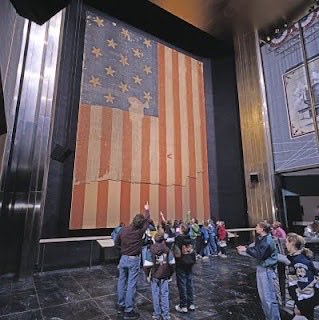
That flag was no ordinary banner. Months earlier, the fort’s commander had commissioned a Baltimore flagmaker, Mary Pickersgill, to sew a flag so enormous “that the British would have no difficulty seeing it from a distance.” It measured roughly thirty by forty-two feet, carried fifteen stars and fifteen stripes, and was so large it had to be assembled on the floor of a brewery because no ordinary room could contain it.
That was the Star-Spangled Banner.
The very flag Key saw through the morning mist.
The very flag that still survives today in the Smithsonian.
Overcome by what he had witnessed, Key reached into his pocket, pulled out an envelope, and began writing. The words came from a heart that had spent an entire night fearing his country might disappear with the dawn.
He first titled the poem Defence of Fort M’Henry.
Within days it was printed and circulating throughout the country. Before long, people began singing it to a melody they already knew—an old British tune called “To Anacreon in Heaven,” originally written for a London social club. There is something beautifully ironic in that: America’s most beloved patriotic song borrowed the melody of the very nation it had just survived. It also explains why the anthem is so notoriously difficult to sing. It was never written for ordinary voices gathered in stadiums or school assemblies.
The song spread quickly and became one of America’s favorite patriotic hymns, but it would wait more than a century before receiving official recognition. Not until 1931 did Congress declare “The Star-Spangled Banner” the national anthem of the United States.