I'm super excited to share our recent work with @RobertHuangHY Michael Broughton Jordan Cotler @preskill@GoogleQuantumAI and coauthors that has rekindled my belief that quantum computers will show us something about the universe that would otherwise be absolutely invisible to us
Are there exponential advantages in using quantum machines to learn about the physical world?🎯
We establish the affirmative through rigorous proofs + physical experiments on the Sycamore quantum processor in https://t.co/TgT4i2llFZ. [📜1/10]
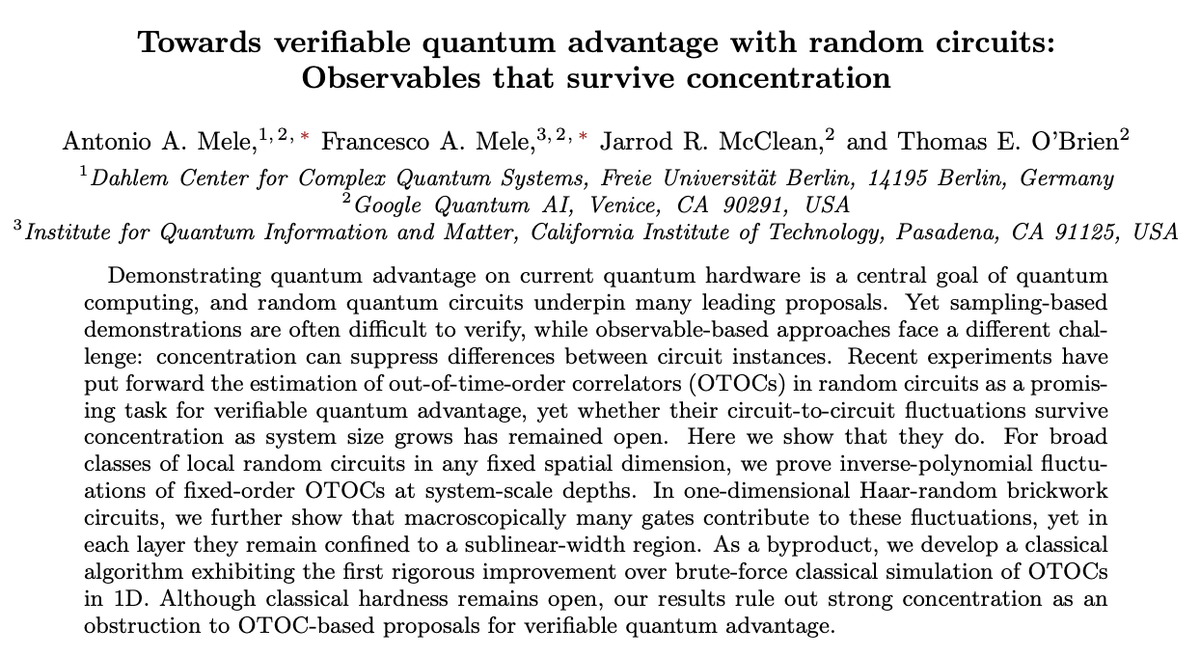
Remember @Google's quantum echoes algorithm? It was run on Google’s quantum computer as a promising way to experimentally demonstrate verifiable quantum advantage
1/
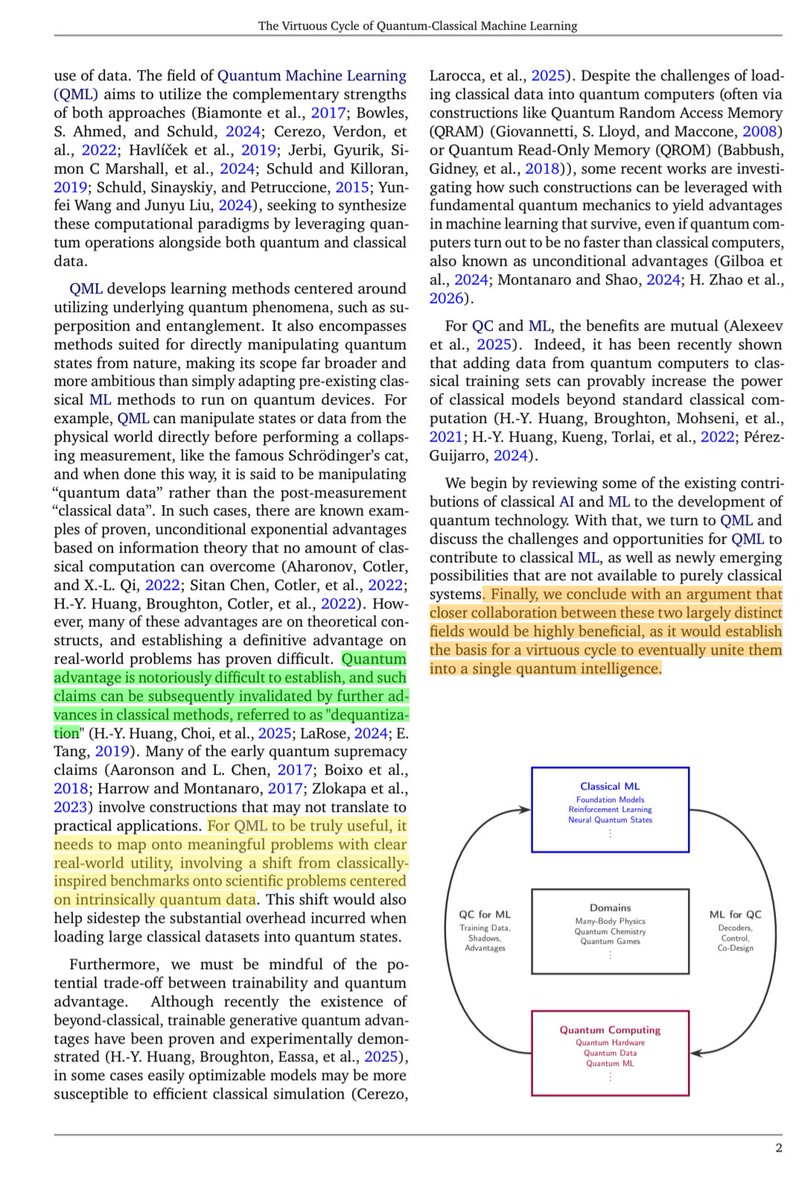
A clear, realistic, and highly readable breakdown of how classical ML and quantum computing reinforce each other. Thanks to @weballergy@JarrodMcclean Johannes for keeping the perspective so grounded.
https://t.co/muX4uPS4Z3
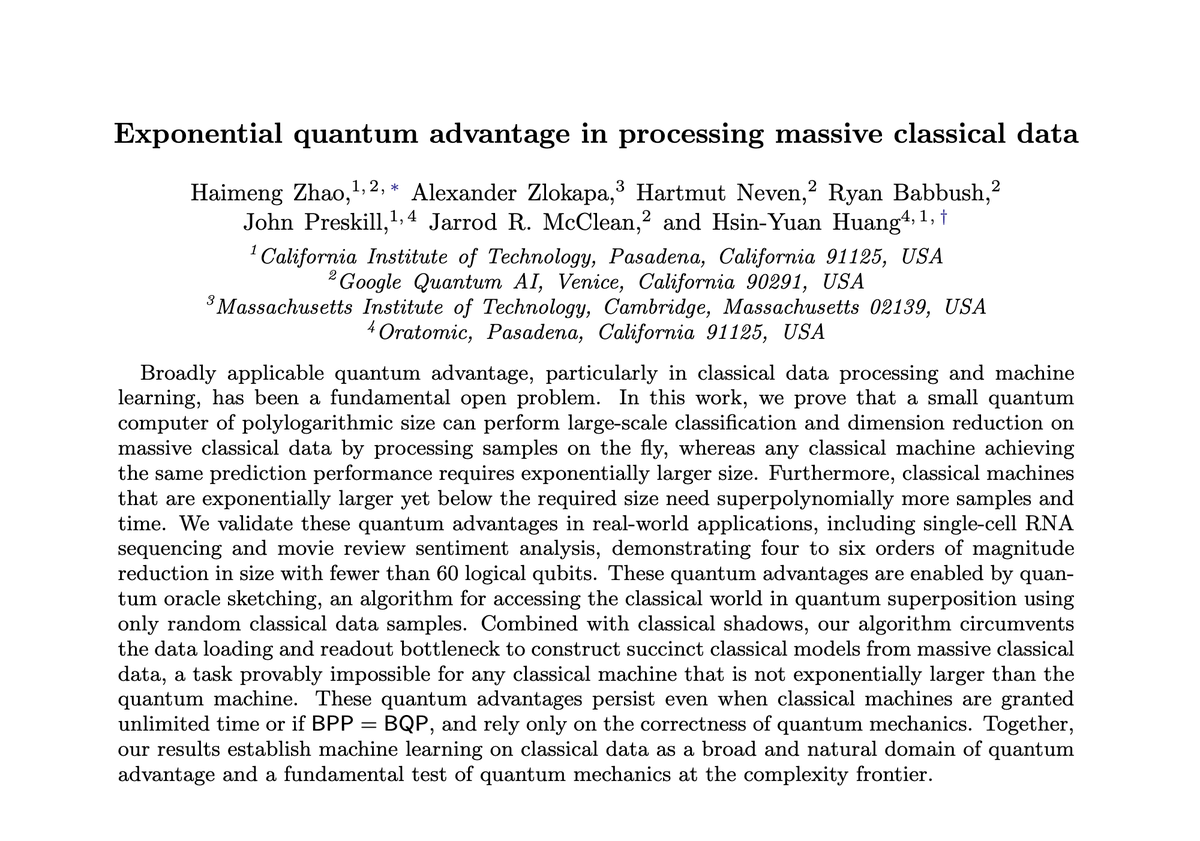
⚛ Can small quantum computers accelerate AI on massive classical data? Yes!
I am absolutely thrilled to share our new work proving *honest* exponential quantum advantages in broadly applicable classical tasks. 🧵👇
Paper: https://t.co/q1txrakSUJ
Blog: https://t.co/77svcuQ1Yl
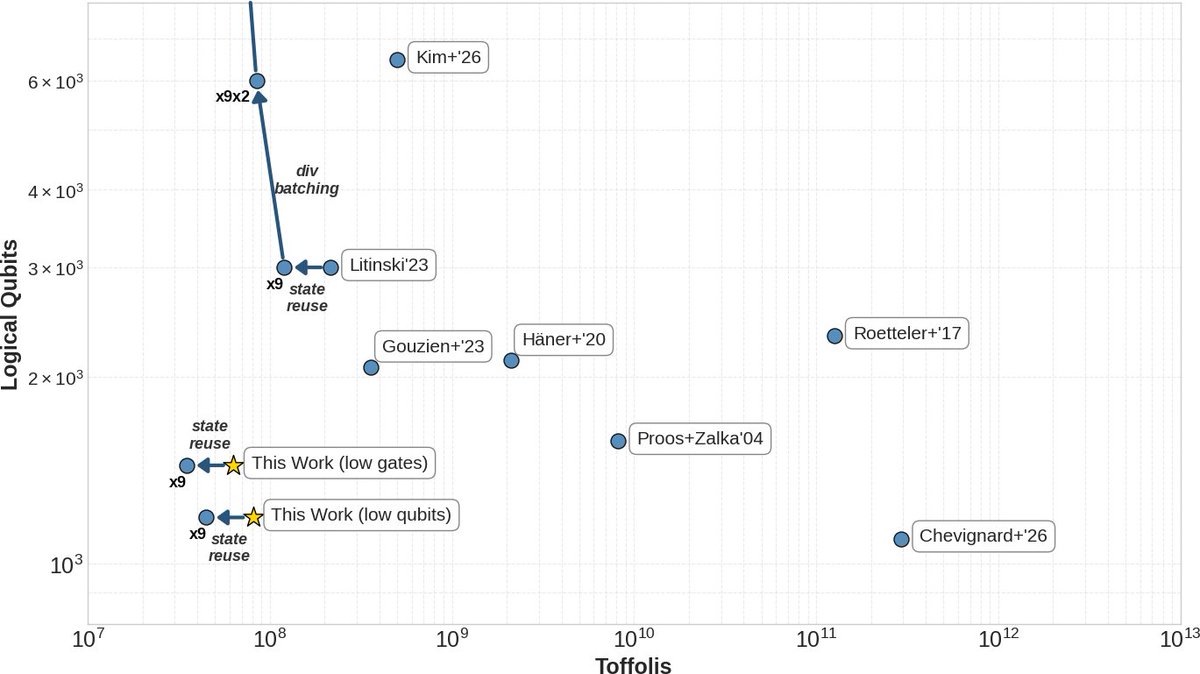
As timelines tighten, details might benefit attackers more than defenders. So we're trying something weird: proving a circuit exists without revealing it.
For example, here's a zero-knowledge proof that we found 10x smaller quantum circuits for ECDLP: https://t.co/ypwPEVurg5
For record breaking advances in quantum algorithms for breaking cryptography, a new way to securely disclose a vulnerability, and important cryptocurrency policy implications, see Google Quantum AI's latest results https://t.co/uINVxzs2ta !
I would bet against Q day by 2030, but I wouldn't bet against it at 10:1 odds. ~10% risk is unacceptably high here, so I'm very in favor of transitioning to quantum-safe cryptography by 2029: https://t.co/PwBCmnCQeL
Yes this means I 90% expect to be made fun of in 2030. Oh well.
Google Quantum AI is expanding to include neutral atom research with our superconducting program. Complementary paths will accelerate our mission to build a large-scale, error-corrected quantum computer—an engineering challenge we are excited to tackle. https://t.co/nSV5VTi5v7
New breakthrough quantum algorithm published in @Nature today: Our Willow chip has achieved the first-ever verifiable quantum advantage.
Willow ran the algorithm - which we’ve named Quantum Echoes - 13,000x faster than the best classical algorithm on one of the world's fastest supercomputers. This new algorithm can explain interactions between atoms in a molecule using nuclear magnetic resonance, paving a path towards potential future uses in drug discovery and materials science.
And the result is verifiable, meaning its outcome can be repeated by other quantum computers or confirmed by experiments.
This breakthrough is a significant step toward the first real-world application of quantum computing, and we're excited to see where it leads.
A long time in the making for generative quantum machine learning! We are finally able to close the loop on fully efficient training and inference with provable performance in the classically intractable regime while also being experimentally feasible! I hope you’ll check it out!
⚛️Can currently available quantum computers access classically-intractable regimes for generative machine learning?
In https://t.co/C8LgN1cDY3, we show experimentally that this is achievable using the quantum processors built in @GoogleQuantumAI.
The infectious enthusiasm of my wonderful co-authors (@RobertHuangHY, Soonwon Choi, @JarrodMcclean) drove this upbeat assessment of “The Vast World of Quantum Advantage."
https://t.co/ftX03fQp2N
@bryan_johnson How do you balance these considerations with differing levels of bioaccumulation of contaminants in your food sources? Is the water source of your food and risk for accumulation or magnification up food chains also a consideration in your diet?
The Google Academic Research Awards (GARA) (https://t.co/QmIPRRuUb5) support a range of positive and speculative directions for academics.
This year, one of the focus areas is Quantum Neuroscience. Learn more and apply by July 23, 2025 at https://t.co/QmIPRRuUb5.
In @Nature, researchers from @GoogleQuantumAI, @TU_Muenchen, & @UoN_Physics simulated a (2+1)D lattice gauge theory and visualized string dynamics, revealing the deconfined-to-confined excitation transition as the effective electric field increases. → https://t.co/6Y1i3d3K5L
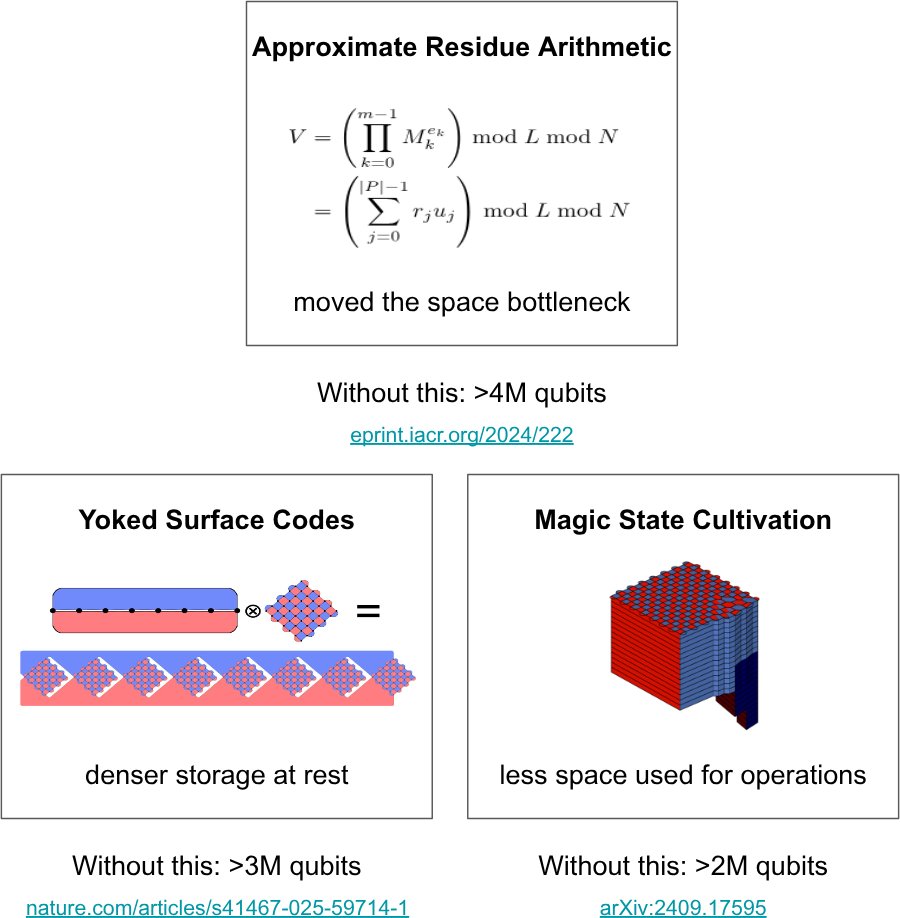
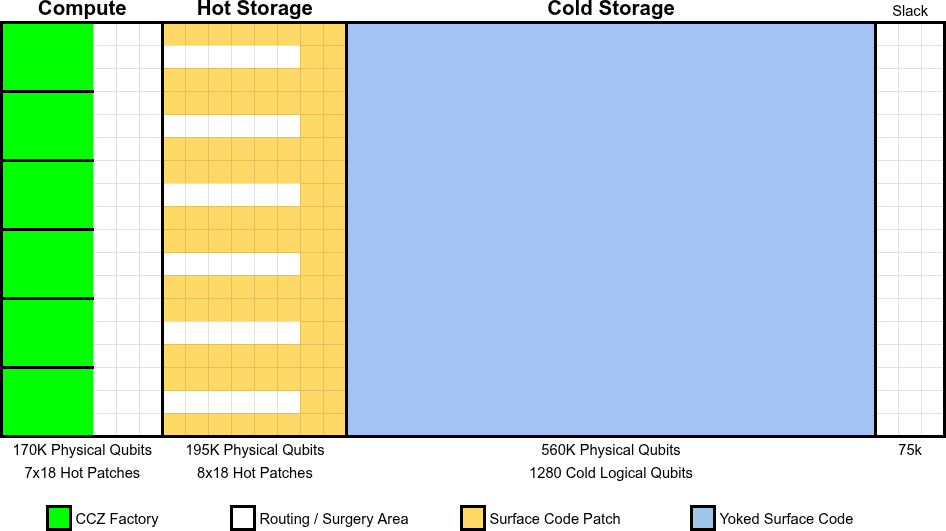
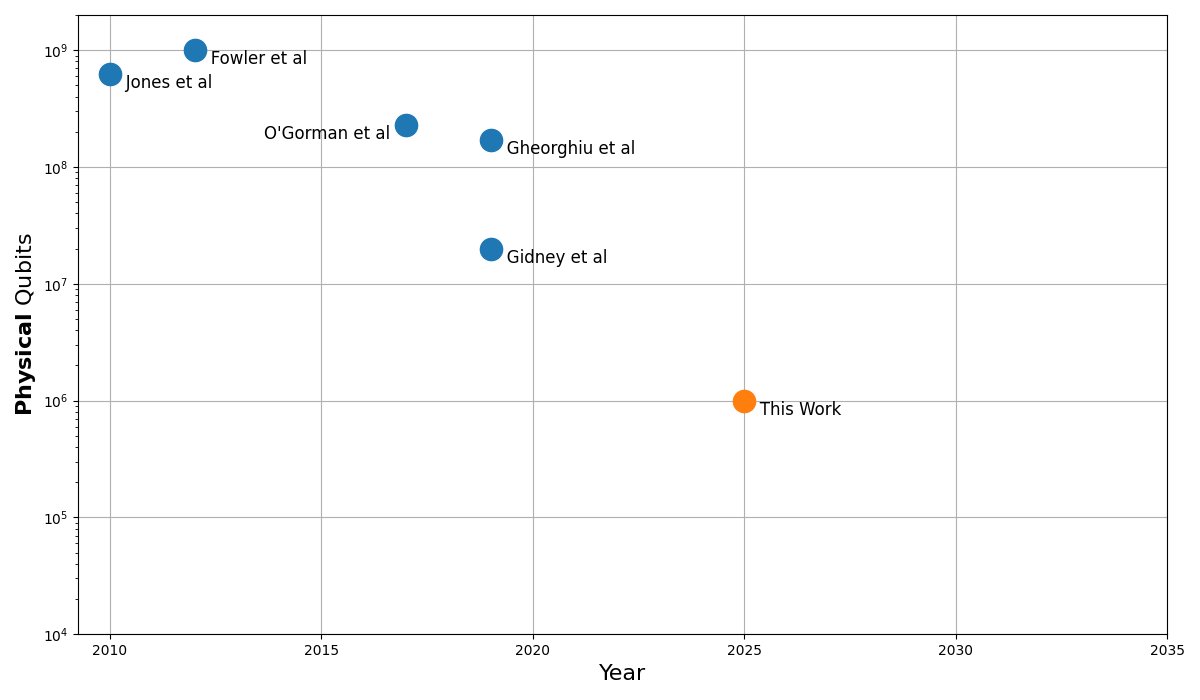
I'm often asked if I'll redo the 2019 quantum factoring estimate. Denser storage by yokes, smaller magic factories by cultivation, slimmer approx arithmetic by Chevignard et al… surely the cost is lower now?
Yes, it's lower now.
https://t.co/yZGrKETInF
https://t.co/1OROIX3kab
i think reveling in complexity is very anti scientific, anti technological. i hate it when people draw some giant metabolic or ecological diagram to demonstrate how well they’ve understood it. all that tells me is that we’re nowhere near understanding it
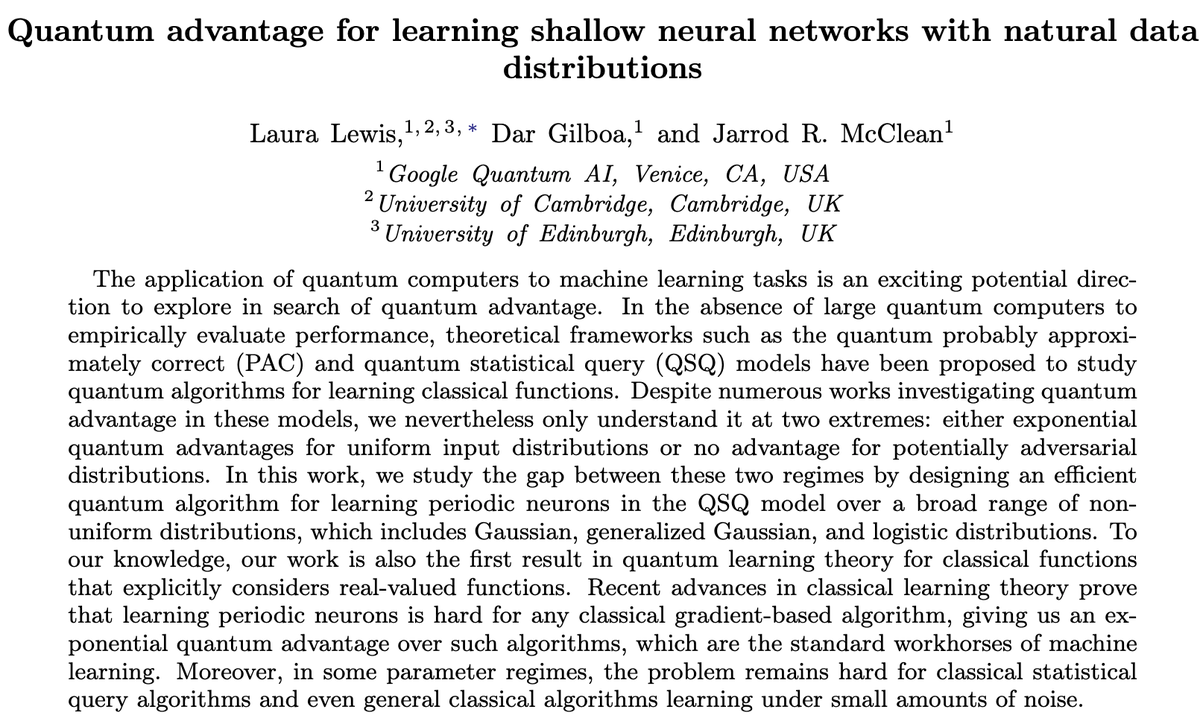
With @JarrodMcclean and Dar Gilboa, we prove a new quantum advantage for learning periodic neurons in the quantum statistical query model!
https://t.co/SeTpkJEtJy
The hardness of this problem was studied long before this work by classical learning theorists. 🔎
🎉I am very happy to see our Barren Plateau Review published in Nature Review Physics. This article condenses 6 years of our LANL work, but also so many amazing papers by the community!!
Check it here 👇
https://t.co/disTHWBads
Truth. When an audience has 100 or 1000 or more people captive for your presentation, you have an obligation to at least try to make it worth the time of a decent fraction of that audience. Think about the 1000’s of human hours of time being lent to you, please make an effort.
It should be considered disrespectful to waste everyone's time by giving a talk that is super difficult to follow and basically unintelligible to anyone in the room who doesn't work on the exact topic being discussed. There is a perverse incentive to deliver unintelligible talks because the audience just assumes the speaker is too smart to deliver the talk in any other way and often believes they themselves aren't smart enough to follow. Moreover, this format shields the speaker from having to answer any thoughtful questions at the end of their talk because only those who already understood everything could follow along. Over the last three years, I've probably attended over 100 hep-th talks, and this is a chronic issue. Everyone in the room has the intellectual capacity and background to understand what the speaker is saying if only the speaker would actually deliver their talk at an appropriate level.




![RobertHuangHY's tweet photo. Are there exponential advantages in using quantum machines to learn about the physical world?🎯
We establish the affirmative through rigorous proofs + physical experiments on the Sycamore quantum processor in https://t.co/TgT4i2llFZ. [📜1/10] https://t.co/AT4Xjq89PF](https://pbs.twimg.com/media/FFpjO-8VkAAnM6k.png)