This 1-hour Stanford lecture by Joel Peterson will teach you more about negotiation and getting what you want than most people learn in years. Bookmark it and give it an hour, no matter what.
An MIT professor gives a student $5 and says: send any amount to a stranger in this room. Whatever you send triples. The stranger decides how much comes back.
Rational answer: send nothing. You lose every dollar you trust.
Most students send almost everything. Most strangers return more than half. The math says keep it. The room says otherwise.
Then the professor runs a different game. Same cash. Same room. One student splits. The other can only accept. No rejection. No consequences.
The offers collapse. Not to zero. But enough to see the line between generosity and strategy.
One year a student got Swiss chocolate instead of cash. She was lactose intolerant. Gave away 100%. The professor noted it. The class laughed. Nobody noticed the point.
She had zero cost of generosity. The moment giving costs nothing, everyone is generous. The moment real money hits the table, the room divides into the same two groups every semester. People who send first. People who wait.
Labor, capital, arbitrage, insurance. Four ways to make money. All four require the same opening move.
You send value before you see a return. A paycheck after the work. A deposit before the interest. A bet before the edge. A premium before the claim.
The lecture is free. MIT filmed it years ago. The game runs every semester. The split barely changes.
Sending first is free. Knowing if it comes back is the part that costs something.
An MIT professor offered his students a simple bet: Heads: you win $125. Tails: you lose $100. Mathematically, it’s a steal. On average, you come out +$12.50 ahead each time you play. It’s what economists call "better than fair." Most of the class said no. They weren't stupid. They were human. The professor took it a step further. He told them: "I’m going to force you to take this bet... unless you pay me to get out of it." How much were they willing to pay? $43. Almost half their money... to escape a bet that was in their favor. That isn't weakness. It’s called risk aversion. And it’s exactly the reason why insurance, extended warranties, and almost all the "safe" financial decisions we make exist. You aren't being irrational when you turn down a good bet. You are putting a price on the fear of losing. In this MIT class, you learn how expected utility really works. Why risk aversion isn't a flaw, but a human trait. And how that explains almost every economic decision we make on a daily basis. Save this for later 🔖
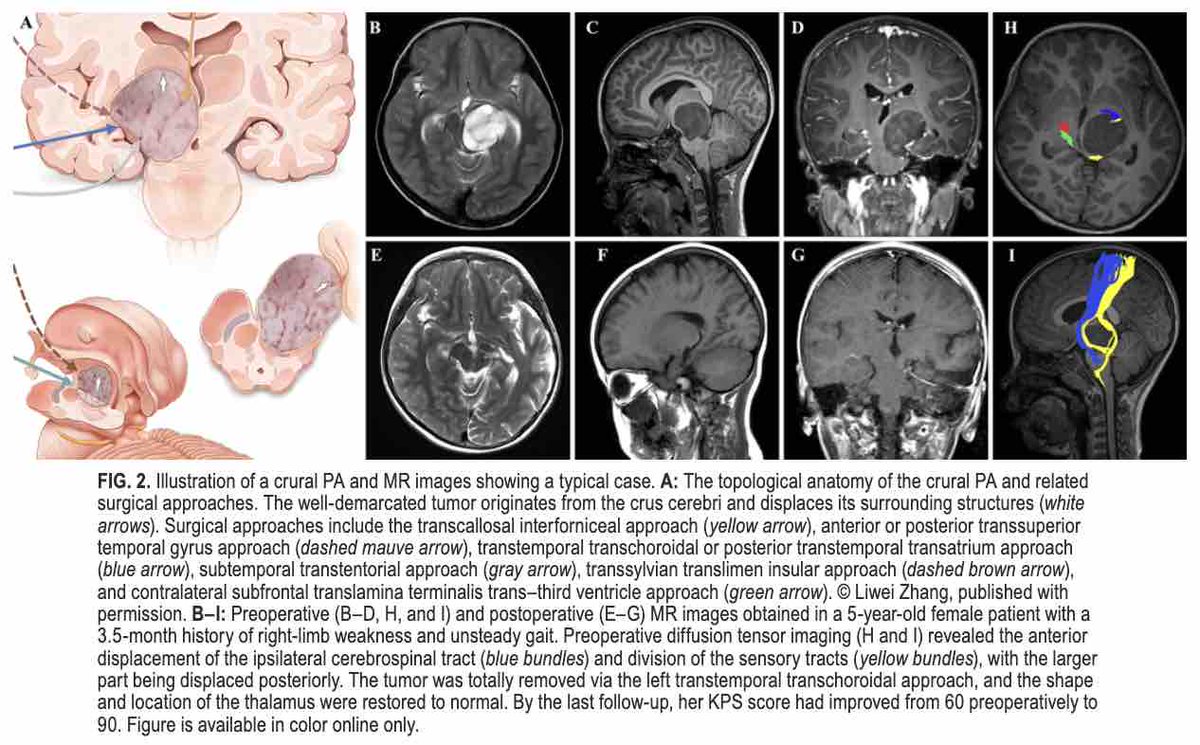
#OnlineFirst: A novel radiological classification of midbrain pilocytic astrocytomas and its implication for surgical management: a single-institution experience of 57 cases.
https://t.co/Ogw2puKb4B.
Study of a large cohort of brainstem gliomas, including diffuse intrinsic pontine gliomas, reveals that DNA methylation data identify distinct clusters termed H3-Pons, H3-Medulla, IDH, and PA-like, each associated with unique genomic and clinical profiles: https://t.co/zWIWzwOdyK
Study of a large cohort of brainstem gliomas, including diffuse intrinsic pontine gliomas, reveals that DNA methylation data identify distinct clusters termed H3-Pons, H3-Medulla, IDH, and PA-like, each associated with unique genomic and clinical profiles: https://t.co/zWIWzwOdyK