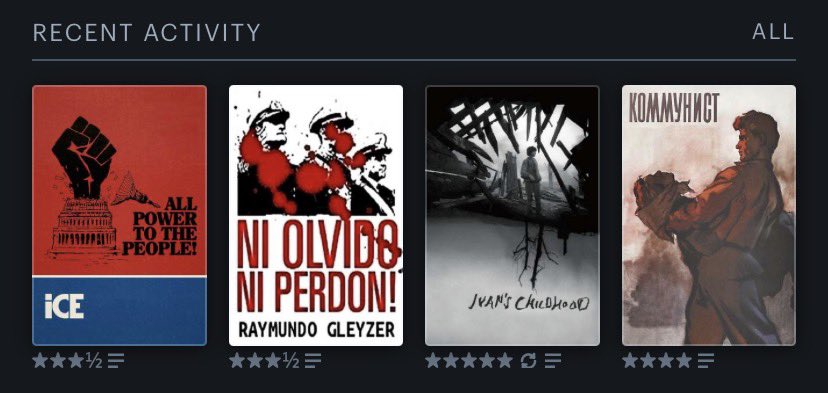
After a life-changing visit Cuba this week, I got inspired to write an essay about the documentary filmmaker Santiago Álvarez, the brutal embargo, and the Cuban people's revolutionary resilience. I hope people enjoy it!
https://t.co/M0Fwg5Z1rP
Death threats against me. A subpoena from Congress. Interviews cancelled and censored. A source indicted. Witnesses killed. Read the book that the corrupt national security state and criminal actors within it have fought tooth and nail to suppress. Now available in paperback.
Fixed it for you:
For decades, Cuba has represented a beacon of hope for the people oppressed by U.S. imperialism.
The U.S. has been trying to strangle the Cuban economy to the extreme, without any goal achieved, therefore, the need for another round of sanctions.
The insane fallout from the Jacobin article against Chris Smalls should make the author and the defenders pause to think why this happened. Dismissing everyone as having an axe to grind or some trolls online isn’t really facing this objectively. The defense that ‘Most of the arguments were substantial and not about AOC’ misses the mark how it was presented. There are thousands of people upset.
The article’s tone and its swipes at his left-sectarianism (especially without engaging the substance of his critiques of AOC and folding them in as symptoms of his larger narcissism) make it feel more like a takedown than a balanced assessment. A truly critical piece would have spent equal time on the impossible situation Smalls was in, not just his personal failings. More on the structural problems and the agency of a persona like Smalls.
Most people can’t verify many of those claims, we can’t verify whether Smalls actually neglected committee meetings or broke promises to Jane McAlevey years ago. The ‘angry’ threads and tweets we can verify, and most of us don’t think Smalls was sectarian, petty, self-aggrandizing or whatever the charges are in those cases. That alone significantly weakens any other criticisms the author makes because her credibility and the intention of the piece is called into question.
A white woman criticizing him and writing about his hip hop aesthetics, also feels very cringe. It’s not that a white writer can never discuss Black working-class aesthetics, but the framing matters if you’re trying to highlight the departure of this particular brand of union organizing.
No one understands, including me, what was the purpose of this piece anyway. If you wanted to bring Smalls down a notch, it worked against it. Smalls is now even more popular, more people will buy his book. Furthermore, more people are alienated from Jacobin. And it’s giving ammunition to people who want to discredit the ALU’s legacy. Finally, it looks like the author is defending even more powerful elected politicians (and I’d add more narcissistic) AOC and company against a less powerful individual.
The article’s arguments may be common sense in little NYC leftist cliques but what those cliques consider common sense doesn’t stand up to the scrutiny of the larger public who know Smalls through a different lens.
Cuba helped several African countries in their liberation struggles against brutal colonial occupiers, including against the apartheid regime in South Africa which the US backed and supported. That’s what he means by “radical left-wing terrorism”, just to be clear.
Imperialists keep having to invent socialist massacres to deflect from the reality that capitalism is one continuous, world-spanning genocide.
We often hear about the 140 people who died trying to cross the Berlin Wall over a period spanning 28 years. But we never hear about the 9,900 people who die every single day because they lack access to healthcare — a direct outcome of imperialism's denial of sovereignty to the global periphery.
We often hear about some number of people who supposedly died at Tiananmen Square in 1989 — a highly-contested narrative. But we do not hear about the 1,545 people who die every single day because of Western sanctions — 38 million people in total over a fifty year period.
Given the sheer barbarism of the imperialist world system, we should marvel at how mild the actions of socialist and revolutionary projects are by the standards of the systemic and unrelenting violence they are forced to confront. And there is certainly no need for progressive forces to be apologetic or ashamed about these measures.
I am more open to criticism of China coming from other developing countries than from Western ones, because I do not trust that the West has any intention of creating an equitable international order.
The West built a liberal international order with rules that asymmetrically benefited itself. When China managed to defy this order and compete with the West on *Western* terms, the West abandoned it, suddenly embracing economic nationalism and protectionism.
All nation-states act in their own self-interest. But the West has the clearest track record of imperialism — from the colonial era, through the liberal international order, to its now unapologetic embrace of nationalism. That history matters.
Otra vez amenazan a nuestro pueblo y sus líderes. Cada acto de esta naturaleza busca causar más daño a las cubanas y los cubanos con el fin de doblegarnos. No nos conocen, aquí solo encontrarán férrea resistencia y determinación de vencer. #LaPatriaSeDefiende
Marco Rubio dice que "no tolerarán regímenes marxistas radicales" en el continente. Volvimos a las injerencias de EEUU en América Latina con idioma de la guerra fría.
Por si alguien está interesado comparto dos películas de Tomás Gutiérrez Alea como son La Muerte de un Burócrata (1966) y Memorias del Subdesarrollo (1968).
🎞️: https://t.co/Pg78xdlj1r
All of this is true except for Gutiérrez being a “dissident.” The film is informed by dialectical materialism and meant to examine and critique vestiges of bourgeois cultural decadence remaining in revolutionary Cuba. If you read it any other way, you missed the point.
"Memories of Underdevelopment" (1968) premiered in 1968, but the Cuban film could not be seen in the USA until it was included in the 1972 edition of the New Directors/New Films series, presented by the Museum of Modern Art and the Film Society of Lincoln Center. A month after it was screened, Federal agents seized the prints before it could be shown at the festival New Cuban Films, which had already been disrupted by Anti-Castro exiles.
The film finally opened in 1973 at a small theater. It received glowing reviews and was selected for an award from the National Society of Film Critics. The US State department denied Tomás Gutiérrez Alea's request for an entry visa.
A visa application for Saul Yelin, director of Cuba's National Film Institute, who had asked to accompany Mr. Gutierrez as an interpreter was also turned down.
Hollis Alpert, The Chairman of the critics group said that he had been warned by an US Treasury official that it would be a violation of the Trading With the Enemy Act, 1917 for anyone to accept the award on behalf of Mr. Gutierrez.
Andrew Sarris, speaking at the awards ceremony which Alea couldn't attend, hailed the director as a courageous dissident.
("U.S. Refuses Visa To Cuban Director To Get Film Award", David Binder, The NY Times, 1974 & "Outside Cuba’s Revolution, Looking In", J. Hoberman, The NY Times, 2018)
P.S: On this day, 58 years ago, Memories of Underdevelopment" (1968) premiered at the Pesaro Film Festival, Italy.
Gutiérrez remained in Cuba for life and was always committed to the revolution. He did, however, offer filmic criticisms of some of the revolutionary government's mistakes in hopes of helping the project improve. That is, in fact, a key tenant of Marxism-Leninism.
An underrated feeling is embarking on a new research project and all that entails: tracking down sources, taking notes, those early half-formed thoughts that will eventually bloom into paragraphs. It’s intoxicating.
I once fell deeply, profoundly in love with movies. I had 600 goddamn DVDs in my house. Then one morning, I woke up and said, "Fuck movies." I renounce movies. I will never set foot in a movie theater again. That's how much “fuck movies."
@DebasedDandy The average sake we get in the US is much worse than the top shelf options in Japan. I only know this because someone brought back a good bottle and shared it with me.