I'm launching a new literary journal with some very cool people and will edit the nonfiction section. Send us your writing, preferably your unconventional stuff.
https://t.co/ycUpma6V3h
@GabrielRockhill It's a great venue! The sound equipment is good and the internet connection is ok enough, but at times weak, for streaming. We hosted a book event for The People Are Not One and it worked out.
It says something that even the most based populism conceals the proletarian condition. The worst thing imaginable would be to fall into a powerless peasantry (which no longer exists) rather than the potentially powerful working masses who are very real but remain unmentionable
Event tomorrow at Minhang Campus of ECNU in Shanghai that will place the public policy framework of ecological civilization in dialogue with world-ecology and ecological science, and will feature presentations by Jason Moore/@oikeios, @_RajPatel, @TuttReal myself, and others
https://t.co/M2UfvafTUi
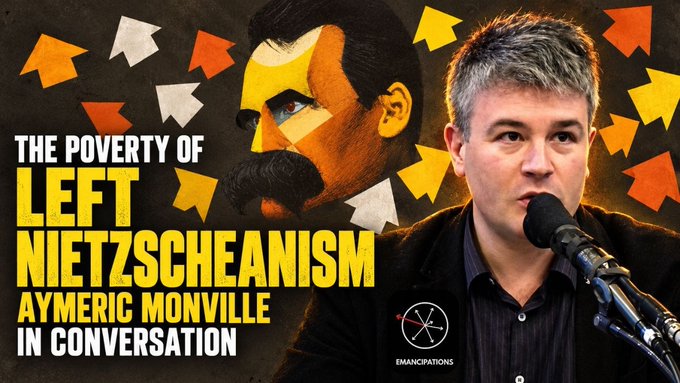
Aymeric Monville, born in 1977, is a French author and publisher specializing in Marxist philosophy and political thought. He is associated with Éditions Delga, a Paris-based publishing house devoted to Marxist research, intellectual history, and the history of the international communist movement. His books include The Poverty of Left Nietzscheanism, The European Ideology, and Neocapitalism According to Michel Clouscard. His work has appeared in publications including L’Humanité, La Pensée, Étincelles, Initiative communiste, Commune, and La Faute à Diderot.
CHAPTERS 0:00 Welcome and Introduction 4:01 The Current Student Uprising in Comparison with May ’68 12:37 The Impact of Lukács and Losurdo in French Intellectual Circles 23:28 Monville’s Approach to Nietzsche 32:00 The Elisabeth Question 38:00 Nietzsche’s Anti-Proletarian Politics 44:00 The Origin of Nietzsche in French Intellectual Life 49:10 The Prehistory of French Nietzscheanism 1:03:00 Deleuze’s Nietzsche 1:09:00 Left Nietzscheanism and Petty-Bourgeois Revolt 1:15:00 Clouscard’s Nietzsche 1:32:21 Michel Onfray 1:37:20 The Moral Left and Nietzsche 1:48:20 The After Lives of Left Nietzscheanism
I'm very pleased to welcome French Marxist author and publisher Aymeric Monville to @emancipations_ for a discussion on his newly translated book The Poverty of Left Nietzscheanism.
We begin with a discussion on the current student uprising and its relationship to May ’68. We then examine how Nietzsche entered French intellectual life and became a major reference point for intellectuals associated with the Left. Monville situates his argument within the Marxist tradition of György Lukács and Domenico Losurdo, tracing the prehistory of French Nietzscheanism and examining Nietzsche’s anti-egalitarian and anti-proletarian politics.
@GabrielRockhill@iskrabooks
https://t.co/eqoiIpCUcT
DC! Oct. 30! Come to @busboysandpoets and hear @GabrielRockhill & Aymeric Monville discuss French Theory, from Foucault and Deleuze to the Nietzschean currents behind them, and how it has shaped how the Western left thinks about power, politics, and liberation. Ticket link below!
My new essay on Marxism and artificial intelligence! I show using the negative materialism of semiotics why we should take AGI and AI safety seriously, and also examine this new phase of class struggle through Marx's political economy.
https://t.co/vZ3L4TDoms
The theoretical cul-de-sacs of bourgeois idealist social philosophy, which are continually re-emerging, very often originate in an abstract and antinomic contrast between the material and the mental, the natural and the social, which inevitably leads to the destruction of all genuine dialectical connections and thus makes the specific character of social being incomprehensible.
Lukács, Ontology of Social Being
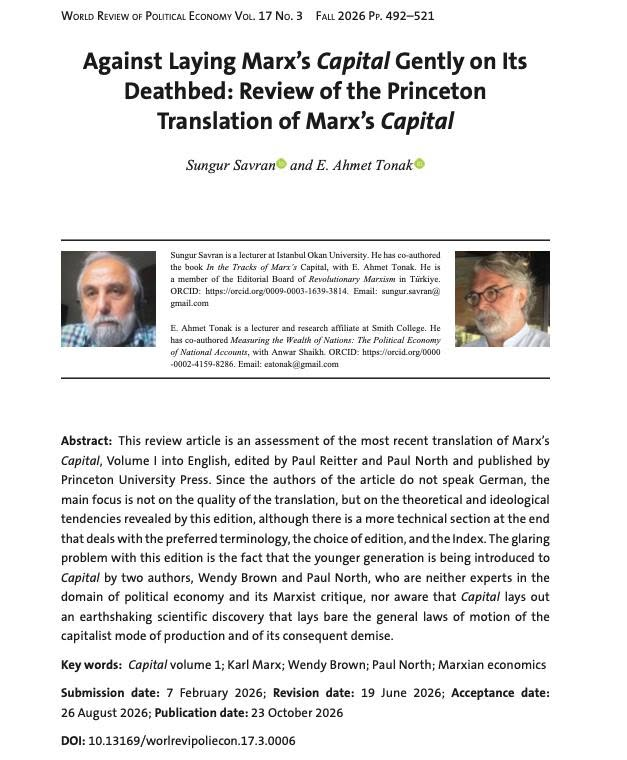
"One is certainly entitled to ask: how can this pass? Capitalism but no classes? Well, that is because our Marx expert does not wish to talk about classes, exploitation, the production of surplus-value, the industrial reserve army, the immiseration of certain layers of the proletariat, and all of capital’s methods through which it makes the working class suffer, but of the poetic images Marx evokes of the development of capitalism, commodity fetishism, Marx’s relation to religion and the sacred, etc."
Somehow I have three talks this week, an eco-socialism conference in China where I will give a talk on Freud, Marx and ecology but it's happening remotely at 2 am on Saturday night 😬 Yesterday I spoke on an interesting panel on socialism and freedom at George Mason University as part of a Platypus forum and tomorrow is the final session of my Lukács seminar with the New Centre.
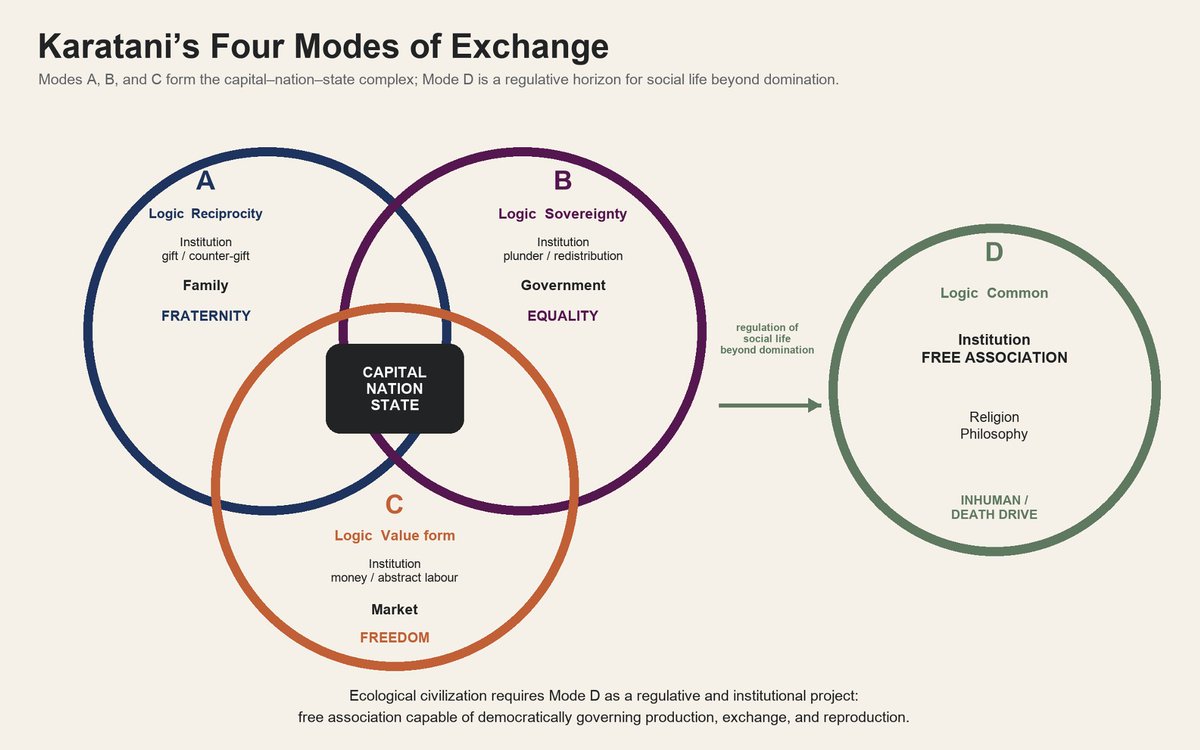
@kritik_d_maeuse He describes Mode D in The Structure of World History at one point as the logic of the death drive in history. I wrote an essay on this which you might like to check out:
https://t.co/3hnn0vAkqV