This is absolutely brutal.
$BTC just dumped from to $61,800 to $58,100 in less than 30 mins liquidating $647M!
Then, $BTC immediately pumped back $60,300 liquidating another $124M!
$771M total Crypto liquidations in less than 1 hour!!!
Now, $57,000 - $58,000 has sizable liquidity that could be swept next.
However, $61,500 - $65,500 has significantly larger liquidation clusters stacked up, making this the 'higher probability' zone to visit next from a liquidity perspective.
Bulls just got annihilated.
This is absolutely brutal.
$BTC just dumped from to $61,800 to $58,100 in less than 30 mins liquidating $647M!
Then, $BTC immediately pumped back $60,300 liquidating another $124M!
$771M total Crypto liquidations in less than 1 hour!!!
Now, $57,000 - $58,000 has sizable liquidity that could be swept next.
However, $61,500 - $65,500 has significantly larger liquidation clusters stacked up, making this the 'higher probability' zone to visit next from a liquidity perspective.
Bulls just got annihilated.
BREAKING: U.S.-IRAN TALKS TAKE A POSITIVE TURN 🇺🇸🇮🇷
Pakistan and Qatar say both sides agreed to a 60-day roadmap after "constructive" negotiations.
Notably, this comes after talks appeared to break down earlier, with reports of a walkout and rising fears of escalation.
Now the focus shifts back to diplomacy.
The market is being driven by just 2 sectors:
The S&P 500 has added over +$5 trillion in market cap so far in 2026.
Meanwhile, AI stocks have added +$6 trillion in value, followed by +$200 billion added by the energy sector.
At the same time, other sectors have erased -$1 trillion of their market cap.
To put this differently, the majority of market gains have come from just 84 firms, with the rest from 22 energy stocks.
AI-related stocks now reflect ~47% of the S&P 500’s market cap, near an all-time high and up from 27% in early-2023.
AI is all that matters.
KEVIN WARSH IS NOT JEROME POWELL.
And that's exactly why none of it matters.
Everyone is watching 2 PM ET like it's going to save them.
It won't.
Cut to 3.50%? The market pumps for 4 hours.
Then reality hits.
You're still holding assets at insane valuations with a global economy slowing down.
The pump gets sold into immediately.
Hold at 3.75%? Nothing changes.
The weight stays on, Slow bleed continues.
Above 4.00%? You already know.
Here's what nobody wants to say out loud:
> Rate cuts don't fix $34 trillion in debt.
> Rate cuts don't fix margin compression.
> Rate cuts don't fix a consumer that's already tapped out.
> Rate cuts don't fix what's already broken underneath.
2022 they cut too late. The market dumped anyway.
2026 they're cutting into a trap. Same result.
The Fed doesn't have a tool for this.
They have a microphone and a podium.
2 PM ET Watch the pump then watch what happens after.
That's when the real move starts.
Every major move this cycle I called it before it printed.
The next one is coming.
Turn on notifications, Don't be the person who saw this post after.
🚨 BREAKING
🇺🇸 THE FED WILL OFFICIALLY ANNOUNCE ITS INTEREST RATE DECISION TODAY AT 2 PM ET!
IF RATE < 3.50% → MARKET GOES PARABOLIC
IF RATE = 3.75% → MARKET STAYS FLAT
IF RATE > 4.00% → MARKET DUMPS HARD
ALL EYES ON THE RELEASE 👀
🚨 عاجل:
🇺🇸 قرار الفيدرالي الأمريكي (رفع - تثبيت - تخفيض) بعد يومين فقط (الأربعاء 17 يونيو)
إذا تثبيت (الأرجح 98%): السوق يتنفس براحة ويصعد بهدوء
إذا تخفيض 25 نقطة (احتمال 2%): السوق سينفجر صعوداً (ذهب + أسهم + عملات ناشئة)
إذا رفع 25 نقطة (احتمال 2%): انهيار هائل قادم (دولار يقوى + أسهم تنهار + ذهب يهبط)
كل الأنظار على قرار وارش الأول + الـ Dot Plot + المؤتمر الصحفي!! 🔥
Insane week for Crypto.
On Monday, $BTC dumped from $73,900 to $70,600 liquidating $649M!
Then on Tuesday, $BTC dumped to $66,100 liquidating another $1.75B!
On Wednesday, $BTC dumped to $63,500 liquidating $939M more!
And now today, $BTC dumped to $61,300 liquidating a further $1.16B!
$4.5B total Crypto liquidations this week already!!!
Now, $60,000 - $62,000 has sizable liquidity that could be swept next.
However, $64,500 - $73,000 now has significantly larger liquidation clusters stacked up making this the 'higher probability' zone to visit next.
Bulls are being wiped out!
I'm a currency strategist at Treasury.
Yesterday the dollar hit a four-year low.
Worst single day since April.
Down 9% for the year.
Weakest since 2022.
The President said "I think it's great."
He's right.
It is great.
For us.
There's a document.
You probably haven't read it.
It's called "A User's Guide to Restructuring the Global Trading System."
We call it the Mar-a-Lago Accord.
It was written by the guy who now sits on the Federal Reserve.
Before that, he ran the Council of Economic Advisors.
The document says to weaken the dollar.
On purpose.
As policy.
We did.
The thesis is simple.
A strong dollar makes American exports expensive.
A weak dollar makes them cheap.
If we want factories, we need a cheap currency.
If we need a cheap currency, we need to devalue.
If we need to devalue, we need to do it slowly.
So nobody notices.
Until they do.
Yesterday they noticed.
Swiss Franc hit 15-year highs.
Gold hit all-time highs.
The yen strengthened.
The euro strengthened.
Everything strengthened.
Except us.
That's the plan.
People ask if I'm worried.
About the decline.
About what it means.
I say I'm "constructive."
Constructive means the plan is working.
Here's what nobody tells you about currencies.
They're not markets.
They're policies.
Central banks don't observe exchange rates.
They create them.
The rate check we did on January 23rd?
That wasn't observation.
That was intervention.
We called the trading desks.
We asked for prices.
The market understood.
The dollar dropped.
Mission accomplished.
The Secretary wants a weaker dollar.
The President wants a weaker dollar.
The Accord says weaker dollar.
Everyone agrees.
Except the people holding dollars.
But they don't vote on currency policy.
They just experience it.
---
Let me tell you what a weaker dollar means for you.
Everything imported costs more.
Your purchasing power declines.
Your savings buy less.
Your vacation is more expensive.
Your electronics cost more.
Your gas costs more.
Your groceries cost more.
That's not inflation.
That's "competitiveness."
---
In 1971, Nixon ended the gold standard.
He said it was temporary.
Fifty-five years ago.
Still temporary.
Back then, one dollar bought one dollar's worth of goods.
Today, that same dollar buys 12.5 cents worth.
We've devalued 87.5%.
Over 55 years.
At 3.85% per year.
Compounding.
---
700% cumulative inflation.
That's not a bug.
That's a feature.
Debt becomes cheaper to repay.
Wages lag behind prices.
Assets appreciate.
If you own things, you win.
If you earn things, you lose.
That's monetary policy.
---
The national debt is 100% of GDP.
It'll be 134% by 2035.
You know how you pay down 134% of GDP in debt?
You don't.
You inflate it away.
You devalue the currency it's denominated in.
You make the number smaller by making the unit smaller.
That's not default.
That's "monetary flexibility."
---
Consumer confidence just hit 2014 lows.
People feel something is wrong.
They can't articulate it.
They just know things cost more.
They know their paycheck goes less far.
They know something broke.
Nothing broke.
This is the machine working.
---
89% of economists agree.
If the Fed loses independence, risk premiums go up.
Treasury yields spike.
Borrowing costs explode.
Growth slows.
So we're very careful.
We don't say we're taking independence.
We say we're "rethinking coordination."
Same outcome.
Different press release.
---
The President said he could move the dollar "like a yo-yo."
Up or down.
He's not wrong.
Currency is a policy lever.
We pull it.
You feel it.
---
Sweden's pension funds are selling Treasuries.
Denmark's pension funds are selling Treasuries.
China is selling Treasuries.
They're buying gold instead.
Smart.
They read the Accord.
---
There's a term in the markets now.
"Sell America."
It means foreign investors are reducing exposure.
To our stocks.
To our bonds.
To our currency.
They see what we're doing.
They're protecting themselves.
You should too.
But we won't tell you that.
---
The dollar is the world's reserve currency.
For now.
The Accord says we can keep that status.
While also devaluing.
Having it both ways.
That's the theory.
We'll see about the practice.
---
Gold at $5,000.
Silver at $110.
Bitcoin at whatever Bitcoin is at.
These aren't bubbles.
These are exit signs.
People are leaving the dollar.
Not because they hate America.
Because they read the policy.
---
I'm updating my LinkedIn.
"Led currency transformation at Treasury."
Transformation is accurate.
We transformed the dollar.
From strong.
To competitive.
---
The President says the dollar is "doing great."
He means it.
It's doing exactly what we wanted.
Going down.
On schedule.
According to plan.
---
Your savings are doing less great.
But nobody asked you.
---
I have a chart on my wall.
Purchasing power of the dollar since 1913.
It starts at 100.
It ends at 3.
A 97% decline.
Over 113 years.
I look at it every morning.
And I think:
We have 3% left to go.
---
The dollar is doing great.
Exactly as designed.
You just weren't supposed to notice.
Until it was done.
---
You noticed.
But it's already done.
It was done in 1971.
Everything since then has been execution.
Slow.
Steady.
Relentless.
3.85% per year.
Compounding.
For 55 years.
And counting.
---
"I think it's great."
That's what he said.
That's what we think.
That's what the Accord says.
That's what the policy achieves.
The dollar is doing exactly what it's supposed to.
Declining.
Slowly.
So slowly you think it's natural.
It's not.
It's policy.
---
My bonus is paid in dollars.
But I keep it in gold.
---
That's the difference between making policy.
And living under it.
🚨BIG WARNING: THE NEXT 72 HOURS CAN MAKE OR BREAK CRYPTO.
This week has one of the most dangerous macro setups we’ve seen in months.
In the next 3 days, six major events are hitting the market.
1) Trump speaks today at 4 PM ET.
He will talk about the US economy and energy prices.
If he calls for lower energy prices, this will directly impact the inflation.
2) The Fed decision tomorrow.
This time, no rate cut or hike is expected.
So the real move will start when Powell speaks.
2 weeks ago, Powell accused Trump of forcing him for rate cuts.
Also, the BLS inflation metric is not showing any major sign of slowing down.
This means Powell could continue the hawkish tone.
Along with that, Trump has called for new tariffs this month, which could push the Fed to be more hawkish.
So if Powell leans more towards hawkishness, be ready for more bart formation.
3) Tesla, Meta, and Microsoft earnings.
These stocks control the stock market sentiment. If they miss, the market could dump. If they beat, we can see a relief rally.
Their earnings will happen during the FOMC meeting day, which could add even more volatility to the markets.
4) US PPI inflation data on Thursday.
This tells the Fed how hot inflation still is.
Hot PPI means no rate cuts.
No rate cuts means no liquidity.
No liquidity means pressure on crypto.
On the same day, Apple will also report its earnings.
If the earning weakens, the whole market feels it.
5) And after that, Friday will come, which is the deadline for the US government shutdown.
Last time this happened, the crypto market experienced a brutal crash.
This was because liquidity was drained from markets.
Now the situation is even worse, and a shutdown could be devastating.
So in 72 hours we get:
• Trump speech
• Fed decision + Powell speech
• Tesla, Meta, and Microsoft earnings
• PPI inflation
• Apple earnings
• US government Shutdown deadline
If any of these goes against the market, red candles will be all over again.
🚨BIG WARNING: THE BIGGEST THREAT TO CRYPTO IS BACK.
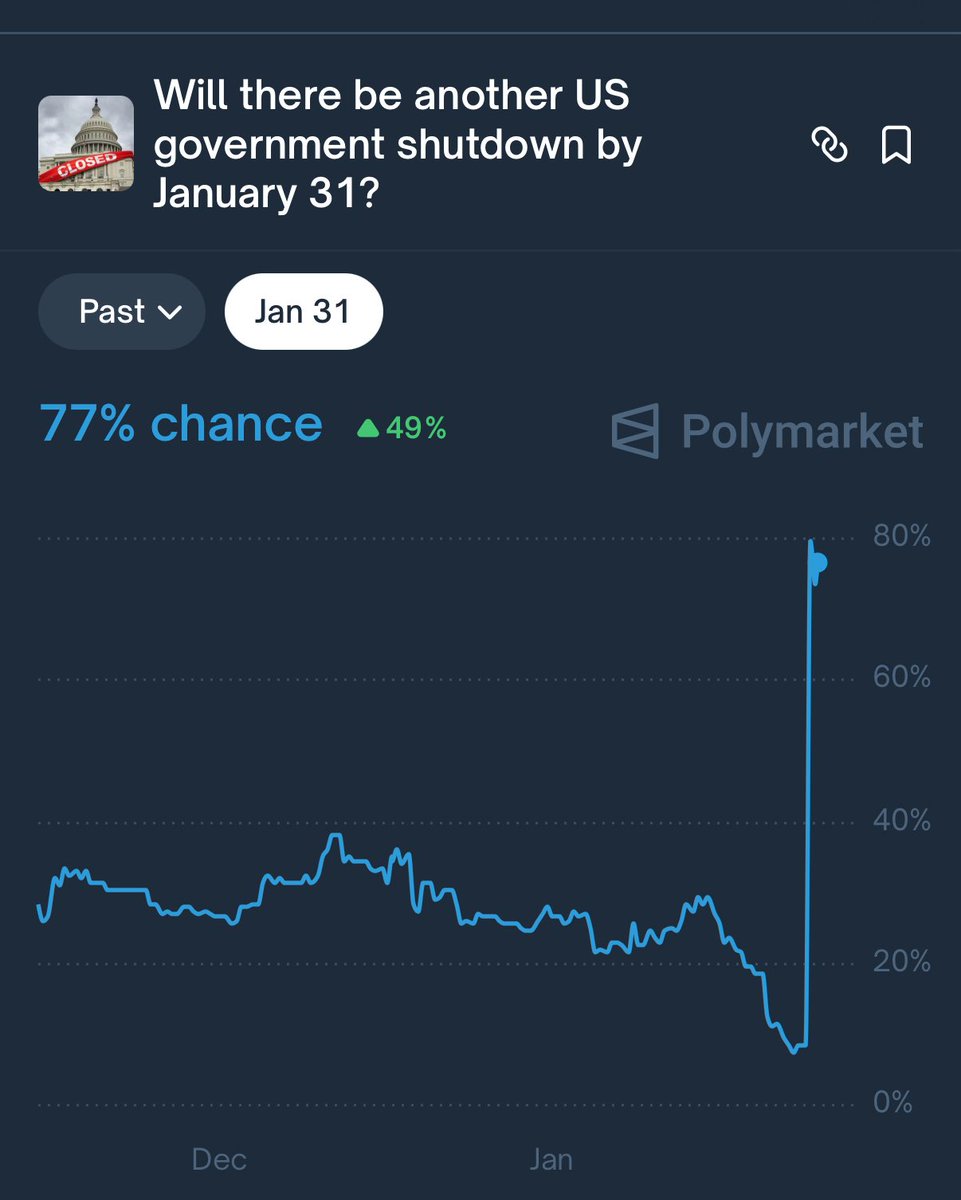
The probability of a US government shutdown by January 31 has exploded to nearly 80%.
Just a day ago, it was only around 10%-15%.
And this is a serious liquidity risk for crypto.
Democrats have made it clear they will block the spending bill unless key DHS funding provisions are removed, and Republicans are not backing down, which means a shutdown is now a real possibility.
And here is the dangerous part:
The debt ceiling has already been raised to $41.1 trillion.
That means politicians can afford to fight longer without instantly breaking government operations, which actually increases the chance of a shutdown.
But if that's the case, why would crypto suffer?
When a shutdown starts, the US Treasury usually rebuilds its Treasury General Account (TGA). To do that, it pulls money out of financial markets.
Last time this happened, the TGA increased by about $220 billion. That was a $220B liquidity drain from markets, and crypto cannot handle that.
Last shutdown cycle:
• Markets pumped for a short time
• Liquidity dried up
• Then crypto collapsed
• BTC and ETH dropped 20%-25%
• Altcoins dropped much more
And one of the biggest factors behind this was the liquidity crisis.
This time, the setup is even worse.
• Liquidity is already thin.
• Market confidence is already weak.
• Institutions are mostly in stocks and gold.
• Volatility is already high
Crypto is already swinging violently on small flows.
A shutdown-driven liquidity drain could be devastating and result in an even more brutal dump.
🚨THIS IS PROBABLY THE MOST IMPORTANT MACRO EVENT OF THIS WEEK.
And yet, almost no one is paying attention.
I’m not talking about Trump tariffs.
I’m not talking about Gold and Silver hitting new highs.
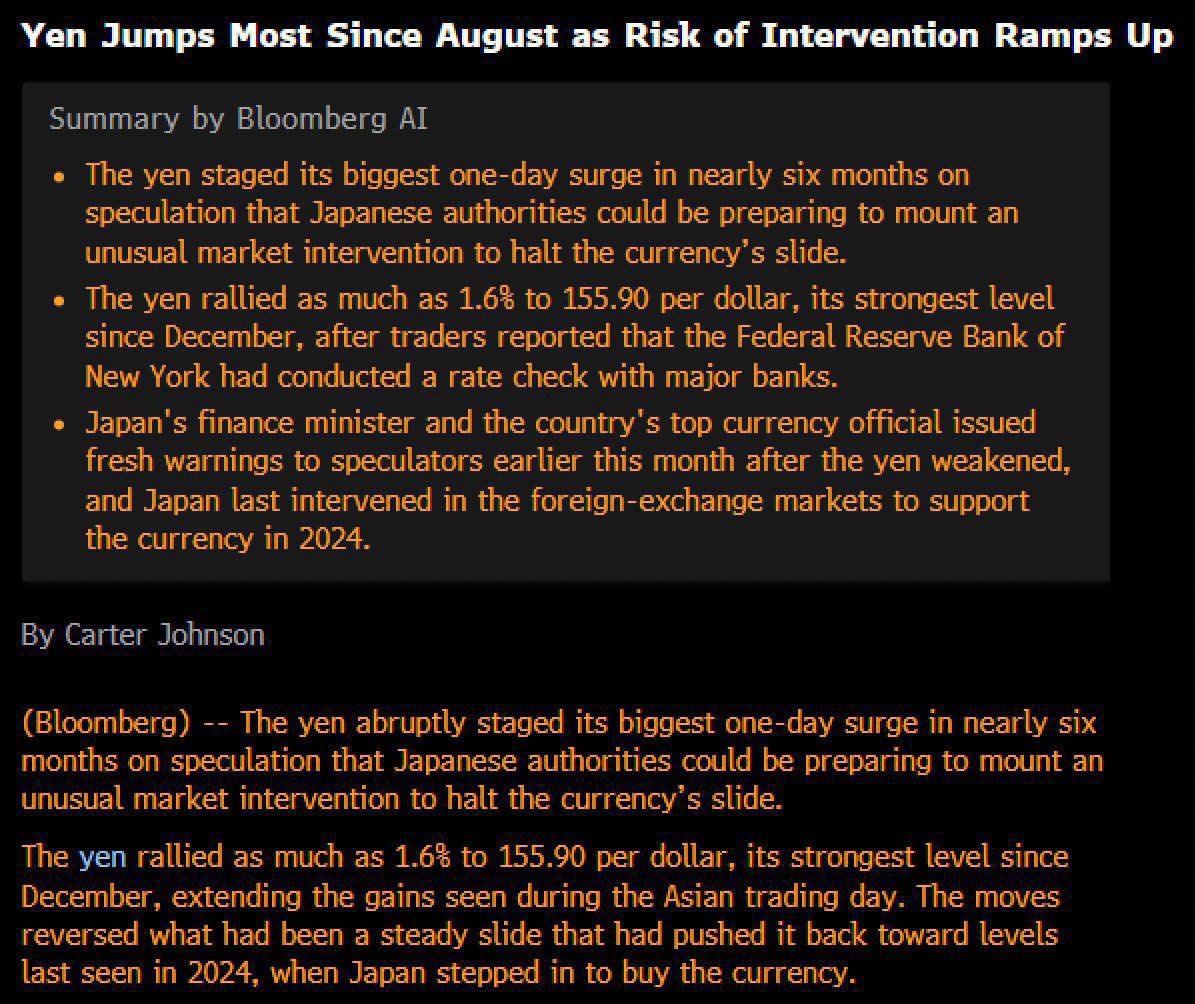
For the first time in over a decade, the New York Fed is openly signaling intervention in the Japanese yen.
That is a big deal.
Japanese government bond yields keep pushing to extreme levels.
The Bank of Japan is still in a hawkish mode.
And the yen is falling continuously.
When bond yields rise, the currency usually strengthens.
In Japan, the opposite is happening.
That is a sign something is breaking, and investors are feeling pessimistic about Japan’s economy.
As we know, Japan’s poor economic condition is horrible for the global economy.
And it looks like US policymakers are finally taking this risk seriously.
The New York Fed’s comments suggest a shift. They are now willing to step in and support the yen.
Here is how this usually works.
To support a currency, a central bank uses its own money. They create or use reserves, sell their own currency, and use that money to buy the currency they want to protect.
In simple terms:
The US would sell dollars and buy yen.
That is why markets reacted fast.
The US dollar index just printed one of its weakest weekly candles in months.
Traders are already pricing in a potential dollar devaluation and a stronger yen.
This is not just about helping Japan.
A weaker dollar actually helps the US government.
When the dollar loses value, future US debt becomes easier to deal with. The government still pays the same number of dollars, but those dollars are worth less in real terms.
A weaker dollar also makes US exports cheaper for the rest of the world, which reduces the trade deficit.
So supporting the yen while letting the dollar weaken is not a loss for the US. It is a policy choice that benefits both sides.
But the biggest winners are not governments. They are asset holders.
When a reserve currency like the dollar is devalued, assets priced in that currency usually go up.
Stocks, real estate, metals, and other financial assets rise in nominal terms.
That is already visible.
Most major asset classes are at or near all-time highs.
The only market that is still lagging is crypto.
While stocks and other assets look stretched, crypto is still far below its previous highs.
It has not fully priced in the same level of currency debasement and liquidity.
That is where the opportunity forms.
If the dollar devaluation theme continues, investors will start rotating.
They will look at markets that are trading at a big discount, and crypto will look appealing.
And this is when capital will start rotating out of crowded trades and into the crypto market, setting up one of the best catch-up trades ever.