🚀 Excited to share our latest paper:
HYPIR — Harnessing Diffusion-Yielded Score Priors for Image Restoration
Image restoration plays a vital role in tasks like photo enhancement and video upscaling. Yet the field has long faced a trade-off: high-quality methods are slow, while fast ones often sacrifice detail. How can we restore a photo both quickly and faithfully?
HYPIR introduces a new paradigm. It achieves the speed of GANs and the quality of diffusion models — with no iterative sampling, no control adapters, and no extra components.
It’s tens of times faster than existing diffusion-based methods. Despite its simplicity, HYPIR delivers outstanding performance in detail recovery, text fidelity, semantic understanding, and user controllability (including text prompts, texture richness, and fidelity tuning). Simple, fast, and powerful.
📄 Paper Link: https://t.co/vsHheqJSog
🔗 Project page: https://t.co/3xrtzxUkaV
💻 Code: https://t.co/5umOD4Q1mF
🧪 Try it online: https://t.co/nuNCRKm4es
Huge thanks to our amazing team — and we warmly welcome your feedback, discussions, and collaborations!
#AI #ImageRestoration #GenerativeAI #DiffusionModels #GAN #ComputerVision #HYPIR
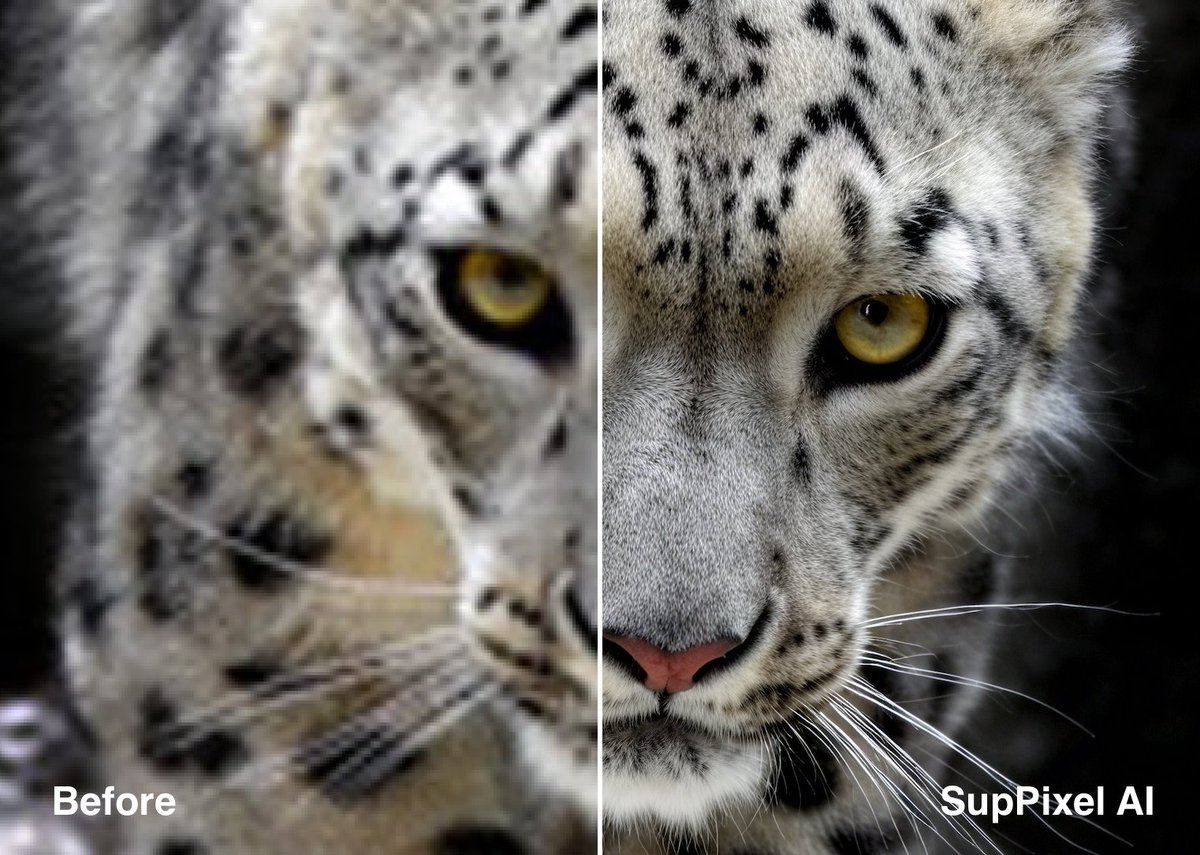
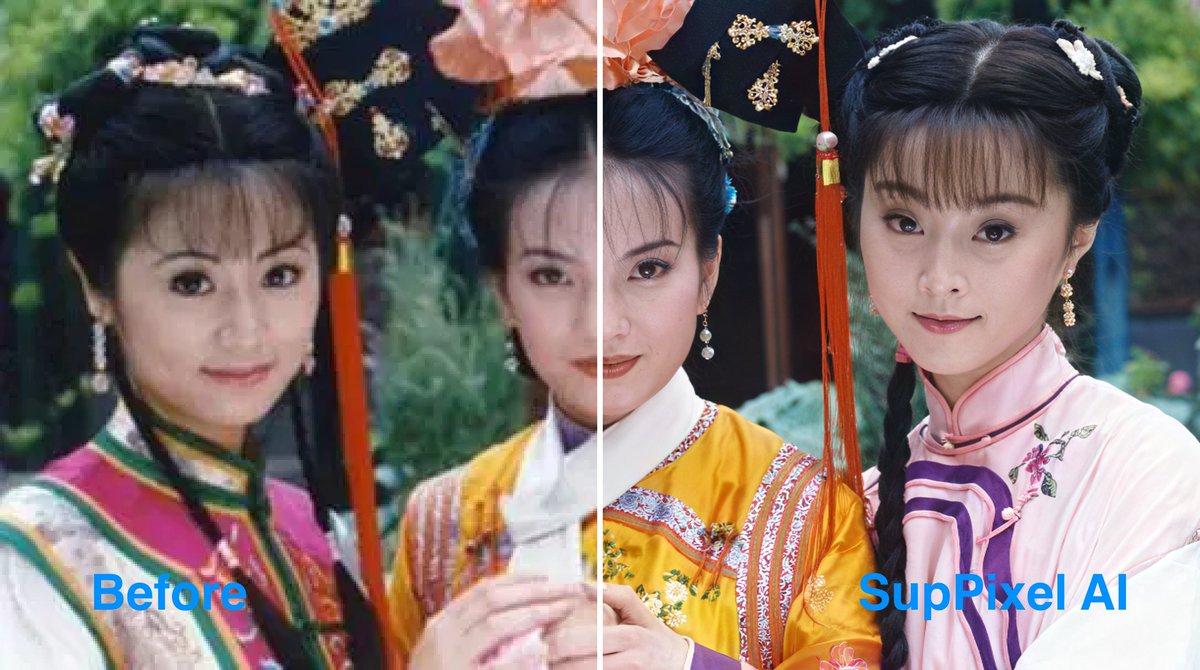
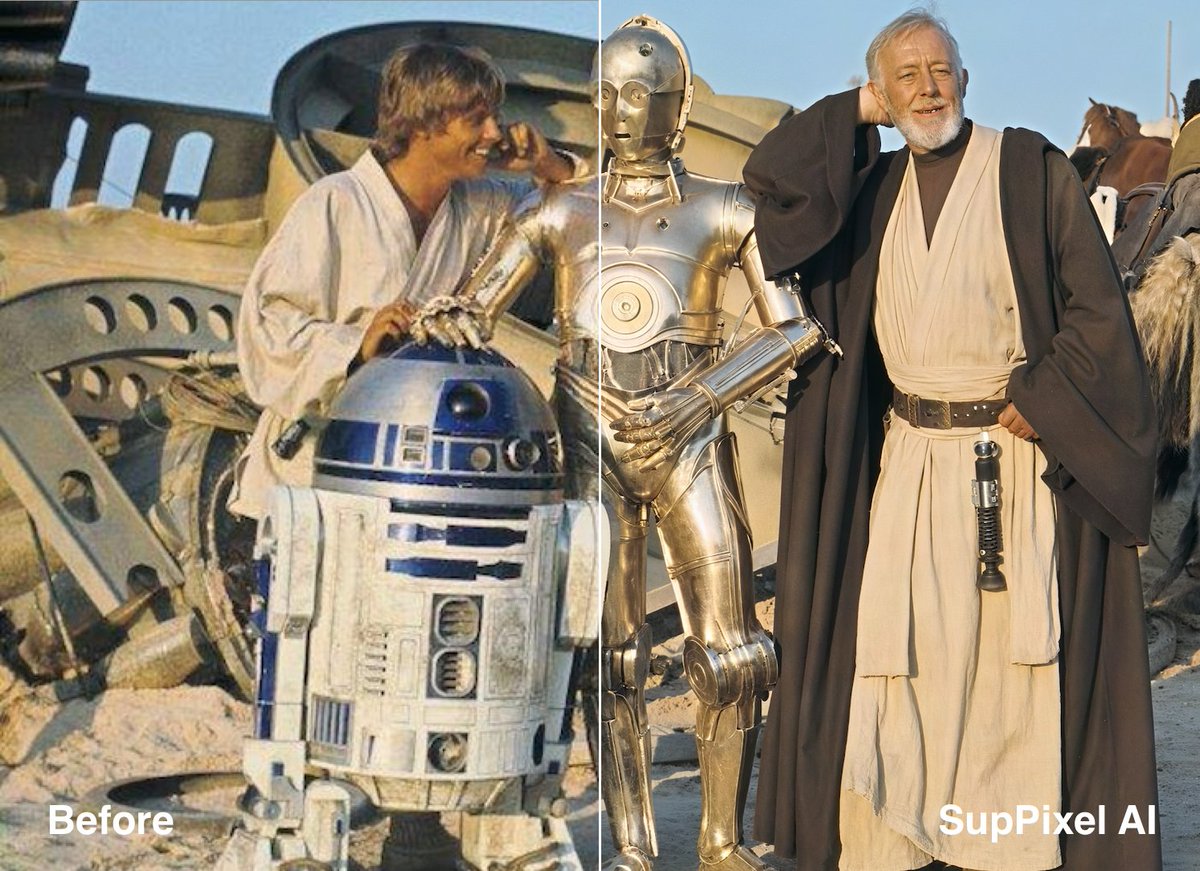
🚀 Ready to take your AI-generated images to the next level? Our latest blog post shows how we’re using super-upsampling to turn cool creations into jaw-dropping masterpieces. 🎨✨
https://t.co/EG6XLSobhw
#AIGC#ImageProcessing#AIArt
Excited about the new Flux model from @bfl_ml! 🎉 Their 1024-res images are amazing. 🎨 But why stop there? 🤔 With SupPixel AI, we can enhance them to stunning 4096 resolution.✨ Experience top-notch image processing: https://t.co/nRLWaPdlZh
#SupPixelAI#Flux#GenerativeModel
🎉 We've just released a new tutorial on mastering SupPixel AI's adjustable parameters! Dive into the features and learn how to enhance your images like a pro. Check it out and start creating magic! ✨ https://t.co/47z1QoZR9k #SupPixelAI#ImageProcessing#TechTutorial
🚀 Excited to announce the launch of SupPixel AI! 🌟 Your ultimate solution for high-quality image processing and upscaling. Developed by top scientists, SupPixel AI delivers unparalleled image enhancement with cutting-edge AI technology.
https://t.co/nLN3FX1YHw
I used to laugh at Hollywood whenever an actor said "enhance image!" and a blurry pixelated mess morphed into a crystal-clear portrait of a villain (a process called upscaling). Now, at long last, it's Hollywood's turn to laugh at me.
[article: https://t.co/4DbDUr5vRk]
Surprisingly, it's not because of my humorous-yet-informative linkedin posts — but rather because a few weeks ago a team of researchers introduced a new upscaling algorithm they call SUPIR (Scaling-UP Image Restoration) which can actually enhance images fairly well.
SUPIR uses a plethora of fun ideas that, together, balance out to a great combination of semantic awareness and fidelity to your input image. They start with the SDXL model to perform image generation, but with heavy modifications so that it will act as an upscaling system rather than a text-to-image generator.
One trick they use is to invoke another model to derive a text description of your low-quality input image. This text description can then be fed into SDXL's text input to help condition the generation. This isn't enough by itself to produce a faithful higher-resolution image, but it helps by explicitly trying to understand the semantic content of the input photo.
Another technique they use is to integrate SDXL generation with a modification of another network called ControlNet. ControlNet is a system specifically designed to be integrated with Stable Diffusion (SDXL is a variant of Stable Diffusion) so that image generation can be further guided by additional external inputs.
The authors also provided a few additional tricks. For example, they had to figure out how to map a low-quality image into the same latent vector as its high-quality version since SDXL "thinks" in terms of latent vectors. They also had to figure out how to avoid catastrophically damaging the output from SDXL when training the ControlNet additions. See sample results, and read the full summary on Learn & Burn.
Work by Fanghua Yu @JasonGUTU Zheyuan Li, Jinfan Hu, Xiangtao Kong @xinntao et alia.
Scaling Up to Excellence: Practicing Model Scaling for Photo-Realistic Image Restoration In the Wild
paper page: https://t.co/yoCkVj3iOr
introduce SUPIR (Scaling-UP Image Restoration), a groundbreaking image restoration method that harnesses generative prior and the power of model scaling up. Leveraging multi-modal techniques and advanced generative prior, SUPIR marks a significant advance in intelligent and realistic image restoration. As a pivotal catalyst within SUPIR, model scaling dramatically enhances its capabilities and demonstrates new potential for image restoration. We collect a dataset comprising 20 million high-resolution, high-quality images for model training, each enriched with descriptive text annotations. SUPIR provides the capability to restore images guided by textual prompts, broadening its application scope and potential. Moreover, we introduce negative-quality prompts to further improve perceptual quality. We also develop a restoration-guided sampling method to suppress the fidelity issue encountered in generative-based restoration. Experiments demonstrate SUPIR's exceptional restoration effects and its novel capacity to manipulate restoration through textual prompts.
𝐒𝐔𝐏𝐈𝐑: An advanced image restoration method that combines generative prior and model scaling,using a 20-million image dataset, and can manipulate restorations with textual prompts.
Kudos to Fanghua Yu @JasonGUTU@xinntao et al🚀
SUPIR supports Gradio demo in repo [links👇]
Recent news of ChatGPT being used for academic writing, and even misconduct, has renewed concerns about the potential societal impact of AI-generated content (AIGC). Last year, we published an article, revealing the challenge of image generative models for scientific publication.
The confrontation between new technologies and countermeasures that prevent them from being abused will become an enduring cat-and-mouse game. Perhaps when these advanced technologies are abused, our cost of obtaining the truth has been irretrievably increased.
Evaluating the Generalization Ability of Super-Resolution Networks
https://t.co/iKmI7gPvMe
by Yihao Liu et al. including @JasonGUTU#DeepLearning#ComputerVision
The source code is released for our recent CVPR'20 work, on leveraging the GAN inversion as a powerful image prior to a range of image processing tasks.
Webpage: https://t.co/9pKQ9rqdDI
Github: https://t.co/8KPKXlhgJa