Professor at ICTA-UAB and Visiting Senior Fellow at LSE • Author of THE DIVIDE and LESS IS MORE • Global inequality, political economy and ecological economics
New research highlights from 2025!
This thread covers some of our latest work on capitalism, imperialism, post-growth and ecosocialist futures. It's all open access, and free PDFs are available via the link at the end of the thread. 🧵
I recently heard a leading public figure claim that high-income countries need more GDP growth in order to increase innovation in things like renewables, EVs, and life-saving medicine.
This makes little sense:
Why do we need to increase *aggregate* production, indiscriminately, from an already very high level, in order to get these specific innovations? Why do we need continued growth in fast fashion and industrial beef in order to innovate better energy systems and medicines?
We don't. This is massively inefficient and unnecessary. Instead, we can use industrial policy and public finance to target necessary innovations directly.
And this does not require high-income countries to achieve even higher levels of GDP. It can be done right now.
Look at China. China has led major innovations in exactly these technologies - renewables, EVs and life-saving medicines, as well high-speed rail, aerospace engineering, microchips etc - with a GDP per capita that is 70% less than that of the US. How? By leveraging industrial policy and public finance.
I spoke yesterday in Paris about how socialist policy can enable us to overcome social deprivation and ecological crisis, by aligning investment and production with democratically determined objectives.
I noticed that some people assume socialism necessarily means 100% public ownership, but this is not the case. Yes, for many important reasons, we need public ownership of public services, utilities and the commanding heights, and yes we need a public finance system, industrial policy and credit guidance...
But there's no reason we cannot have private firms producing consumer goods like watches, beer, etc - the key is that they should be democratically owned and managed, by workers or communities empowered to determine the objectives of investment and production.
We know that when people have democratic control over production they are more likely to align it with social and ecological needs.
Socialism is ultimately about economic democracy: extending the principle of democracy into the realm of production. Cooperatives are an important step in this direction.
Following Sen's work, there were several other studies that assessed the development performance of countries that implemented socialist policy. Here are two:
One by Cereseto and Waitzkin:
https://t.co/SPhW5uIFv4.
Another by Lena and London:
https://t.co/adSD1ecAF8
For those who are wondering, the paper I mentioned yesterday is by Amartya Sen. I said Jean Drèze was a co-author, but that's not the case. They co-authored Hunger and Public action, also a must-read! https://t.co/uxHg3NjrvC #WIC2026#GlobalJusticeReport
Cuba helped several African countries in their liberation struggles against brutal colonial occupiers, including against the apartheid regime in South Africa which the US backed and supported. That’s what he means by “radical left-wing terrorism”, just to be clear.
For decades, Cuba has been the world capital for radical left-wing terrorism. The regime in Havana has recruited, trained and backed violent Marxist and third-worldist movements across our hemisphere and beyond. Today, we are targeting the network that enables and funds Cuba's subversive and radical operations.
Pursuant to sanctions authorities created by President Trump’s groundbreaking Cuba Executive Order, I am designating the following entities:
1. Ministry of the Revolutionary Armed Forces of Cuba (MINFAR)
2. Cuban Institute of Friendship with the Peoples (ICAP)
3. Amistur Cuba S.A.
4. Committees for the Defense of the Revolution (CDR)
5. Minera La Victoria S.A.
Anyone providing services to these sanctioned actors is at risk of sanctions themselves. Foreign banks and other companies that provide services to these entities should freeze those activities.
The Trump Administration will no longer tolerate radical Marxist regimes in our hemisphere seeking to threaten U.S. national security and engage in influence operations to export their poisonous and evil “revolution” to our country and around the world.
New Internationalist is an excellent magazine, and they need support to keep doing their work: brilliant independent journalism with a commitment to internationalist values. Please consider donating and subscribing. @newint https://t.co/pRqrALqTka
It is crucial to understand that this is a major reason for the West’s increasing belligerence toward China over the past decade. China’s development is challenging Western monopolies. This imposes a direct squeeze on Western profits but it also undermines a core tenet of imperialism.
The West’s monopoly power allows them to impose dependency on the global South. The South is forced to export large quantities of raw materials and intermediate goods in order to pay for imports at monopoly prices.
This produces large net flows from the global South, propping up the West’s growth and profits. If the West’s monopoly power declines, this flow gets cut off. They are desperate to prevent this from happening, to the point of fantasising about going to war with China to destroy China’s industrial base.
The West’s whole model for capital accumulation depends on Southern dependency. As that arrangement becomes increasingly unstable, the Western ruling class will become increasingly violent.
We know of a man who was caught publishing dozens of AI-generated articles in academic journals. The journal that caught him pursued a ban not only from that journal but also from all journals by that publisher. This is a major crisis and it seems the consequences will be severe.
@patrickmokre In my view value capture is best understood as value captured by capital, at various production nodes in a supply chain. We have a paper coming out soon that calculates this on a world scale, with an emphasis on the share that is taken as profits.
This is a really striking paper. It shows that vehicles "Made in Germany" are mostly not made in Germany at all.
Only 46% of the labour that goes into producing "Made in Germany" vehicles occurs in Germany. The majority of the labour is performed elsewhere (with wages as low as one-fifth the level), and the majority of the emissions occur elsewhere, but the value is disproportionately captured in Germany.
The paper was led by our colleague Laura Pérez-Sánchez at ICTA.
https://t.co/HrGLgvwszN
The people have asked, who am I to deny them.
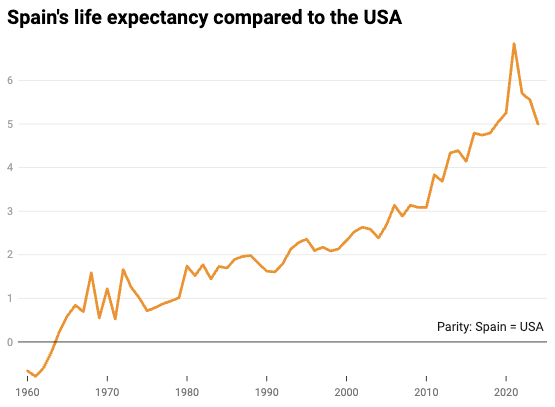
Spain, which has 36% less GDP per capita than the US, has a life expectancy that is 5 years longer. And Spain's advantage in terms of healthy longevity is even greater.
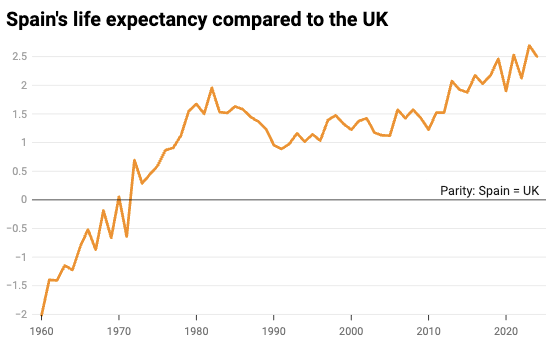
Btw, Spain's advantage here is not just in raw longevity, but in *healthy* life expectancy. Spain's healthy life expectancy is 2.5 years longer than Britain's. People in Spain live longer, healthier lives.
People are talking about how Spain has lower GDP than the UK... but look how Spain's life expectancy surpasses the UK's in the early 1970s, with progress accelerating again after 2010. Today people in Spain live 2.5 years longer than people in Britain.
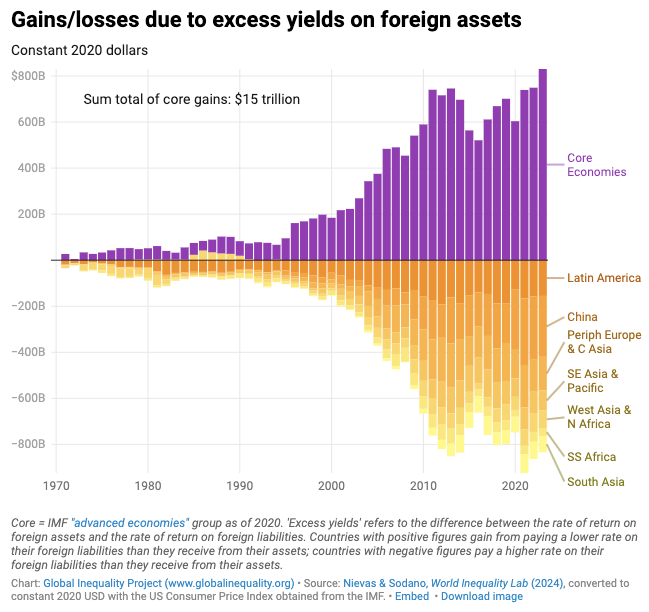
Scholars point out that rich countries enjoy this ‘exorbitant privilege’ because they issue international reserve currencies. This allows them to pull in the savings of the periphery by issuing low-yield bonds and other low-return assets denominated in their currency. Core states and corporations can then invest these inflows into more profitable ventures, pocketing the difference as a net gain.
This net flow from periphery to core not only boosts the income of the core, but also directly gives the core more power over production in the world economy – more power to determine what to produce and for whose benefit. Meanwhile, the periphery is forced to finance this capital transfer with a trade surplus or with more debt.
The imperial core has gained $15 trillion through exorbitant privilege since 1970, getting higher returns on foreign assets than what they pay on foreign debt. This privilege is financed by transfers from the global South, outstripping aid flows many times over.