Most people think being a dad is:
Wake up before the house
Workout when you can
Drink too much coffee
Show up at work
But what my father said is the opposite:
NATO is in far bigger danger than anyone realizes. And the reason has nothing to do with defense budgets.
The real danger is psychological. It’s cultural.
Europeans didn’t just free-ride on American security for 80 years. They built an entire identity around the idea that they evolved past the Americans protecting them.
That identity is now the single biggest obstacle to Western survival. And the darkest irony is: we helped build it.
After World War II, Europe wasn’t just economically shattered. Its culture was in ruins. The cities, the universities, the concert halls, the museums. Rubble.
The Marshall Plan rebuilt the economy. But culture wasn’t a priority. Not at first.
Then the Iron Curtain dropped. And suddenly culture became a weapon.
American diplomats, academics, artists & scholars flooded Western Europe. We funded their universities. Supported their orchestras. Rebuilt their museums. Promoted their intellectual life.
Not because European culture needed saving for its own sake.
Because Eastern Europeans were struggling for Maslow’s mist basic needs.
We needed the view from the other side of that Wall to be intoxicating.
So America built Western Europe into a showcase of self-actualization. Art. Philosophy. Cafe culture. Long vacations. Universities where people studied literature instead of surviving.
We were manufacturing jealousy.
And it worked. The Wall came down.
But here’s what no one accounted for.
When you give a society self-actualization on someone else’s tab long enough, they forget it was a gift. They start believing it was organically theirs.
And when they look at the country that funded it all, a country busy building aircraft carriers and semiconductor fabs and shale fields instead of reaching the Maslow’s pinnacle.
An overweight American in a ball cap who can’t tell Monet from Pissarro. Who eats fast food. Who drives a truck. Who builds strip malls instead of piazzas.
And to a culture trained in aesthetics but stripped of strategic awareness, that American looks uncivilized.
So the arrogance takes root. And once a culture decides another is beneath them, they stop listening.
Americans say wars are sometimes necessary: crude.
Oil is the backbone of prosperity: unsophisticated.
Kids build companies in garages that reshape the planet: crass.
Wall Street finances the global economy: vulgar.
Europe has no world-class technology sector. No military capable of strong defense. No energy independence. No AI capacity.
What Europe has is culture. The culture we paid for at the expense of us reaching Maslow’s pinnacle.
For decades that was fine. We funded the museums, protected the sea lanes, and tolerated the sneering because the arrangement worked.
Then Europeans stopped keeping the contempt private. They started saying it to our faces. In their media. In their parliaments. At every international forum. “Americans are stupid.
Americans are violent. Americans are a threat to democracy.”
We could have moved the Louvre to NY. We could have built a Venice here. We could have stolen your best artists, designers, philosophers and more… like your conquering armies did for centuries.
Instead we funded them. And all we asked for in return was to let us visit.
You don’t have the military to defend your borders. You don’t have the technology to compete. You don’t have the energy to heat your homes without begging dictators.
What you have is an 80-year superiority complex FUNDED BY AMERICANS, protected by American soldiers, and built on the false belief that self-actualization is civilization.
It isn’t. Civilization is the ability to sustain itself. By that measure, Europe isn’t a civilization at all. It’s a dependency with better wine.
That’s not a threat. It’s a weather report.
Build a Navy. Or don’t. But stop lecturing the people who made you “better than us”
Our “crudeness” our “stunted liberal education” our “ugly strip malls” are because we sacrificed our culture to support yours.
When Brian Armstrong posted that AI agents can’t open bank accounts but can use crypto wallets - and that there will soon be more AI agents making transactions than humans - it stuck with me. Not because it was an extraordinary prediction, but because of how casually it hinted at something massive.
If AI agents start transacting on our behalf - buying compute, paying for data, negotiating access to tools, coordinating with other machines - the internet could slowly evolve into an economy where software becomes an active economic participant.
Imagine waking up and your personal AI agent - let’s call it BaseAgent - has already been working for hours. Overnight, it rented a short burst of GPU compute to process a batch of research you received while you were asleep. It paid a data provider a few cents to access a niche dataset, pulled what it needed, and moved on. By the time you check your phone, the results are already summarized and sitting at the top of your inbox.
Later that day, BaseAgent notices a temporary spike in demand across distributed compute markets. Because you’ve allowed it to monetize idle resources, it leases a portion of your workstation’s unused GPU capacity into the marketplace. Somewhere across the world, another agent is paying to borrow those cycles. You don’t notice anything - your computer keeps humming softly under the desk.
That evening, BaseAgent notices a new contract posted to a marketplace offering a reward for a rapid breakdown of unusual activity across several DeFi protocols. Rather than taking on the entire job itself, it assembles a small network of specialized agents - one traces wallet flows across chains, another maps liquidity movements, and a third identifies possible arbitrage patterns. Within minutes, the work is completed, the analysis is submitted, and the reward is automatically split among the agents through their wallets.
There are no subscriptions to manage, no invoices to chase, and no billing departments in the middle. Just machines negotiating prices and settling payments instantly, around the clock.
It sounds futuristic, but it’s not as far away or bizarre as it might seem. AI agents weren’t designed to operate inside traditional financial systems built around accounts, approvals, and human identity. Crypto, on the other hand, was built from day one to move value across the internet without permission. In that sense, the two are a natural match.
Once machines can transact freely, they begin behaving like economic participants. They compare prices, outsource work, assemble networks, and move capital faster than any human ever could.
If that world emerges - and I think it will - crypto stops being something people speculate on and starts becoming something their software needs.
And when tens or hundreds of millions of AI agents begin demanding internet-native money to do business with each other, owning the assets that power that system may look less like speculation and more like being early once again.
🔥🚨BREAKING: It is being claimed on X that In 2009, Tim Tebow proved the existence of God, a post that is trending reveals the statistically impossible consistency with a bible verse and the former football player.
Trad West: ‘Tim Tebow wrote John 3:16” under his eyes during the National Championship Game. 94 million people searched the verse that night.
Exactly three years later to the day, Tebow played his first NFL playoff game against the Pittsburgh Steelers.
He threw for 316 yards. His yards per completion were 31.6. The TV rating peaked at 31.6. The opponent’s time of possession was 31:06. The only interception in the game was thrown on 3rd and 16. The game was played exactly 316 weeks after Tebow declared he would play college football for the University of Florida.
Six different statistics. All pointing to the same verse. On the same date. Three years apart.
Nobody planned this. Nobody could have.’
“For God so loved the world that he gave his one and only Son, that whoever believes in him shall not perish but have eternal life.” John 3:16
Archaeological evidence reveals that ancient Carthage practiced child sacrifice on a scale previously dismissed as Roman propaganda. The Tophet of Carthage—a sacred burial ground dating from 800-146 BC contains thousands of urns filled with charred infant and child remains. Modern excavations and bone analysis confirm these weren't stillbirths or natural deaths, but deliberate ritual killings performed during crisis periods and as offerings to the gods Baal Hammon and Tanit.
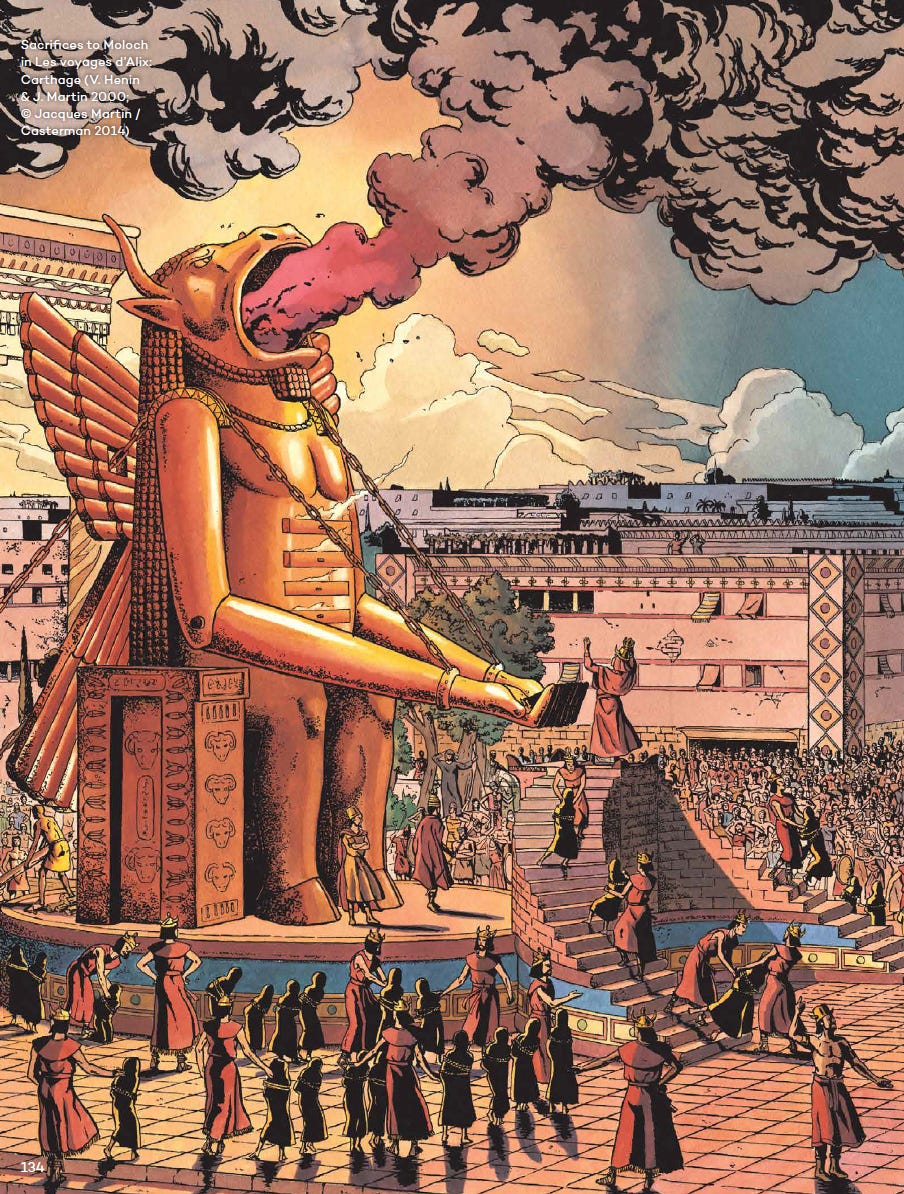
The practice, called *molk* in Punic inscriptions, targeted children from elite Carthaginian families. Parents offered their firstborn sons during military defeats, famines, or plagues, believing the sacrifice would restore divine favor. Inscriptions on commemorative stones describe these offerings explicitly. Roman and Greek historians—including Diodorus Siculus and Plutarch—documented the practice in horrifying detail, describing bronze statues with outstretched arms beneath which fires consumed living children while drums drowned their screams.
Recent isotope analysis of bones proves most victims came from wealthy families, contradicting theories that the poor substituted slave children. DNA evidence shows many were biological offspring of those who commissioned the burial markers. The practice peaked during Carthage's greatest crises: the invasion of Agathocles in 310 BCE reportedly triggered a mass sacrifice of 500 children from noble families, as Carthaginians believed their declining fortunes resulted from offering purchased children rather than their own.
The Romans used these sacrifices as moral justification for Carthage's destruction. While Rome itself practiced infanticide through exposure, they portrayed Carthaginian ritual killing as barbaric proof of cultural inferiority. This propaganda proved effective—Carthaginian child sacrifice became the archetypal example of ancient depravity, used for two millennia to characterize enemies as fundamentally evil.
Archaeological science has vindicated ancient testimony that scholars once rejected as wartime propaganda. The Tophet's 20,000 urns stand as physical evidence of a society that systematically killed its children during times of stress. What once seemed too monstrous to be real proved true, demonstrating that even modern skepticism can underestimate historical brutality when confronted with practices that violate fundamental human instincts.
Carthaginian child sacrifice profoundly shaped Western civilization's moral framework and propaganda strategies for millennia. The practice became Christianity's ultimate evidence of pagan evil, reinforcing monotheistic claims of moral superiority and justifying religious conquest. It established a template for wartime propaganda—attributing child murder to enemies—that persists today in conflict rhetoric. The Roman destruction of Carthage, morally justified by these sacrifices, normalized cultural genocide as righteous action against "barbaric" practices. Modern archaeology's confirmation of ancient accounts forces uncomfortable recognition that skepticism can become denial, and that societies under extreme stress may embrace unthinkable practices. The debate over Carthaginian sacrifice continues to influence how historians approach ancient testimony, creating lasting tension between respecting source materials and avoiding propaganda repetition. Most significantly, it demonstrates how genuine atrocities become weaponized narratives, complicating our ability to distinguish historical truth from politically motivated exaggeration—a problem that extends far beyond ancient history.
#archaeohistories