Research Scientist- Wildlife Ecology. Head of #ACMELab @UVicEnvi. Chase wolverines, bears, deer, &c. Camera trapper. Distillery co-owner. Boat Cap'n. Curious.
Like to hear some cool stories about how #nature responded to #COVID19 lockdown? This Friday Nov 12, 9EST @cbcdocs
Canadian doc ‘Nature’s Big Year’ shows how wildlife has adapted during the pandemic https://t.co/Wv32G64XO5 via @torontostar
Folks, I can no longer support the crazy dingdong running this show. I have to say "so long' to my 1000s of followers and followees, and start all over at bluesky. Find me @random-blackbear.bsky.social.
Keeping this accountso noone starts posting in my name. It has happened.
@adamTford Except that in the original analysis habitat alteration is binned as "statistically insignificant", a foundation conclusion of the orig. paper.
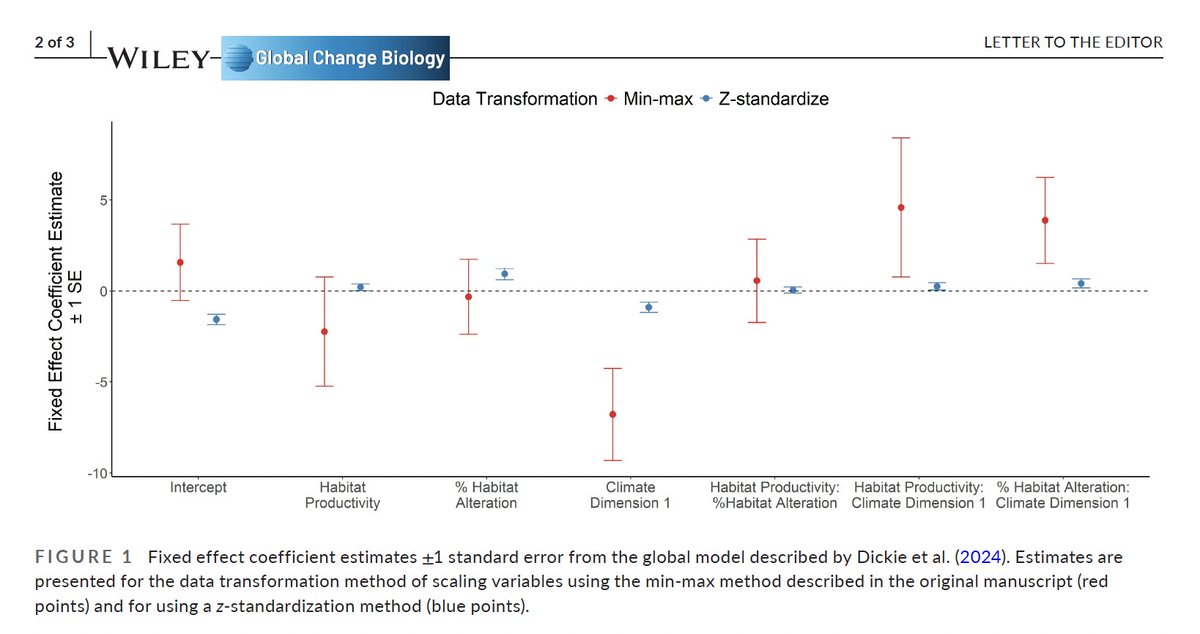
Re-analysis: habitat alteration is also driving deer densities - with an effect size equal to climate. VERY different conclusion.
So apply a different normalization to the deer data: different model outcome. (If all normalizations are equal this wouldn't have happened!)
Again, this is a common outcome in stats models, nothing to be surprised by.
https://t.co/2IHicRbVFh
https://t.co/2Mt1eMs8Zn
@adamTford Notable: min-max scaling is sensitive to outliers.
When you have data with many varying and extreme values (as seen in the deer density dataset) they behave differently than z-scaled or robust-scaled data.
Yes they have collinear means: stats 101. It's the error that counts.
@adamTford Different normalizations are not "the same picture". They affect error structure of the data, which of course affects model fit. Some good resources:
Digestible synopses: https://t.co/5MYhemIApV
https://t.co/WtfR5DYe5A
Papers:
https://t.co/2IHicRbVFh
@taaltree Agreed, which was our point. Like the Gould paper, we need to be very careful with conclusions drawn from a single model, as different decisions yield different outcomes. No harm or foul.
***New paper alert***
White-tailed #deer are expanding through the #boreal forest with substantial negative consequences. Why?
A recent paper stressed this is primarily #climate driven, but our re-analysis suggests it's 50/50 habitat/climate.
https://t.co/KdT53THzyU
@MelanieDickie This is the crux: scaling change (and other modelling decisions) takes habitat from "statistically insignificant" to something very different -and more in line with what we've been finding for the last decade, that climate and habitat are both significant.
@MelanieDickie Key point is that there isn't a right or wrong way - you did nothing wrong - but a simple twist of the model goes from "habitat is statistically insignificant" to "significant and of equal effect size".
This is common, as we tried to make clear by citing:
https://t.co/YeXzeVgN0O
@MelanieDickie Hi Mel, here is why transformation can change the outcome of models: transf. variables are correlated by carry different RMSE. As GLMs fit models to data based on error structure, one gets different model fits.
https://t.co/5MYhemIApV
@adamTford Respectfully my friend, yes we did. A slightly different model treatment turned "habitat is statistically insignificant" to "significant and of equal effect size".
This was not an attack on our comrades, or your work. It is just a common phenomenon.
https://t.co/YeXzeVgN0O
@adamTford "Negligible" in that "statistically insignificant" is widely interpreted as such - which is the claim of the OG paper and refuted by us, empirically.
@adamTford On these points we fully agree. Unlike the cage-match contest created on the OG paper, the rebuttal matches our contention there are cumulative effects at work here, and cumulative management strategies are needed to solve this problem.
@adamTford That this view was amplified by unfortunate reporting in the media, compounds the problem. Many took this as "landscape development is not the deer problem". We just showed that a simple twist of the model yields a very different answer -- and that managers need to be aware.
@adamTford We really appreciate that we can discuss these issues with our colleagues (and hopefully, still friends). The dismissal of habitat effects on deer as "statistically insignificant" is certainly interpreted by managers as "irrelevant - they have told us as much.
@adamTford That is Bolker's view but certainly not Gospel! And his paper targets (rightfully) issues with shrinkage with multimodel averaging, which we did not do.
@adamTford The emphasis on statistically insignificant comes up time and again, despite a push by many to avoid the tyranny of the p value and instead examine effect sizes.
https://t.co/8pqZFxam3Z
@adamTford The original title was "Habitat alteration or climate: What drives the densities of an invading ungulate?" - a very binary contest.
The original analysis discarded habitat alteration as "not statistically significant". Classically this is interpreted as "negligible".
@adamTford GLMs fit models to assumed PDFs based on error structure. This is why one gets different beta estimates and z scores with different normalizations.
Dickie's response contests this, but it is nonetheless true - and why Barnas et al. found different answers in their analysis.
@adamTford Means are correlated true among transformed variables, true, but error structures are not. A very good example is here: https://t.co/5MYhemIApV.
Different normalizations yield different RMSE.