I was holding her hand when she took her last breath on 3 June 2026. Kanya King CBE. Founder of MOBO. My dearest best friend and soulmate of almost thirty years.
She built everything from nothing, for the love of her people. I have lost my person.
Rest in power, Kanya.
I saw that Bonnie Blue has a BTS TikTok where she does skincare & relatable family content, breaking down her “rage bait”videos and it’s full of young women in the comments saying how much they love 😍 her.
Such a smart move, she’s even going on brand trips….
You truly have to live this life, run as fast as you can and make every bit of impact possible because tomorrow is not promised.
We all knew Kanya’s diagnosis, but I truly never expected this news so soon.
It is with immeasurable sorrow that the MOBO Organisation announces the passing of its Founder and CEO, Kanya King CBE.
Kanya passed away peacefully on 3 June 2026 after a courageous and characteristically determined battle with colon cancer. She was surrounded by her family, close friends and love.
Thirty years ago, Kanya King remortgaged her home, alone, without institutional backing or industry support, to build a stage that would transform British music forever.
She was a single mother from a Kilburn council estate who was told that Black music was too niche, that there was no market and that the industry was not interested. Instead of arguing, she built. Six weeks later, the first MOBO Awards was broadcast to the nation, and nothing was ever the same again.
What Kanya created was never simply an awards ceremony. It was an act of cultural justice. MOBO did not just celebrate Black music; it legitimised it, amplified it and transformed the cultural landscape of the UK.
From Stormzy, Little Simz and RAYE to Craig David, Ms. Dynamite, Amy Winehouse, Central Cee and countless others, generations of artists have benefited from Kanya King's vision.
She built a platform that reached hundreds of millions of people around the world. She was awarded a CBE and received an Ivors Academy Honour in 2025. She never stopped. She never asked for permission. She never accepted that the word “no” was final.
When she stood on the MOBO stage in Newcastle in February 2025, just months after her diagnosis, she told the audience: “I never allowed someone to define my limits. Not in life. Not in business. And I’m certainly not going to have that happen now.”
That was Kanya King. Right to the very end.
The 2026 MOBO Awards, held during the Organisation’s landmark 30th anniversary year, will be dedicated entirely to her memory.
The world was a profoundly better place with Kanya King in it. The MOBO family is heartbroken, but endlessly grateful, proud and inspired by everything she gave to music, culture and future generations.
Rest in power, Kanya.
You built this.
All of it.
I wrote about something weird I’ve been seeing online for @NYTmag: people who are outsourcing their morning routines to Claude and ChatGPT https://t.co/MBxOuIvLCK
We are increasingly forming our worldview through social media clips rather than lived reality. The danger is that our understanding of people, places and events becomes mediated by algorithms, outrage and spectacle, rather than direct experience and relationships.
The French hate air conditioning.
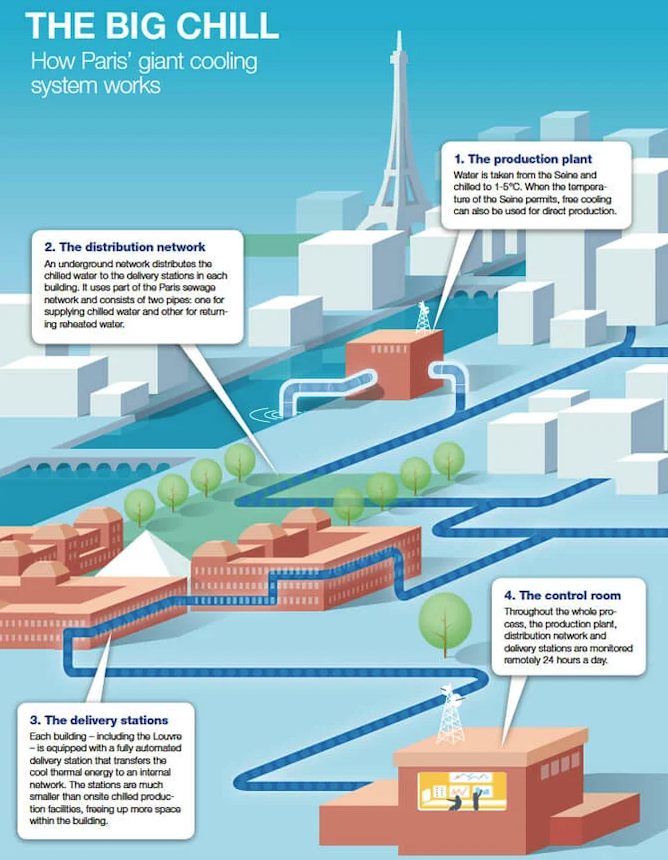
So Paris built a 120-kilometre machine under its streets for producing cold.
It’s called Fraîcheur de Paris, and it does for summer heat what district heating did for winter: centralise the problem.
Instead of every museum, office, hotel, hospital and shop bolting its own cooling plant onto the building, Paris moves cold through pipes.
The network sends water chilled to 2 to 4°C through buried supply lines. The water enters a connected building, absorbs heat through an exchange station, then returns at 12 to 14°C to be cooled again.
It essentially functions with two pipes. One carries the cold out, the other carries heat back.
The production plants cool the circuit from 12°C to 4°C. Some sites use the Seine as a heat sink. In colder periods, the system can use the river’s own temperature for free cooling, which means the machines work less and the electricity demand drops. The Seine water doesn’t become the building water. It stays separate, passing temperature across heat exchangers.
The scale is pretty strange when you see it written down though.
It's got 15 production sites, 4 storage sites, 120 km of underground network with 924 subscribers. This has resulted in 7 million square metres cooled, and 493 GWh of cooling sold.
A cold utility running beneath one of the densest cities in Europe.
The Forum des Halles has been cooled this way since 1979. The Louvre since 1986. Galeries Lafayette, Opéra Garnier, Hôtel de Ville, Station F, La Samaritaine and the National Assembly all sit on the same idea. Tourists stand in the Louvre looking at paintings while a municipal cold loop does part of the dull work below ground.
The boring part is the breakthrough.
Cold can be stored at night in chilled water or ice, then used during daytime peaks. The network is monitored from a control room with more than 125,000 control points. A delivery station inside a building takes 5 to 7 times less space than a standalone cooling installation and avoids the roof and façade clutter that turns cities into compressor farms.
That matters because conventional air conditioning solves heat by moving it somewhere nearby. In a dense city, thousands of private machines mean thousands of outdoor units rejecting heat into streets, courtyards and roofs, plus refrigerants, noise, vibration and maintenance spread across every building.
Paris’s public cooling network has a stated coefficient of performance of 4, against 3 for a wet standalone system and 2 for a dry standalone system. Against an equivalent set of autonomous installations, Fraîcheur de Paris says the network gives 100% higher energy efficiency, 35% less electricity use, 90% fewer refrigerant-fluid emissions and 50% lower CO2 emissions.
The climate backdrop is the real reason this exists.
Paris ran a full crisis exercise called “Paris at 50°C” in 2023. Météo-France’s 2050 reference trajectory for France points to heatwave days becoming five times more frequent, hot nights rising sharply in urban centres, and some local extremes around 48°C becoming possible.
The city signed a 20-year concession in 2022 with Fraîcheur de Paris, owned 85% by ENGIE and 15% by RATP. The contract is worth a projected €2.4 billion. The plan is to extend the network by 158 km by 2042, add 20 production plants and 10 storage sites, and reach more than 3,000 subscribers, including hospitals, nurseries, schools and care homes.
This is basically the infrastructure version of admitting that summer is becoming a public systems problem...