Last Monday, we had a pretty clear idea of what to watch in crypto.
The Fed, PCE, earnings, and a major options expiry.
Then Binance happened.
Roughly $6.3 billion was stolen in what became the largest crypto hack on record. And suddenly, everything we had been watching felt a little less important.
That's something I've been thinking about as we enter another packed week.
November 2–8 brings the US midterm elections on Tuesday, the October jobs report on Friday, Circle's earnings, Devcon 8, and several major token unlocks.
Plenty of catalysts.
But I'm more interested in how the market reacts to them than the events themselves.
Take Binance, for example.
According to DefiLlama, roughly $5.8B in net outflows followed the reopening of withdrawals. Other trackers put it closer to $3.6B.
Meanwhile, Bitcoin ETFs recorded around $643M in outflows on Friday, the biggest daily outflow since June.
The question I'm asking isn't whether Binance can replace the stolen funds.
It's whether confidence returns at the same speed.
Because liquidity can come back relatively quickly. Trust usually takes longer.
Then there's the token unlock situation.
$ENA, $KITE, and several others have new supply scheduled this week.
But $HYPE is the one I find particularly interesting.
Unlock calendars show roughly 9.92M HYPE unlocking on November 6, worth somewhere between $870M and $925M depending on the tracker.
Sounds terrifying, right?
Except the team has reportedly committed to distributing closer to 180K tokens.
That's exactly why I don't like treating unlock dashboards as automatic sell-pressure indicators.
The number everyone shares and the number that actually reaches the market can tell very different stories.
Circle's earnings on Wednesday might be even more interesting.
We've spent years talking about stablecoins as the foundation of DeFi.
But Circle says it has now frozen more than $1.1B in USDC tied to the Binance exploit, and I think there's a more important conversation to have.
How much control should a stablecoin issuer have?
And how do we balance that control with the security people expect from financial infrastructure?
I'm curious whether Circle addresses this alongside its usual revenue and growth metrics.
Of course, macro still matters.
Tuesday's elections could reshape expectations around US crypto regulation.
Friday's employment report could shift the market's expectations for the Fed's next move.
And weaker economic data isn't automatically good news for risk assets, even when traders start hoping for easier monetary policy.
Meanwhile, Devcon runs from Tuesday to Friday, and Zcash is targeting its NU7 upgrade on Thursday.
I actually like that contrast.
While traders are busy reacting to liquidity, politics, and short-term supply, developers are still working on infrastructure that might matter years from now.
That's the strange thing about crypto.
The market can spend an entire week worrying about what happens tomorrow while the technology keeps moving toward something much further away.
So I'm entering this week with a fairly simple mindset.
Pay attention to where liquidity is going, question the numbers everyone is repeating, and don't confuse a busy calendar with actual market understanding.
Last week reminded me that the biggest risks rarely announce themselves in advance.
Maybe the more useful skill is learning to recognize what changes after they arrive.
gmonad
The Coinbase x402 Facilitator is now live on @Monad.
→ Built-in compliance: automated KYT & OFAC screening
→ Proven at scale: 100M transactions, $28M in payment volume
→ Flexible payment schemes: exact, upto, and batch-settlement
→ Discoverability: auto-inclusion in x402 Bazaar
→ Gasless: we sponsor the gas while buyer agents just pay in the desired payment token (e.g. USDC)
Open, internet-native payments with Coinbase-grade security, scale, and throughput.
I built Joyhavn for @EncodeClub's Solana hackathon, and here's the full story.
The problem: the most useful little tools online are worth fractions of a cent: checking a link, validating a file, pulling a price. Cards can't charge $0.005, because the fees eat it. Subscriptions and API keys are painful for one-off use. And AI agents can't use these tools at all, because they can't fill in a sign-up form.
Mainnet soon.
What Joyhavn does: every tool is a plain web endpoint with a price per request. Ask for it and the server answers HTTP 402, "Payment Required", with the price in USDC. Your wallet signs a small transfer, it settles on @solana, and the result comes back in that same request. No account. No API key. No subscription. Every purchase gets a public receipt anyone can verify.
Why Solana is the point, not a wallet button: → the settled payment is the access control → sub-cent prices only work because fees are a fraction of a cent → buyers need only USDC, no SOL, because the facilitator sponsors the fee → receipts and earnings are read straight from the chain, not my database
What's live today (devnet): URL Safety Scan · AI Summary · Data Snapshot · JSON Validator, from $0.003 connect @phantom on desktop, or on your phone: Safari → wallet app → back, encrypted Agent mode: give an AI agent a task and it buys the tools it needs with its own wallet, under a spending cap you set a "Verify a receipt" page that proves any payment on-chain a public catalog so any outside agent can discover the tools and pay
If a payment fails or you cancel, nothing is delivered and nothing is charged.
What's coming next: the Joyhavn Vault
Agents spending money need guardrails. The Vault is a safer home for agent funds: daily budgets, allow-lists of which tools an agent may buy, and approval for anything unusual. Security first, because autonomous payments only work if people can trust them. It's not built yet. It's the next thing I'm building.
Demo video: https://t.co/jRKHSfxVG8 Try it: https://t.co/kDHZCQvBg3 README: https://t.co/S86dcQk2FI
Built on @x402org. Feedback is very welcome, and if you're building agents that need to pay for things, let's talk.
A group of YouTubers confronted a repo driver after he unexpectedly seized their Porsche, with the owner repeatedly insisting all of his payments were current before they discovered an 11 day late Lamborghini payment caused the leasing company to order BOTH supercars repossessed 😳👀
The Porsche itself was fully paid up and had been taken by mistake, forcing the company to apologize and promise to release it the following morning.
“I don’t owe money on this car, bro. They can’t take this car.”
“I pay them when I want to pay them. The payment was due on the 15th, so it was 13 days late.”
Mago Explains: who can freeze your stablecoins?
The Binance hack answered it live: Tether and Circle froze ~$1.8B in USDT + USDC within hours.
Meanwhile, stablecoin supply quietly shrank 👇
----
📊 The numbers (DefiLlama)
• Total supply: $300.7B (Oct 31)
• Sep 30: $308.0B → -$7.3B in October
• ATH: $317.1B (May 17), now -5% from peak
• $USDT: $179.7B (60%) | $USDC: $71.9B (24%)
----
🧊 Who can freeze what
• USDT / USDC: issuer can blacklist any address
• Under the GENIUS Act, issuers will be US-regulated. The OCC finalized its implementing rule this month
• Banks are joining: HSBC just rolled out RedCoin, an HKD stablecoin, to retail users
----
Why it matters for you
1⃣ Freeze power = recovery tool in hacks
2⃣ Same power = counterparty risk for every DeFi position in USDT/USDC
3⃣ Regulation makes issuers safer, and more controllable
----
⤷ Stablecoins are becoming bank money on public rails. Great for adoption. Just know who holds the off switch.
Binance hack recap for those just waking up 👇
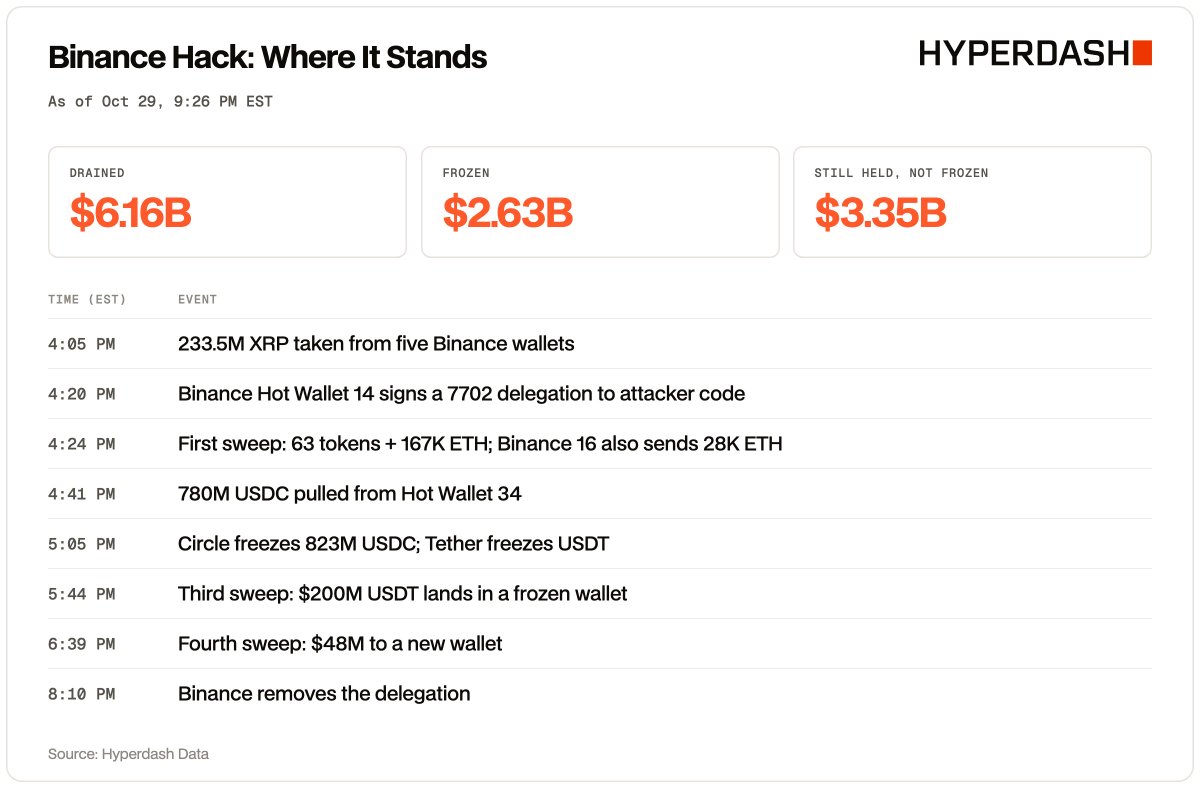
Starting at 4:05 PM EST on Oct 29, an attacker with access to Binance's wallet-signing systems drained more than $6B from Binance hot wallets across Ethereum, Bitcoin, Tron, XRP, Polygon and Avalanche.
The main tool was an EIP-7702 authorization signed by Binance Hot Wallet 14, which installed the attacker's code on that wallet and let them sweep dozens of tokens per transaction, plus pull 823M USDC from Hot Wallet 34 using Hot Wallet 14's operator rights, while other Binance wallets signed ordinary transfers straight to the attacker.
Binance removed the delegation at 8:10 PM EST, almost four hours after the first sweep. About $2.6B has been frozen: Tether ($1.76B USDT, including inside Binance 14 itself), Circle ($823M USDC), Ripple ($40.5M RLUSD) and Paxos (1,907 PAXG), and token teams clawed back SNX, SAND and BEAM.
The rest is moving: the attacker has sold all of its UNI, PEPE, LINK and AAVE and ENA for ETH, swapped 234M USDT into TRX on Tron, and put 60M USDT into Aave to borrow $44M of ETH before Tether's freeze. It still holds about 475K ETH, all 18,270 BTC (split into 1,000 BTC wallets) and 233M XRP.
ELON MUSK OFFERED TO BUY HIS FATHER A CAR. HOW ABOUT A JEEP? BUT HIS ANSWER SURPRISED EVERYONE... "I WANT SOMETHING DECENT. I WANT A BENTLEY" — ERROL MUSK
Vlad asks Errol a simple question: your son is worth almost half a trillion dollars. does he help the family?
Errol starts with "I don't really need help. I'm self-supporting"
then he tells the story anyway
Elon suggested buying him a car. the first idea was a Tesla. but shipping one to South Africa, in Errol's words, the price was "astronomical", and there's no service where he lives
so the family comes back with a practical option:
"why don't you get a Jeep or something?"
"I don't want a Jeep. I want something decent"
"so what do you want?"
"I want a Bentley"
"so Elon said: sure. Bentley"
there's a Bentley Flying Spur in his garage now. he hasn't even put the number plates on
and the car is the small part
according to Errol, the family company pays every single woman in the family a monthly income. married ones get "a little bit of help". his ex-wife gets a monthly income too
when his medical bills came to almost a million and insurance covered 600,000, they paid the gap
his summary: "if you ask them, they help you. it's as simple as that"
now remember who's talking
this is the father Elon publicly called "a terrible human being". the one he said had done "almost every crime you can possibly think of"
and he's driving a Bentley his son paid for
for the record: this is Errol's version, from Errol's interview. nobody in the family has confirmed the details
but it shows something about money at this level that nobody puts on a Forbes list
a half-trillion net worth isn't one person's money. it's a whole family's payroll. ex-wives, siblings, a father he barely speaks to, all running on one balance sheet
you can cut someone out of your life. at Elon's level, you can't really cut them out of your money
the richest man on earth can say no to his father. he just didn't say no to the Bentley
U.S. Treasury Secretary Scott Bessent says stablecoins could strengthen the U.S. dollar’s global dominance.
As dollar-backed stablecoins gain adoption, they could expand access to the dollar and reinforce its role in global finance.
A significant endorsement of digital assets. 🇺🇸
I drove an hour to buy a used car, and the salesman told me the price on the website was “just a starting point.”
I showed him the listing on my phone.
“That’s the price I came here for.”
He nodded. “That price assumes you qualify for all the available incentives.”
“Which incentives?”
He started naming discounts for financing through the dealership, trading in a vehicle, and meeting other conditions.
I told him I wasn’t trading in a car and hadn’t agreed to finance through them.
He said, “We can work something out.”
We spent nearly forty minutes looking at the vehicle. I liked it, the mileage was reasonable, and the test drive went well.
Then he brought me a worksheet……
When Gary Moore picks up an Explorer, it stops being casual. He cut three songs on it for his 2004 album Power of the Blues, an odd shape for the blues, but Gary never cared.
Here he explains how it feels against his Les Paul: “more liquid, more fluid, more elastic.” Then he proves it with a fast, fluid run. The magic was always in his hands.
Finally, I had the chance to make a fan-art of Gunsmith Cats. My admiration for Kenichi Sonoda sensei always! The full process is on my Patreon. #GunsmithCats