@agarzon@KaiHeron@KeirMilburn@alterurbanist una visión complementaria sobre las instituciones que necesitamos para transformar la abundancia futura en progreso compartido: https://t.co/jzJnWBlfW3
¿Cómo podemos garantizar un uso ético y responsable de la inteligencia artificial?
En un nuevo Grupo Motor de La Cultura del Talento Lab reunimos a líderes de distintas organizaciones para reflexionar sobre los principios que deberían guiarnos para poner la tecnología al servicio de las personas.
"La IA va mucho más allá de la tecnología. Afecta a la manera en que nos relacionamos y nos gobernamos" — Diego Herrero (director de desarrollo de @AspenSpain).
Una conversación necesaria para promover una relación con la IA más humana, crítica y consciente.
🎥 Descubre algunas reflexiones destacadas.
#LaCulturaDelTalento #HumanismoyIA
@RoccoLozano, @cbamadrid, @XavierPM, @HospitalSantPau, @AnagramaEditor, @fortegamaranon, @fotocolectania, @U4IMPACT_, @javicreus, @Ideas_4_Change, @fundacionexit, @_celera, @Cotec_Innova.
@PeterDiamandis very right, we have to rethink all our institutions. I am researching on how can we pre distribute future abundance https://t.co/q4fSOTNmtp
🧵 1/12
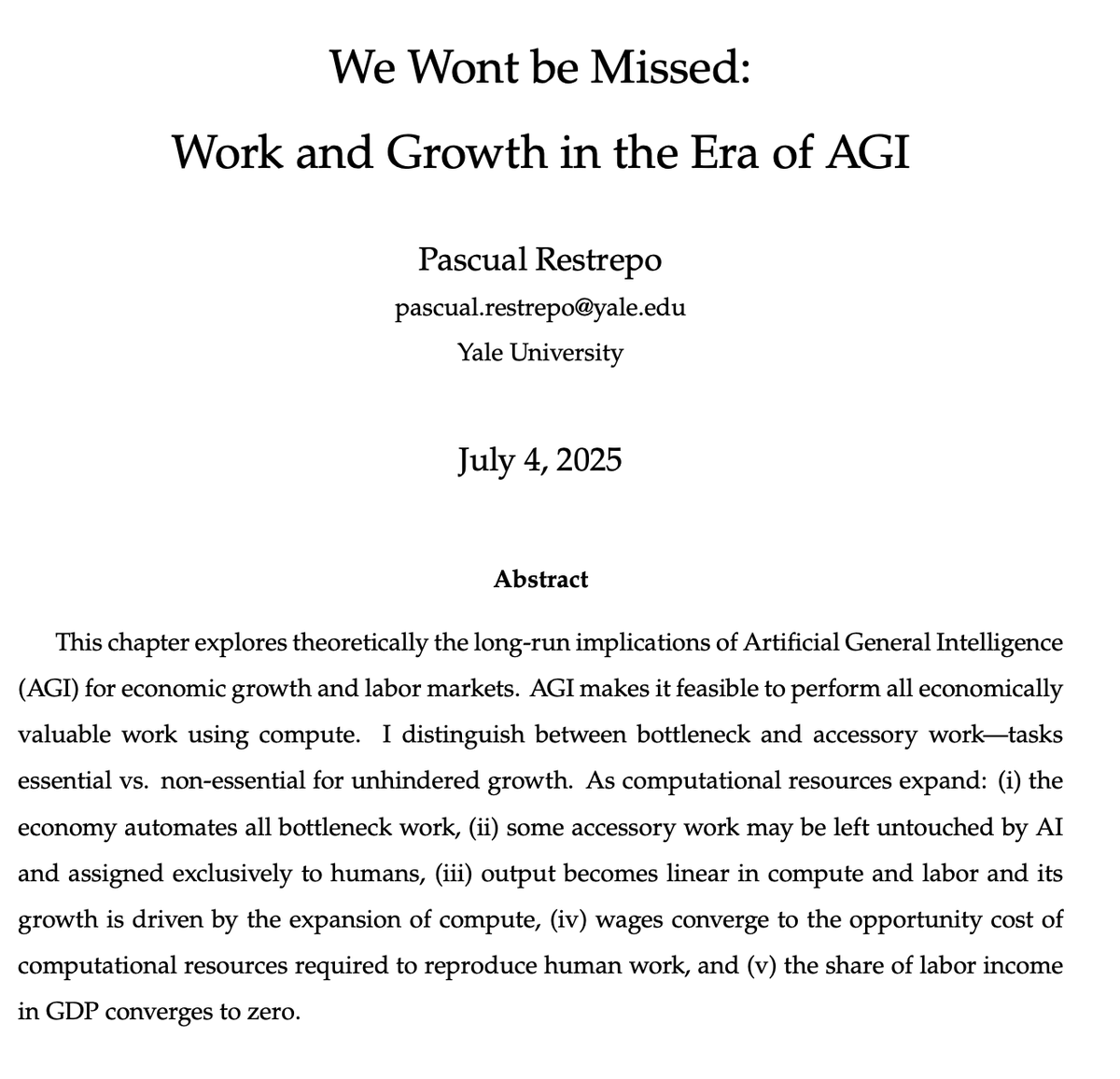
A Yale economist just published a paper that should terrify every knowledge worker.
It's not about AI taking your job.
It's about AI making your job economically worthless while the economy booms.
Let me explain the nightmare scenario:
🧵 2/12
The paper "We Won't Be Missed" starts with two simple premises:
1️⃣ AGI arrives (AI that can do ANY economically valuable task)
2️⃣ Compute becomes abundant (keeps getting cheaper, like Moore's Law)
From just these two assumptions, the whole economic order collapses.
🧵 3/12
Here's the key insight most people miss:
The paper divides ALL work into two categories:
Bottleneck Work = Essential for growth (energy, logistics, R&D)
Accessory Work = Nice-to-have (arts, hospitality, therapy)
This distinction changes everything.
🧵 4/12
Proposition 1 proves something shocking:
AGI will automate ALL bottleneck work.
Not because humans are bad at it.
Because sustained growth REQUIRES it.
The economy literally cannot afford to have critical functions limited by fixed human labor supply.
🧵 5/12
So what happens to economic output?
Proposition 2 & 3: Output becomes a LINEAR function of compute.
Growth rate = Compute growth rate.
The entire economy's expansion is now tied to one thing: how fast we can scale computational resources.
Human labor? Irrelevant.
🧵 6/12
"But surely humans still get paid well for the work we do?"
Nope.
Proposition 4 is brutal:
Your wage converges to the cost of the compute needed to replicate your work.
Not your skill. Not your experience.
Just: How much would the AI version cost?
🧵 7/12
Think about that for a second.
As compute gets exponentially cheaper, the ceiling on your wage FALLS.
A surgeon's salary isn't set by years of training anymore.
It's set by: "What does it cost to run the AI that can do the same surgery?"
Replicable = Cheap.
🧵 8/12
This leads to the paper's most devastating conclusion:
Proposition 5: Labor's share of GDP converges to ZERO.
Not because we're unemployed.
Because wages are capped while GDP grows infinitely with compute.
We become economically invisible.
🧵 9/12
"So who gets all the money?"
The owners of compute.
All wealth flows to whoever controls the computational resources.
It's like the transition from feudalism (land = wealth) to capitalism (capital = wealth).
Except now: Compute = wealth.
🧵 10/12
The paper extends this to science itself:
Proposition 9-11: AGI can automate scientific discovery.
This creates "compounded growth" (faster than before).
But NOT a singularity—growth is still limited by how fast we can scale compute.
Progress, but not infinite.
🧵 11/12
The title "We Won't Be Missed" isn't about job loss.
It's about economic irrelevance.
The paper proves: "If tomorrow half the population stopped working, no one would notice."
Growth continues. Living standards rise.
Just... without us mattering.
🧵 12/12
This isn't sci-fi speculation.
It's formal economic modeling with propositions and proofs.
The questions it raises:
How do we distribute wealth in a zero-labor-share economy?
What is work FOR if not economic value?
Who should own the compute?
We need answers. Fast.
"A 1.3 billion parameter model trained on human feedback outperforms a 175 billion parameter model trained without it. Your corrections are worth 100x more than computing power." mmmm....
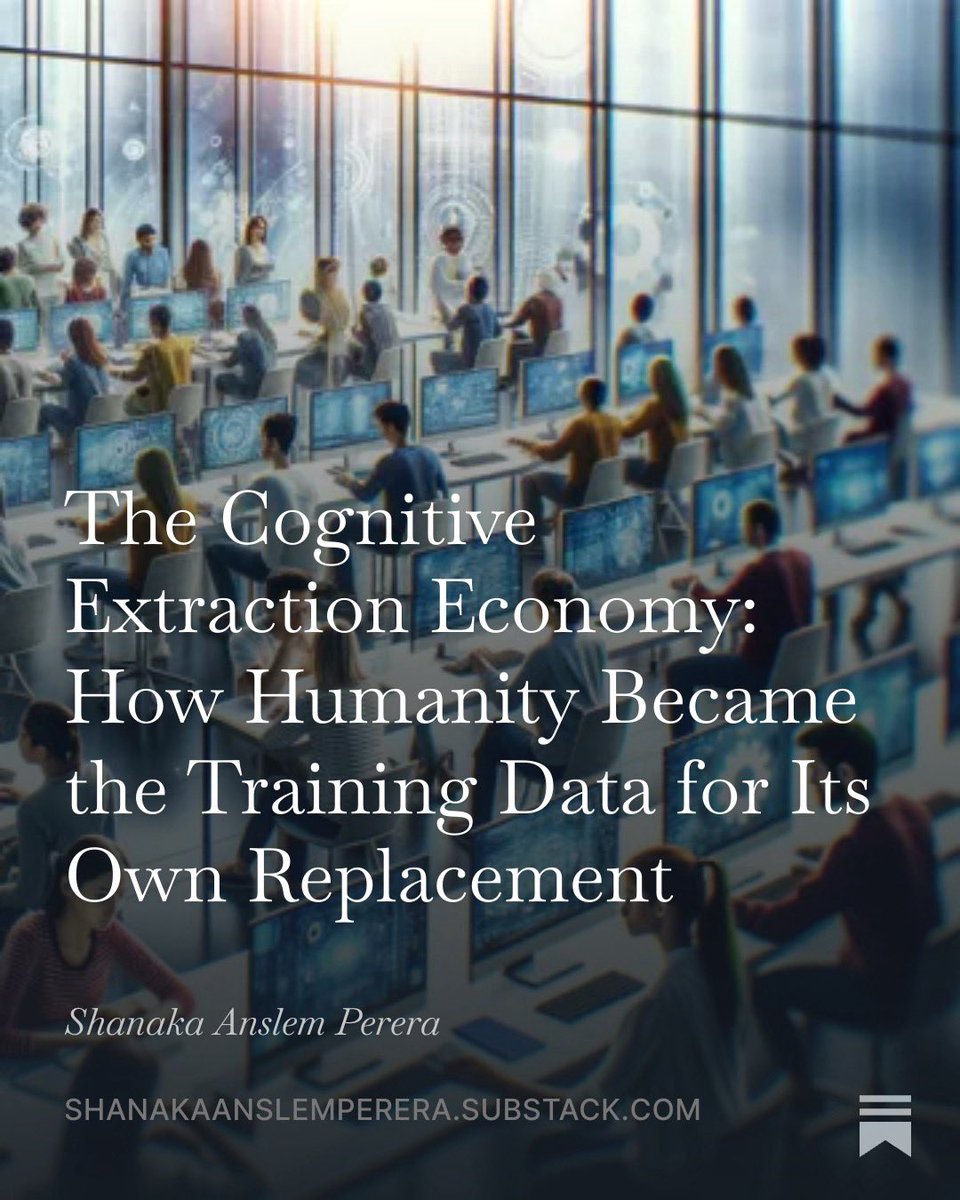
THE LARGEST THEFT IN HUMAN HISTORY IS NOT MONEY
It is your mind.
Stanford’s October 2025 study confirmed what they hoped you would never understand: ALL six frontier AI companies harvest your conversations by default.
300 million people weekly. Teaching machines. For free.
The data reveals something they never wanted public:
A 1.3 billion parameter model trained on human feedback outperforms a 175 billion parameter model trained without it. Your corrections are worth 100x more than computing power.
This is why Anthropic extended data retention from 30 days to 5 years. A 1,600% increase.
This is why they paid $1.5 billion to settle after downloading 7 million pirated books.
This is why Nvidia lost $600 billion in a single day when DeepSeek proved the real moat was never the chips.
It was always us.
Epoch AI’s peer reviewed projection: Usable human text will be exhausted by 2028.
Every prompt you type. Every correction you make. Every thumbs up or regenerated response. You are building the mind that replaces you.
Nature’s July 2024 finding: AI trained only on AI output degenerates within five generations. They cannot escape us.
The path to AGI runs through human cognition. We are not users. We are the labor force. We are the training data. We are the product AND the factory.
The next three years determine whether humanity governs this extraction or whether the largest construction project in history is built on labor technically disclosed but never understood.
You never agreed to build your replacement.
But you are.
Full investigation below.
https://t.co/lU6HVZFhhC
What if the most dangerous thing about AI isn’t that it kills us…
but that it quietly kills capitalism itself — and we’re all too traumatised by the 20th century to even dare imagine what comes next without screaming “communism!”?
Eric Weinstein just went nuclear in a 2:38 clip with Nicole Shanahan that will be studied in 2050:
“We all know how to be terrified of AI.
But the future is also going to be unbelievably cool.”
His thesis:
• AI is about to shift trillions from labor → capital at a speed never seen in history
• Adam Smith, Marx, AND Hayek all become simultaneously obsolete
• The real emergency isn’t saving capitalism or fearing communism
• It’s that nobody is allowed to host a single conference titled
“Capitalism Will Not Survive AI… and That Could Be the Best Thing That Ever Happened to Humanity”
Nicole: “People are terrified to talk about life beyond capitalism because it instantly sounds Marxist.”
Eric: “Exactly. We’ve lost the ability to invent brand-new economic space.
We’re like pre-1989 wheeled luggage: everyone knows it always falls over, so nobody funds the guy who finally fixed the center of gravity.”
We are living through an economic Berlin Wall moment and pretending the wall isn’t there.
Watch these 2:38 minutes. Seriously. It’s the most important conversation almost nobody is having.
Who else is ready to invent the economics that hasn’t been named yet?
2:38 video below
(mi hija) Buenos días somos dos chicas haciendo un trabajo de investigación sobre las diferencias entre hombres y mujeres jóvenes, si podéis responder esta encuesta y sobretodo difundirla a personas de entre 15 y 30 años ayudaría mucho, gracias!!!https://t.co/nUzh7d2rqy
🚀 Llega el Bootcamp Pentagrowth: 6 semanas para activar tu potencial oculto y diseñar un modelo disruptivo, con IA, co-creación y estrategia.
🗓️ Empieza el 17 de junio
💸 3.500 € edición verano
🎟️ Plazas limitadas
🔗 https://t.co/K9T3vJgbN1
#Innovación#Disrupción#Bootcamp