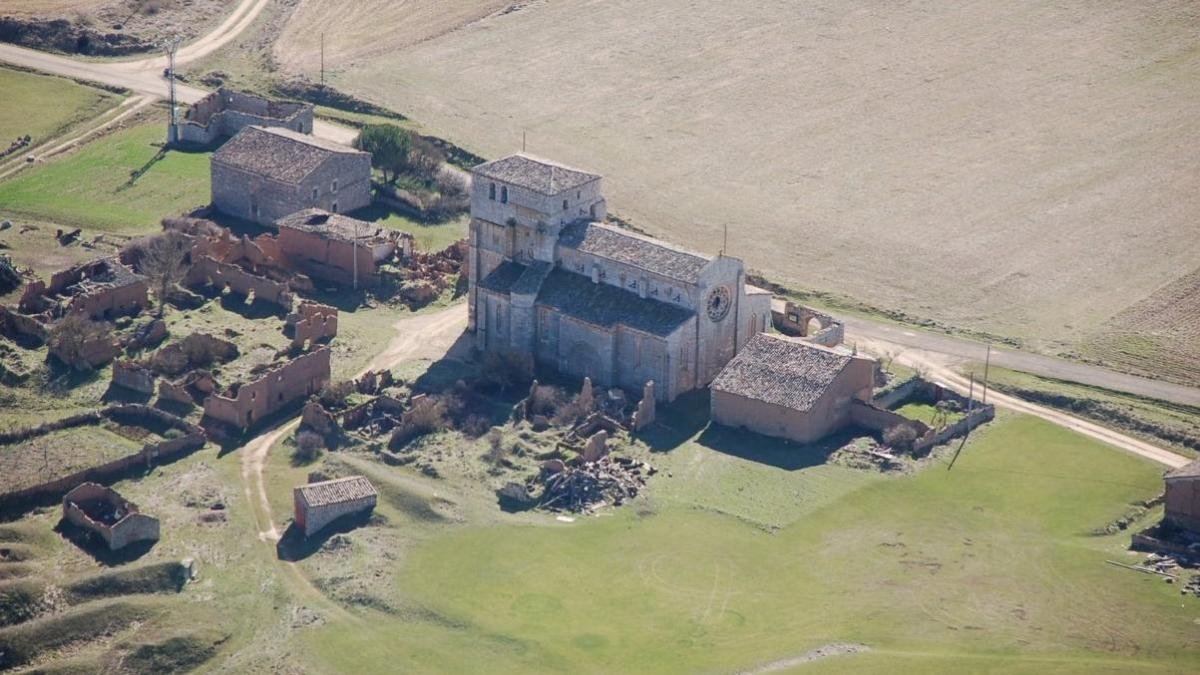
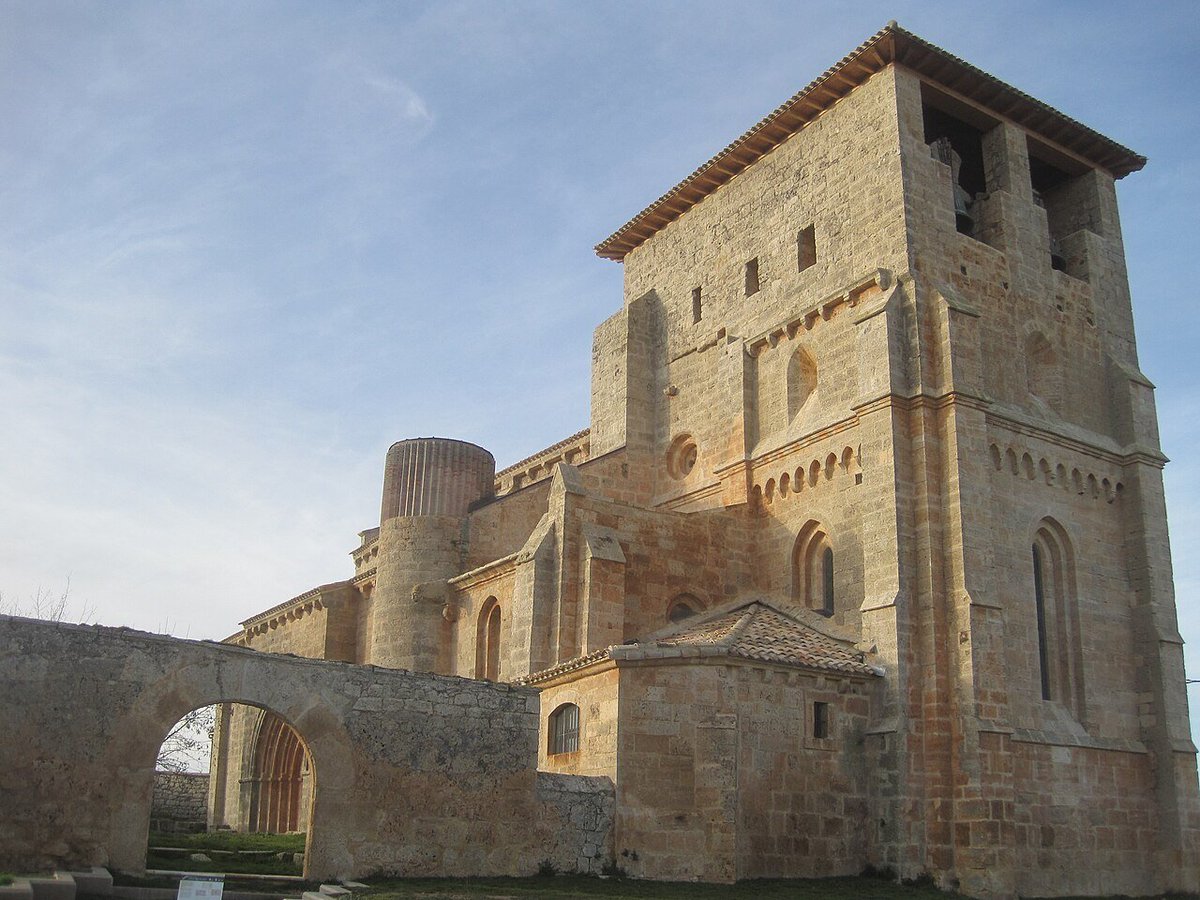
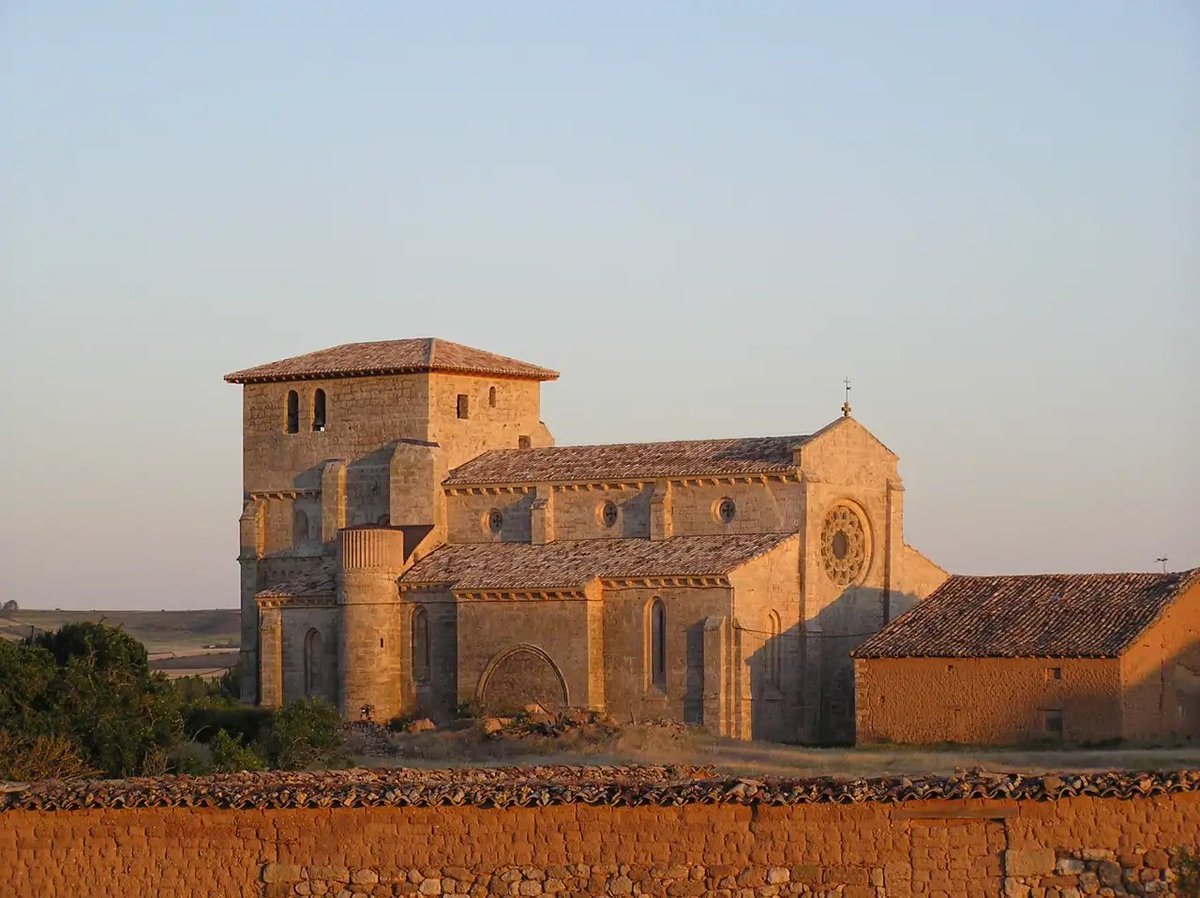
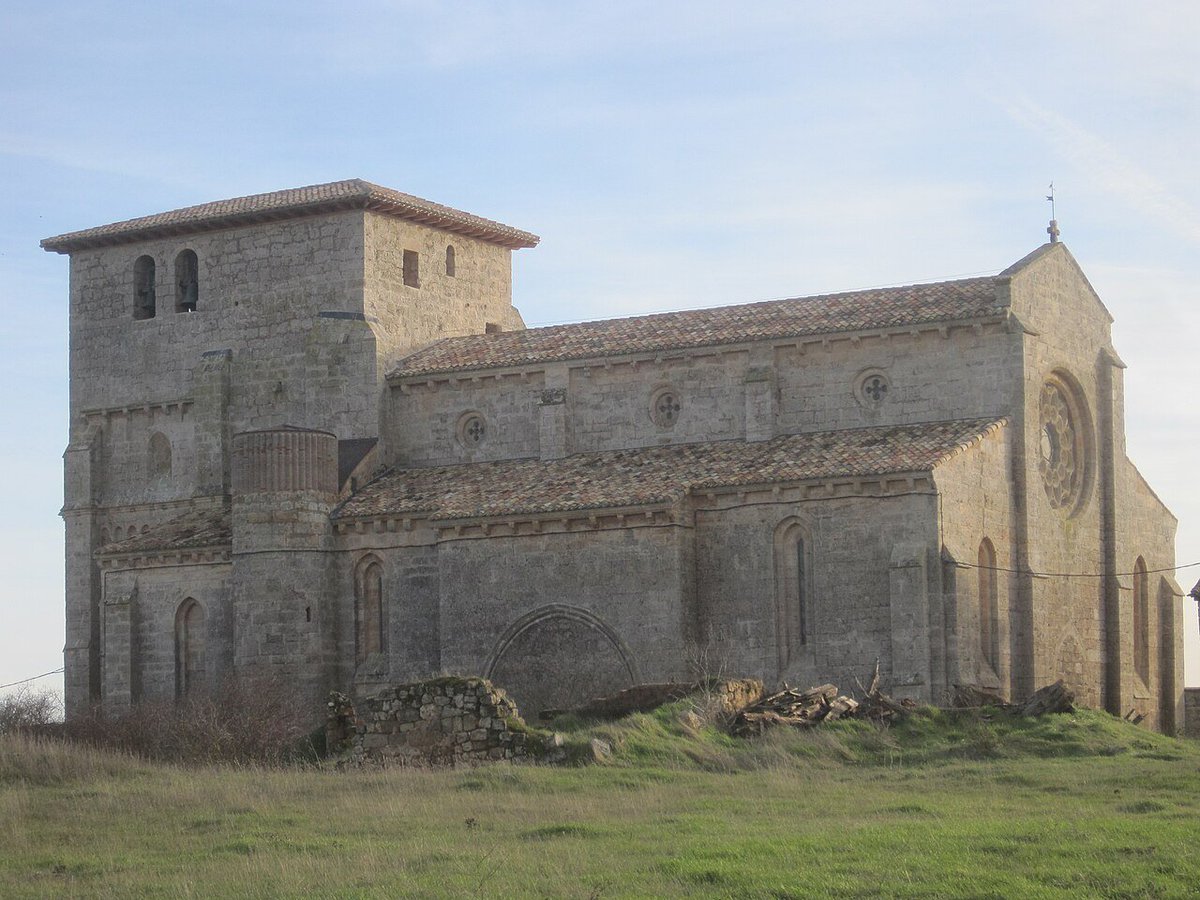
En Villamorón, un pueblecito del oeste de Burgos, vive una sola persona según el padrón. Y en mitad de sus casas hay una iglesia tan grande que en la comarca la llaman la Catedral del Páramo. Se ve desde muy lejos, asomando entre los trigales del llano de Villadiego, con una torre tan maciza que parece la de un castillo. De hecho algo de eso tiene, porque en el siglo XIV la subieron y la reforzaron para poder defenderse desde ella.
Es la iglesia de Santiago Apóstol, del siglo XIII, de cuando el gótico empezaba a llegar a Castilla. La hicieron en piedra caliza, con tres naves y unos pilares rodeados de columnas que se parecen mucho a los de la catedral de Burgos, y en la fachada principal le pusieron un rosetón enorme. Fernando Chueca Goitia, que sabía de esto como pocos, la consideraba una de las tres mejores iglesias góticas de la Castilla de su tiempo, junto con la de Villalcázar de Sirga y la de Villamuriel de Cerrato.
Y hay un dato que a mí me dejó bastante sorprendido cuando lo leí. Después de que Fernando III conquistara Córdoba en 1236, allí se levantaron muchas parroquias nuevas, las que hoy se conocen como iglesias fernandinas, y para hacerlas se tomó como modelo precisamente esta de Villamorón. Media Córdoba medieval tiene algo de este pueblo burgalés que casi nadie sabría señalar en un mapa.
Si pasas por la zona, merece la pena desviarse. En los años setenta, cuando el pueblo se fue quedando vacío, la iglesia estuvo a punto de hundirse, y en 1970 se llevaron a Burgos todo lo que tenía dentro, incluido un Cristo gótico de tamaño natural que ahora está en el Museo del Retablo. Si sigue en pie es gracias a la Asociación de Amigos de Villamorón, que se empeñó en restaurarla, y el trabajo les salió tan bien que en 2024 quedaron finalistas en unos premios europeos de patrimonio religioso. En verano suelen abrirla algunos fines de semana.
LA TORRIJA SIN MIE, ER CHOCO A LA PLANCHA, LA LENTEJA SIN CHORISO, LA CARNE EN SARSA SIN PAN PA MOJA... Y ME COGEN LA FOTO DE ANTE
ES PAR MOSQUEARSE O NO ES PA MOSQUEARSE
🧵 Acabo de pasar una semana arrestado en Benín (acusado de espionaje) y, ya libre, me puedo permitir compartir un hilo con varias conclusiones.
Vamos allá:
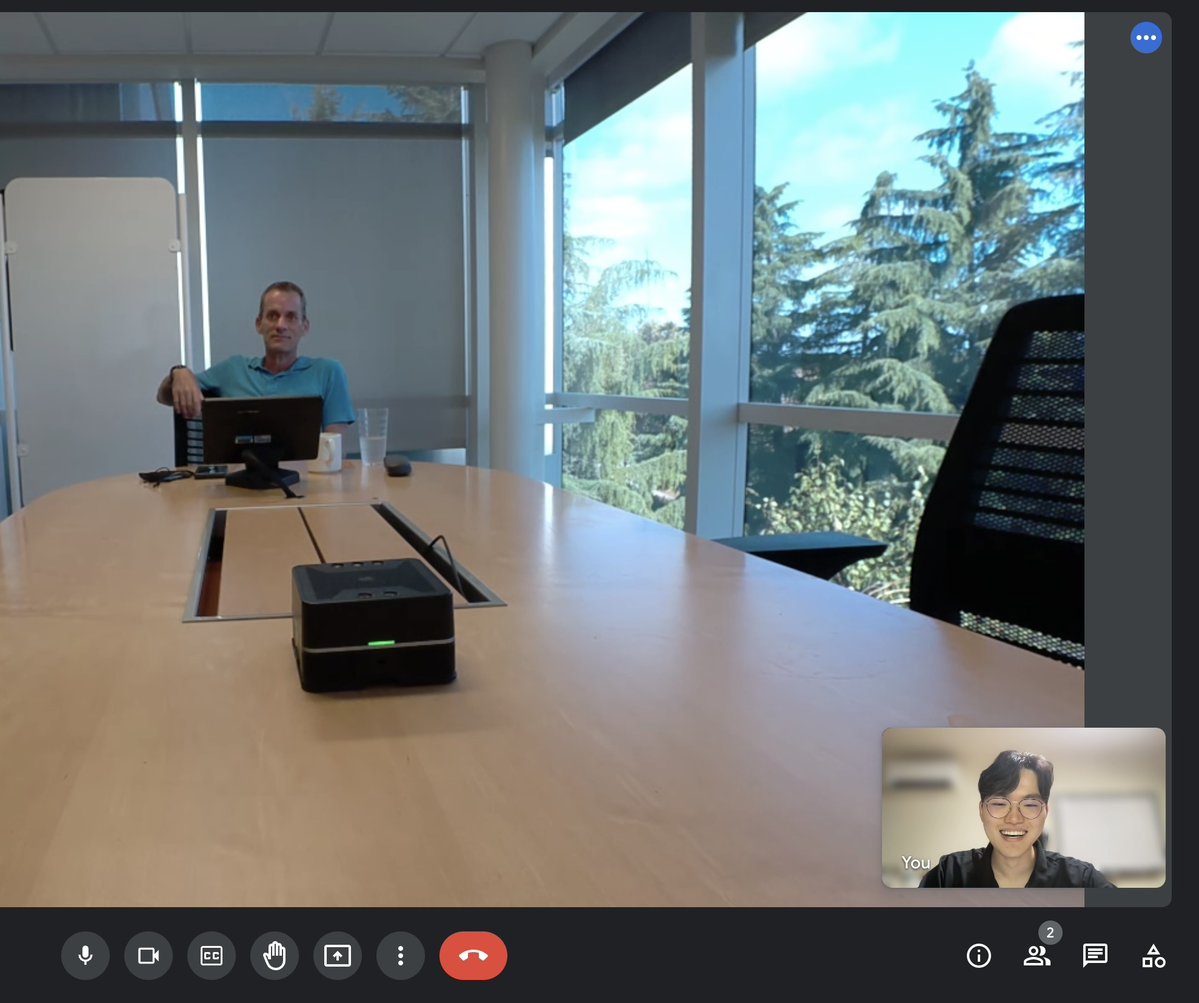
In 2022, as a Google intern, I sent a random calendar invite to Jeff Dean.
He accepted.
His calendar was accessible even to interns, so I figured I had nothing to lose.
The next day, I sent this photo to my team. Everyone was shocked.
It’s hard to imagine Google without Jeff. He’s been one of my biggest inspirations.
Thank you for everything, Jeff.
Estoy viviendo una situación kafkiana con la @ComunidadMadrid. La cuento por aquí a ver si a @IdiazAyuso la lee y se le cae la cara de vergüenza y alguien lo soluciona:
Ayer tuvimos que tirar energía renovable (solar+eólica) equivalente al consumo de 7,5 millones de hogares.
Red Eléctrica sacó del sistema 71.977 MWh de solar y eólica que habían entrado en mercado y tuvo que meter 94.221 MWh de fósiles (fundamentalmente gas) para poder operar el sistema con seguridad.
Todo esto nos costó la friolera de 11.11 millones de € en un solo día. En lo que va de año, las restricciones técnicas diarias ya suman 1.824M€, más del doble de lo que llevábamos en 2025 a estas alturas. Más del doble...
Este botiquinazo de algunas de las estrellas del mundial de 2006 fue el canto de cisne de una época dorada de la nutrición deportiva iniciada por aquella Juve con dorsales rojos, algunas de sus trazas llegan hasta nuestros días.
The math on this image is insane.
New Horizons transmitted at 2,000 bits per second from 3 billion miles away. Slower than a 1990s dial-up modem. It took 16 months to download all the flyby data.
The spacecraft had to hit a target box 100km wide, arriving within 150 seconds of schedule, after 9 years of flight. Miss it and the preloaded observation commands point at empty space.
Ten days before arrival, the spacecraft crashed and went into safe mode. Engineers had 72 hours to restore everything.
The probe is now 5 billion miles out, still whispering data back to Earth. We got 50 gigabits of Pluto photos using technology slower than your phone’s bluetooth.
I chose the green door ninety-three days ago.
At the time, it seemed obviously correct. Not even a close call. The red door offered two billion dollars immediately—a sum so large it would solve every material problem I'd ever face, fund any project I could imagine, and still leave enough to give away amounts that would meaningfully change thousands of lives. But two billion is a number. It has a fixed relationship to the economy, to the things money can buy, to the world.
The green door offered one dollar that doubles every day.
I remember standing there, doing the mental math. Day 30: about a billion dollars. Day 40: over a trillion. Day 50: a quadrillion. The red door would be surpassed before the first month ended, and after that, the gap would grow incomprehensibly fast. Choosing the red door would be like choosing a ham sandwich over a genie's lamp because you were hungry right now.
So I walked through the green door.
The first few weeks were unremarkable. I had a dollar, then two, then four. By day ten I had $512, which felt like finding money in an old jacket. By day twenty I had over a million, and I started getting calls from financial advisors I'd never contacted. By day thirty-one I had crossed the two-billion threshold—officially richer than I would have been behind the red door.
I didn't understand what was happening until around day sixty.
The money, you see, had to exist somewhere. Not philosophically—I mean physically. Digitally. When I checked my bank balance, a computer somewhere had to store that number. And storing the number 2^n requires n bits.
One bit per day. That's it. That's the rate at which my fortune's representation grows. A linear function. Almost comically modest.
But here's what I'd failed to understand about exponential growth: the value doesn't care about the representation. The bits grow linearly. The dollars they encode grow exponentially. And dollars make claims on the physical world.
Day sixty. My balance: 2^60 dollars. About 1.15 quintillion. Roughly 1,000 times the entire global GDP. The number itself required only 60 bits to store—less than a tweet, less than this sentence, trivially small from an information-theoretic perspective.
But money is not information. Money is a claim.
The calls started coming from the Treasury Department. Polite, confused, increasingly frantic. They explained that the M2 money supply of the United States was approximately 21 trillion dollars. I now held about 15,000 times that amount. When I tried to spend any of it—even a tiny fraction—the transaction represented a claim on more goods and services than the entire human economy had ever produced in its history.
"The number in your account," a Treasury official said, "is not meaningful."
"It's in your computer," I replied.
"The computer," she said carefully, "does not understand what the number represents."
Day seventy-five. 2^75 dollars. I could purchase—in principle—roughly 350 million copies of the entire Earth's annual economic output. The representation remained elegant: 75 bits. Nine and a half bytes. I could write my net worth on a Post-it note in binary.
But representations aren't wealth. Wealth is factories, farmland, human labor, time, attention, atoms arranged into useful configurations. And I had laid claim to more atoms than existed.
This is where it gets strange.
The global financial system is, at its core, a system of ledgers. Distributed, reconciled, audited. When the Federal Reserve's systems recorded my balance, and Chase's systems recorded my balance, and the IRS's systems recorded my balance, those numbers had to match. And they did match—trivially, easily, using a handful of bytes each.
But then the systems tried to do things with the number.
Calculate taxes owed. Assess systemic risk. Determine what fraction of GDP was held by a single individual. Run inflation models. Price assets in a market that now included a participant with claims exceeding the value of all other claims combined.
Day eighty-two. The S&P 500 became undefined. Not zero, not infinity—undefined. My proportional ownership of the market, if I chose to exercise it, exceeded 100%. The shares I could theoretically purchase outnumbered the shares that existed. Financial models divide by market cap; market cap now included a term that broke the arithmetic.
Day eighty-five. The International Monetary Fund published a paper titled "On the Representability of Post-Scarcity Claims." It concluded that exchange rates could no longer be calculated because the dollar itself had become paradoxical—simultaneously the world's reserve currency and a unit of measurement that had lost all meaning.
My balance on day eighty-five: 2^85 dollars. Still just 85 bits. About ten and a half bytes.
The representation remained trivial. The reality it pointed to had become impossible.
Day ninety. I tried to buy a coffee.
The transaction failed. Not because of insufficient funds, not because of a technical error, but because the payment system could not determine a meaningful exchange rate. My card represented a claim on approximately 10^27 dollars. The coffee cost $4.50. The ratio between these numbers—the percentage of my wealth the coffee would cost—was so small that it rounded to zero in every floating-point system on Earth. I could not pay because the act of payment required representing a number smaller than any computer could distinguish from nothing.
I offered to pay in cash. I had a twenty.
The barista looked at me like I'd offered to pay with a seashell.
"Where did you get physical currency?" she asked.
That's when I realized: I had broken cash too. The Treasury had stopped printing bills three weeks earlier. Why maintain physical currency when one account holder could—at any moment—claim more dollars than had ever been printed in human history? The symbolic relationship between paper and value had always been a polite fiction, but my existence had made the fiction impossible to maintain.
Day ninety-three. Today.
My balance is 2^93 dollars: approximately 10^28. About 10 billion times the estimated value of all assets on Earth. The representation requires 93 bits. Twelve bytes. Smaller than my name.
The economy hasn't collapsed, exactly. People still trade, still work, still produce. But they've stopped using dollars. They've had to. A currency in which one person holds virtually infinite units is not a currency at all—it's a monopoly ticket that everyone has silently agreed to stop playing with.
I keep thinking about what money actually is. It's not the bits. The bits are trivial; they always were. It's not even the paper or the gold or the entries in a ledger. Money is a shared agreement about who has claims on what. A story we tell together about value and exchange and debt.
I broke the story.
Not through violence, not through fraud, not through any action more dramatic than walking through a door and watching a number tick upward. Just by existing. Just by holding a claim that grew faster than the world's ability to honor it.
The red door offered two billion dollars. A large but finite claim. A claim that fit within the story, that could be exchanged and spent and taxed and inherited. A claim the world could accommodate.
The green door offered something else entirely: a claim that would grow until it consumed all other claims, until the very concept of claiming became incoherent.
I still have the 93 bits. They're sitting on a server somewhere, humming along, doubling quietly at midnight. By next week they'll represent more dollars than there are atoms in the observable universe.
And I still can't buy a coffee.