The Economics Department at Universidad de San Andrés (@EconUdesa) invites applications for full-time faculty positions at all ranks, in all fields of economics. If you're on the market and considering Argentina, please apply at: https://t.co/XuRdaXR710
RTs are welcomed!
🏆 Felicitamos a Genaro Damiani (Mae. 2025), ganador del Premio de Investigador Joven en la LXI Reunión Anual de la AAEP.
🎉 Además, nuestra profesora Jimena Ferraro, junto con Raúl Sosa (Mae. 2024) y Franco Vazquez (Mae. 2024), recibieron una mención especial en el Premio ANCE. ✨📚
@jimesf@raul_sosa2908@VazquezFrancom
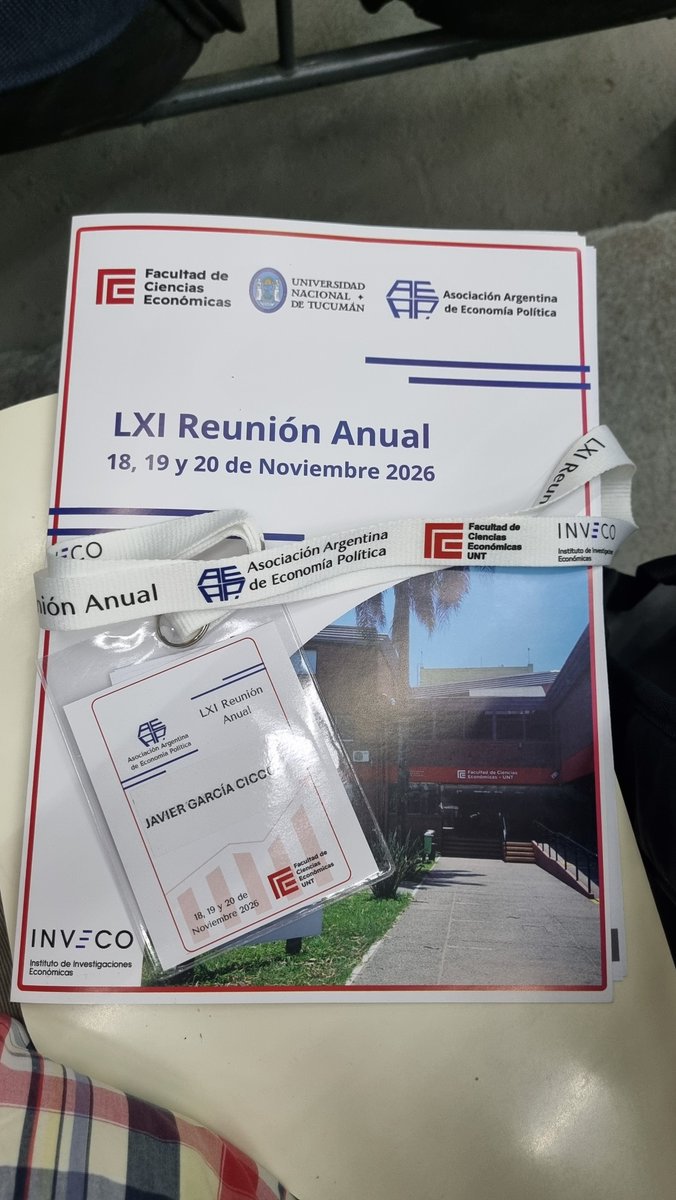
Excelente experiencia en Tucumán, felicitaciones a la AAEP y a la Facultad de Cs Económicas de UNT👏👏👏 Muchísimos asistentes (record histórico de paper presentados) y conversaciones muy interesantes.
Y la banda de UdeSA dijo presente (si cuentan en la foto, éramos 44!)
UdeSA participó de la LXI Reunión Anual de la AAEP, en la Universidad Nacional de Tucumán. 📑
Tres jornadas de presentaciones, debates e intercambio entre docentes, investigadores y estudiantes de todo el país para compartir avances en investigación económica. 🇦🇷📚
María Edo, directora académica del Centro de Estudios para el Desarrollo Humano (CEDH), lidera la agenda de economía de género del centro. Está a cargo de la nueva edición del curso de @RedNIE5, en Tucumán.
"De las preguntas a la evidencia: lecciones desde la economía de género"
Gran arranque de la reunión anual de @AAEPoficial , con excelente organización de la Universidad Nacional de Tucumán. Muchísimos asistentes para 3 días de mucho intercambio académico y social con colegas de todo el país. Felicitaciones a los organizadores!!!
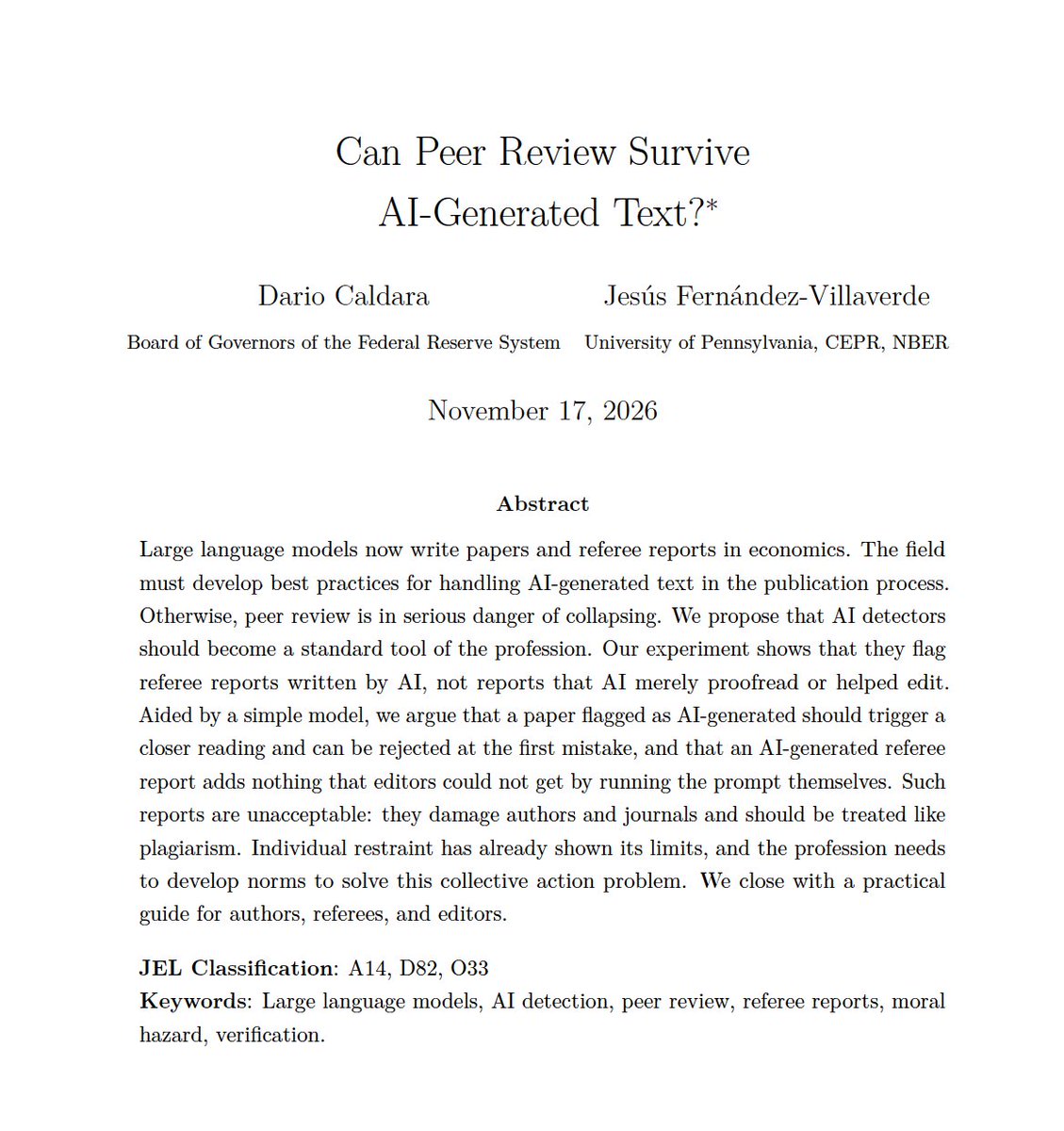
I am sharing a new paper today with Dario Caldara: “Can Peer Review Survive AI-Generated Text?”
https://t.co/lufwMLCu0L
Dario and I, as editors, are increasingly getting papers submitted to our journals that are 99 percent AI-generated. Even worse, we are also receiving many AI-generated referee reports, both as editors and, more frustratingly, as authors.
And we cannot emphasize this enough: the real problem is not that the papers and reports were AI-generated; it is that no one had done the thinking behind them, and you can so easily tell. The papers were eminently forgettable, and the referee reports were disappointingly uninsightful. We have seen too many reports of the form: “The paper is well-written and addresses an important problem. However, the authors should consider additional baselines.”
This deluge of AI-generated text puts peer review in jeopardy: journals will be flooded with low-quality submissions, economists will decline requests to referee papers or routinely use AI to referee them, and which papers get published will become less and less linked to their quality.
We do not want to defend the status quo entirely. Peer review is slow, many reports are poor, and editors (including us!) make bad calls all the time. Still, well-executed peer review remains the best system we have for assessing each other’s work and advancing the profession. AI could improve peer review if used deliberately for that purpose, for instance, to check proofs and code. That is not what we are seeing.
The difficulty is that readers, including editors and referees, cannot see how AI was used. As a result, in practice, the burden of verification shifts from the author to the reader.
Since we reject this shift, Dario and I did what economists always do when something bothers us: we wrote a paper.
So, what do we do in it? First, we check whether AI detectors such as Pangram get this right: is a referee report flagged as AI-generated indeed AI-generated? Or is Pangram just flagging proofreading and editing? No. We run an experiment with 25 referee reports from the pre-AI era. Proofreading and editing do not trigger AI-generated flags. Only when we ask the LLMs to substantially rewrite the referee report or to generate a new report do we get the AI-generated flags. Pretty compelling evidence, if I may say so.
Second, we build a theoretical model to explore who should bear the burden of verification: the author or the reader? (Yours truly always enjoyed the courses on the rules of evidence in law school; yes, as Billy Wilder would say, nobody is perfect.)
The answer is that it is much more efficient for the author to do it, because the author can verify at a much lower cost and only needs to do it once (rather than each reader repeatedly). Before AI, the authors more or less had to verify the results, even if only because they had to type them in. This was not perfect (and all papers ever published in economics probably have at least one mistake). But the problem is that, with AI, the author does not even need to read the text. Or can just skim it. Writing is thinking, and without writing there is usually not much thinking.
So, a paper flagged as AI-generated is prima facie evidence that the author has not verified it. Should this lead to an automatic rejection? No. But there should be a zero-tolerance policy for serious mistakes. The first serious mistake we find in the paper, and it is out! In comparison, for a non-flagged paper, a serious mistake is something that the editor might determine it can be fixed in a revision.
We are stricter with referee reports. There is absolutely no point in the referee generating a report using an LLM. As an editor, I can do that directly and save myself the trouble of asking you for it. Now, of course, you can use the LLM to help you with the report (if the journal allows it! Many journals do not allow you to upload the paper to an LLM, and you need to follow the rules). For example, you can use the LLM to search for existing results in the literature.
But peer review is not about finding one sentence that is not entirely precise or a slightly sloppy mathematical proof. Referees are asked: “Is this idea important despite its flaws?” And, relatedly: “Is the paper a good fit for the journal in terms of quality and focus?” That judgment is the task for which you are selected as a subject expert.
We also propose that journals require that, before a paper is submitted, the author submit it to an LLM using an approved prompt and include the LLM report and a discussion of what was and was not fixed. That way, the referee would not need to check (or at least not check so carefully) every technical detail, and they could focus on the big picture: Is this a good paper? Is this a good fit for this journal? What is fundamental for this paper to become publishable at this journal?
Anyway. The paper has many other arguments, and we try to be nuanced. So, before ferociously typing the first complaint that crosses your mind, would you consider reading it? Chances are that we have already discussed your objection. We have been thinking about this for a long time.
But by all means, leave good comments!
PhD students & early-career researchers: how do you build a successful research programme?
This Expert Workshop with Dr Mimosa Distefano, Prof Henry Overman OBE & Prof Anna Valero will cover developing, funding & managing research.
Register here: https://t.co/b3zRtsMZty
📢 8vo Workshop sobre Economía del Medioambiente y Cambio Climático!!!
🗓️martes 24 de noviembre de 9:00 a 18:30 hs.
📍 UCA Puerto Madero (presencial)
📷programa e inscripción
https://t.co/UbaQvf02Ac
cc:
@elisabelfiori@marianaconteg
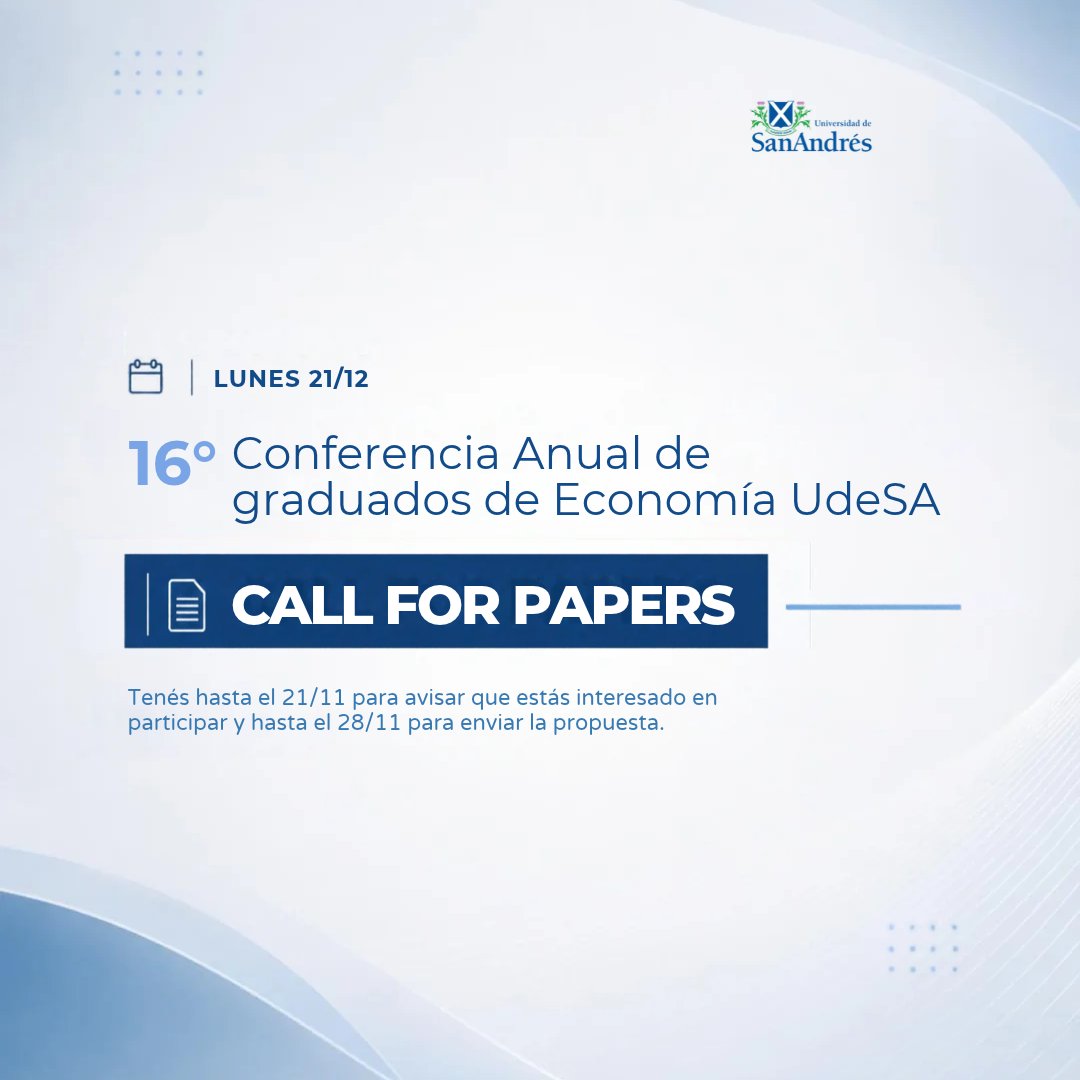
Se acerca el cierre de la convocatoria para la Conferencia Anual de Graduados del Departamento de Economia de UdeSA. No dejen de mandarnos sus trabajos!
16° Conferencia Anual de Graduados del Departamento de Economía de UdeSA.
Invitamos a nuestros graduados a reencontrarnos el lunes 21 de diciembre de 2026, en el Campus de Victoria.
📅 Fechas importantes:
Hasta el 21/11 para confirmar el interés en participar.
Hasta el 28/11 para enviar la propuesta de trabajo.
📩 Enviar las propuestas a [email protected].
@wsosaescudero Y en el mismo handbook dónde está el de newey, a 3 joyitas de time series:
Estimation and inference for dependent processes (J.M. Wooldridge).
Unit roots, structural breaks and trends (J.H. Stock).
Vector autoregressions and cointegration (M.W. Watson).
I was just walking my dog, John Nash, in our quad at the University of Chicago and I ran into a student. Nice chap. I asked him his major and he said “Physics.” I then, of course, asked if he ever thought about an econ major. He basically scoffed, and said "economists aren’t real scientists, they don’t even have laws.” I laughed, ended with a quip, and John Nash and I were on our way.
In economics, I tend to think we have something harder: conditional laws. When I jump out of a tree, gravity doesn’t care which country or at what time of day I jump, it has a wonderful prediction of my velocity when I touch down.
Our regularities, on the other hand, care a great deal about who’s doing the jumping and where and when that jump occurs. Take the endowment effect. This is about as famous as behavioral “laws” get, and was advanced by Danny Kahneman, Dick Thaler, Jack Knetsch, and many others. In my sportscard field experiments, I found that it more or less vanished for experienced traders. I viewed that as a law with really interesting fine print: it is true for some people, in certain situations, and at some doses.
This brings us to the key point. There are two ways we experimentalists can respond to such fine print. We can sulk, and give up by despairing: “nothing generalizes, so why bother?” I prefer a different route. Make the conditions the object of study and be a scientist to understand them.
As I discussed in my recent Nature paper, from the very beginning you should go beyond A/B testing and use “Option C Thinking”. For example, backward induct from where the idea will ultimately live. Conceptualize which people, which situations, and at what dosage. Then, generate the scientific evidence under those conditions from day one. I call this creating policy-based evidence.
So, what was my quip as I left the Physics student? “Interesting point, your particles don’t read the newspaper, mine do. But that is why beyond measuring we social scientists must also read the room. In fact, mapping the conditions then becomes a key addition to our science. Because of that, I tend to think of economics as the harder science.” He just smiled and nodded.
No idea if I convinced him, but the two papers (the endowment effect field experiment and the Nature piece) that I mentioned above are in the first comment if you are open to being convinced about economics as a (harder) science!
@EstanislaoRios@Tommy_E_Murphy@JavierGC14@_martin_rossi@gcruces_@UdeSA Guat? No trabajaria en ninguna universidad en la que no crea FERVIENTEMENTE en mi tarea y en la de mis colegas. Todo lo que yo hago es "chivo" de la universidad que apostó en mi en los ultimos 36 años. Y no estudiaria en ninguna unviersidad con profes que no lo hagan.