"Dejar la vida para que se entienda, como experiencia docente. Que el otro entienda es una apuesta política. Porque sólo entendiendo se toma la palabra, se toma la palabra con conocimiento, con fundamento, se aprende a argumentar, se aprende a debatir." —Maria Cecilia Colombani
We got to the point in which human thinking is considered a waste. While predictable, it's still unfortunate.
@amjad I still want to believe you mean well, but selling the idea of computation in an impenetrable black box is not the path to empowerment.
3M+ lines of "from-scratch" code, yet it depends on:
- Servo's HTML parser
- Servo's CSS parser
- QuickJS for JS
- selectors for CSS selector matching
- resvg for SVG rendering
- egui, wgpu, and tiny-skia for rendering
- tungstenite for WebSocket support
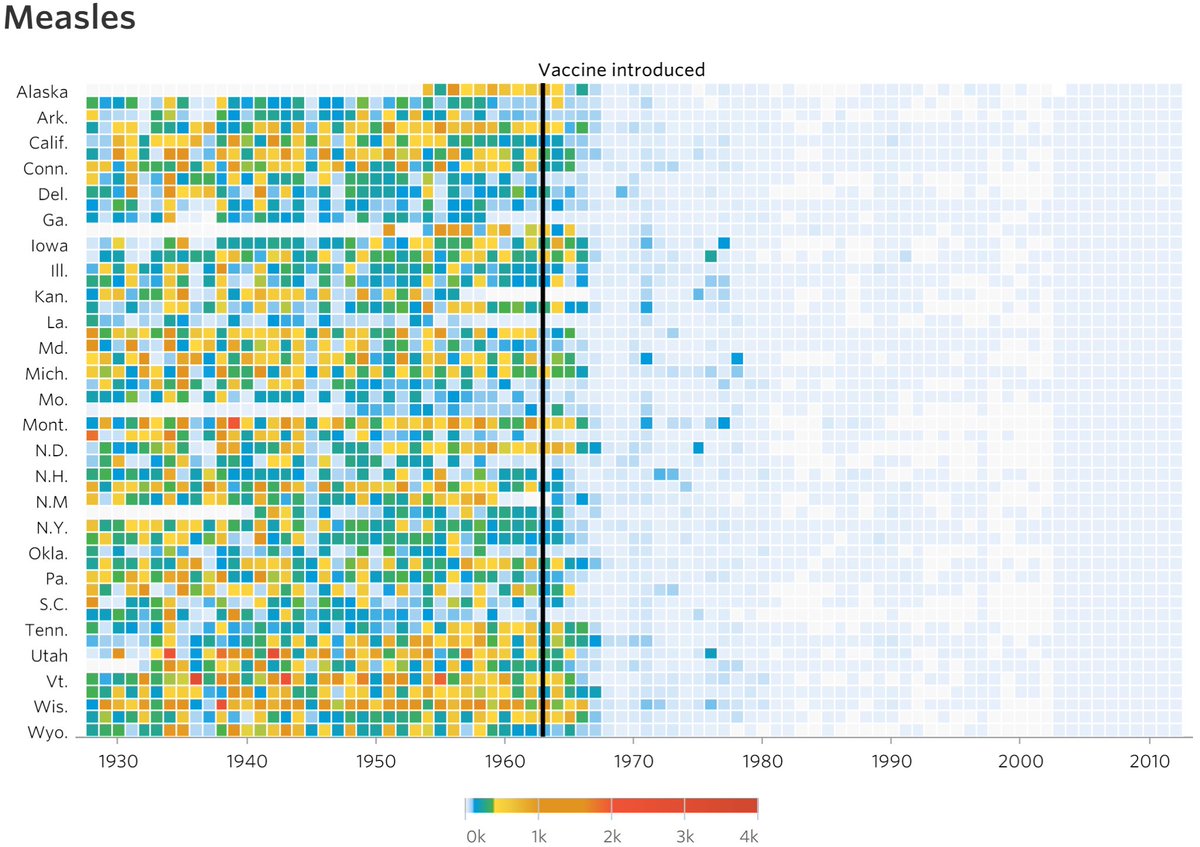
A los más jóvenes que miran videos de Tiktok de influencers antivacunas llenos de teorías conspirativas. Miren estadísticas, vean los datos.
Evolución de los casos de sarampión en EEUU, por estados y por año. Miren que pasa cuando aparece la vacuna y se hace masiva...
Antes de convertirme en un sujeto que no cita a quienes me hacen pensar, aunque sea en disenso, me cacheteo. Cosas que te deja la formación académica: siempre se cita fuente
@msimoni Also, I think there's a tendency to confuse dynamic typing with "weak typing". For example, when JavaScript returns undefined when you try to access a nonexisting property, that's *not* because it's dynamically-typed (it could have raised an exception, for example).
@msimoni I agree. I think one of the problems is that most popular dynamic languages and their environments do not take advantage of the (potential) benefits of being dynamically typed. And, even if some tools do provide some support, the community doesn't make extensive use of them
## AI as teleportation
Here's a thought experiment for pondering the effects AI might have on society: What if we invented teleportation?
A bit odd, I know, but bear with me...
---
The year is 2035. The Auto Go Instant (AGI) teleporter has been invented. You can now go anywhere... instantly!
At first the tech is expensive and unreliable. Critics laugh. "Hah, look at these stupid billionaires who can't spend a minute of their time moving around like the rest of us. And 5% of the time they end up in the wrong place, LOL"
But soon things get cheaper and better. The tech hits mass market.
There are huge benefits. Global commerce is supercharged. Instead of commuting, people can spend more time with family and friends. Pollution is way down. The AGI company runs a sweet commercial of people teleporting to see their parents one last time before they die.
At the same time, some weird things start happening.
The landscape starts reconfiguring around the new reality. Families move to remote cabins, just seconds away from urban amenities. The summit of Mt. Everest becomes crowded with influencers. (It turns out that if you stay just a few seconds, you can take a quick selfie without needing an oxygen mask!)
Physical health takes a hit for many people. It's harder to justify walking or biking when you could just be there now.
In-between moments disappear. One moment you're at work, the next you're at your dinner table at home. No more time to reset or prepare for a new context.
But the biggest change is the loss of serendipity. When you teleport, you decide in advance where you're headed. You never run into an old friend on the street, or stop at a farmstand by the side of the road, or see a store you might want to stop into someday.
To modern teenagers, the idea of wandering out without an exact destination in mind becomes unthinkable. You start with the GPS coordinates, and then you just... go.
Advocates of the new way point out that there's nothing stopping anyone from choosing traditional methods for fun. And indeed, the cross-country road trip does see a mild resurgence as a hipster thing.
But when push comes to shove, most people struggle to make the time for wandering—our schedules are now arranged around an assumption of instant transport.
This isn't exactly to say that the old way was better. Most people can agree that teleportation a net win. Yet for those who remember, there's a vague unease, a sense that something important was lost in the world....
---
In his book Technology and the Character of Everyday Life, the philosopher Albert Borgmann talks about wooden stoves in houses.
What is a stove? Yes, it warms the house... but it's also so much more than that. You gotta cut the wood, you gotta start the fire in the morning...
"A stove used to furnish more than mere warmth. It was a focus, a hearth, a place that gathered the work and leisure of a family and gave the house of a center."
When you switch to a modern central heating system, you cut out all these inconveniences. Fantastic!
Oh, and by the way, your family social life is totally different..... wait what?? Yes, the inconveniences were inconvenient. But they were also holding up something in your life and culture, and now they're suddenly gone.
I think of this as kind of a Chesteron's fence on hard mode. Yes, the stove was put there for warmth, that was the main goal. But you should also think hard about its secondary effects before replacing it.
---
OK so... how does this apply to AI?
I'm personally excited about AI and think it can improve our lives in a lot of ways. But at the same time I'm trying to be mindful of secondary effects and unintended consequences.
Here's one example. If your mental model of reading is "transmit facts into my head", then reading an AI summary of something might seem like a more efficient way to get that task done.
But if your mental model of reading is "spend time marinating in a world of ideas", then reducing the time spent reading doesn't help you much.
The point was the journey you underwent while reading, and you replaced it with teleportation.
Another example. One of the great joys of my life is having nerdy friends explain things to me. Now I can get explanations from AI with less friction, anytime, anywhere, with endless follow-up.
Even if the AI explanations are "better", there's a social cost. I can try to mindfully nudge myself to still ask people questions, but now it requires more effort.
Final example: I'm trying to be mindful of the effects of vibe coding when designing software interfaces. On the one hand, it can really speed up my iteration loop and help me explore more ideas.
But at the same time, part of my design process is sitting with the details of the thing and uncovering it as I go—more a muscle memory process than a conscious plan. Messing with this process can change the results in ways that are hard to predict!
I guess the throughline for all of these examples is: sometimes the friction and inconvenience is where the good stuff happens. Gotta be very careful removing it.
---
The takeaway here isn't that "AI is bad". I'll just say that I'm personally trying to be mindful about keeping good friction around.
During COVID, we kinda got teleportation via Zoom for a while. I decided to "virtual commute" every day, walking around the block to get some fresh air and a reset before/after work. This wasn't a big deal but I found it really helpful.
As AI makes a lot of things easier, it'll be interesting to ponder what kinds of new frictions we'll want to intentionally add to our lives. Teleportation isn't always the best answer...
It really does not need to be like that. there is no reason why we should relinquish our ability to understand.
The assumption here is that we must read to understand code. That's not needed. In fact, reading is the problem regardless of how the code was created.
Instead, we can get computers to view the code for us in exactly the way we want to see it. For every single problem, a dedicated view.
There is no reason why we should apply this idea only to end-user interfaces. We can apply it throughout the system. And this changes the meaning of programming.
A QA engineer walks into a bar. Orders a beer. Orders 0 beers. Orders 99999999999 beers. Orders a lizard. Orders -1 beers. Orders a ueicbksjdhd.
First real customer walks in and asks where the bathroom is. The bar bursts into flames, killing everyone.
Does astrology work? We tested the ability of 152 astrologers to see if they could demonstrate genuine astrological skill.
Here is how the study was designed and what we found (including a result that really surprised me):
🧵
@BartoszMilewski e.g. you can represent the conceptual state changes as a series of immutable "snapshots", and so on.
Either way, programming languages should give you tools to represent those "domain rules" while being efficient, safe, etc. on the computational aspects of the resulting program.