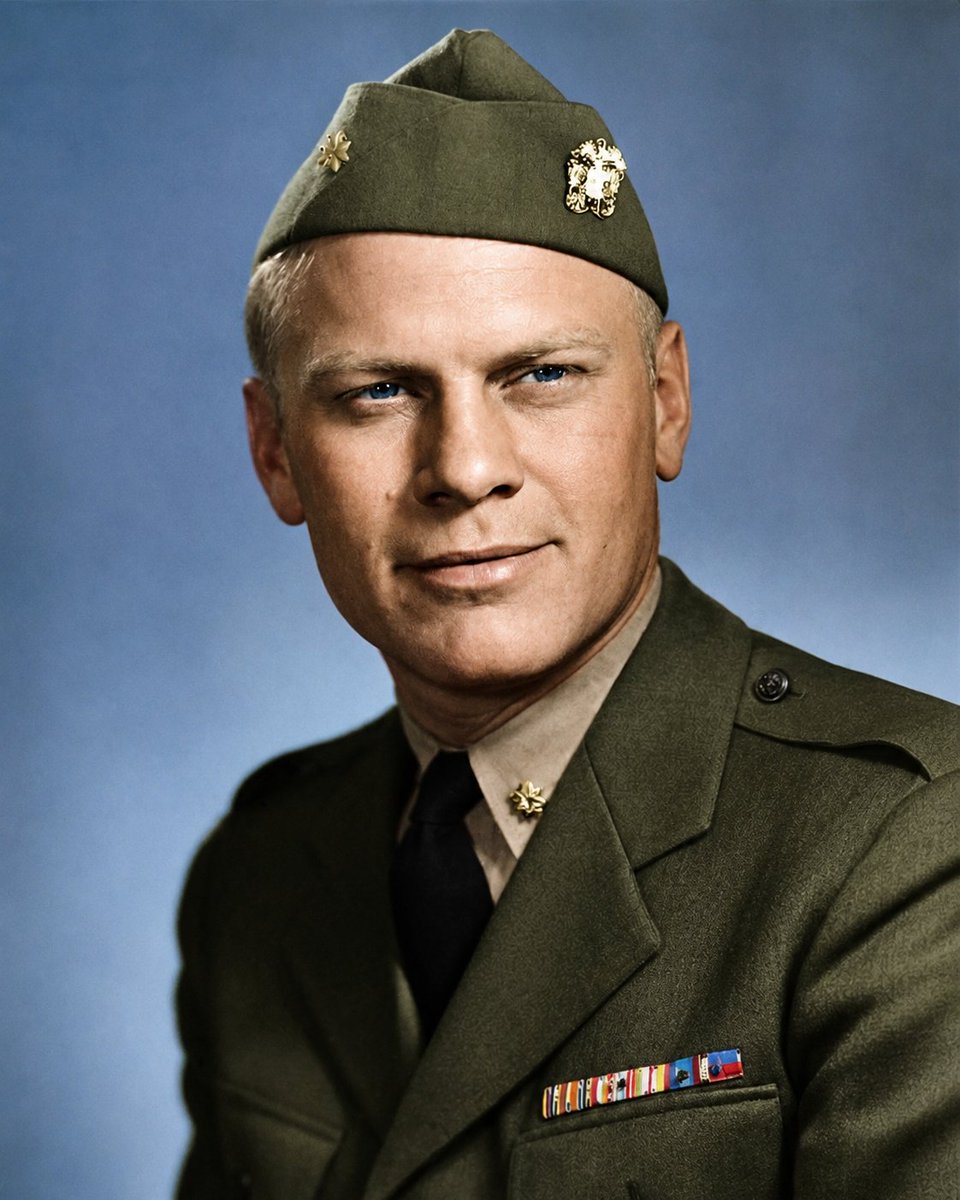
Gerald Ford is the president America remembers as a klutz. Chevy Chase built a career on it. He fell down the stairs of Air Force One once and it followed him to the grave.
The man was probably the best athlete ever to hold the office. Starting center on Michigan's back to back national championship teams in 1932 and 1933, team MVP in 1934, and he turned down contract offers from both the Packers and the Lions to go be a coach and read law at Yale.
Then there is the fall nobody talks about.
December 1944. Ford is a lieutenant aboard the light carrier USS Monterey, somewhere east of the Philippines, when Halsey's Third Fleet sails into the middle of a typhoon. Not near it. Into it. Winds over 100 knots, seas the sailors describe as mountains, visibility zero. Three destroyers roll over and sink that night and roughly 790 men die. It remains one of the worst disasters in the history of the US Navy and no enemy was involved.
On the Monterey the aircraft break their tie downs. Loose planes, full of fuel, sliding around a closed hangar deck in the dark, striking sparks. The hangar catches fire. General quarters sounds and Ford heads for his station on the bridge, crossing the flight deck of a small carrier in a typhoon at night.
The ship rolls about 25 degrees. His feet go out from under him and he starts sliding toward open water.
What saves his life is a steel lip maybe two inches high running along the edge of the deck. It catches him just enough to spin him and drop him into the catwalk instead of over the side. In a sea like that, nobody would have found him. Nobody would have even known.
His own line about it later: I was lucky. I could have easily gone overboard.
He got up and went below to help fight the fire. Men died in that hangar. They saved the ship, barely. Monterey was so badly burned she had to be pulled out of the war entirely and sent back for repairs. Ford finished the war having gone from a physical fitness instructor who begged for sea duty to an officer aboard a carrier that collected 11 battle stars, and he left the Navy in 1946 as a lieutenant commander.
Thirty years later a comedian made him a national punchline for tripping.
The one time it actually mattered, he caught himself on two inches of steel in a hurricane, then walked into a fire.
"Kathy Hochul cares about the environment! She just put a moratorium on data centers."
Here's a quick political science 101 on what Ms. Hochul is up to by pandering to the emotions around data center build-outs nationwide right now.
Firstly, New York State doesn't have the power to support data centers. Why? Starting in 2019, to justify the Climate Act, we took over 2,000MW of reliable (nuclear) energy offline to create a "climate crisis" that they claimed we needed wind and solar to "fix."
It's why this same woman has asked you to set your thermostat to 78 this summer. It's also why there's a bill in our state senate as we speak that would give the state the right to CONTROL your thermostat.
Instead of admitting they tanked our grid as part of the green energy grift, Ms. Hochul is painting herself as a "savior from data centers" today.
This woman is also up for re-election in November. Her opponent, @NassauExec, is gaining traction on her while also outwardly proclaiming he is against ORES and what Hochul has done to our home rule.
@KathyHochul admitted for the world to see yesterday that she has the power to STOP and DISSOLVE the Office of Renewable Energy Siting at any time. But she won't. The kickbacks, foreign corporate deals, and subsidies and credits with solar and wind are worth the risk for her.
Thousands of acres of designated habitat, bald eagle nesting sites, state endangered species nesting habitat, wetlands, imperiled grasslands, and USDA prime farmland are locked up into ORES solar and wind contracts forced on our towns.
She doesn't care.
She's playing politics 101, painting herself a savior to a problem that our state can't support anyway. And it's all due to the 2019 Climate Act religion.
I can't believe this is real.
The Chancellor of UC San Francisco testified under oath that a "vast majority of pregnancies are in women." Implying some pregnancies occur in men.
When asked directly whether a non-biological woman has ever had a baby, he refused to answer. This is the head of one of the top medical schools in the country.
Mark Zuckerberg, an outspoken critic of "man-made climate change", shows off his new $300,000,000, 287-foot mega yacht, powered by four gigantic diesel engines.
Yet another stark reminder that Net Zero is only for the peasants
Patient: "What are the side effects of the statin?"
Doctor: "Some people get muscle aches. Usually mild."
Patient: "And if I get them?"
Doctor: "We'd add naproxen for the pain."
Patient: "Does naproxen have side effects?"
Doctor: "It can irritate the stomach. Reflux, sometimes an ulcer. So we'd add omeprazole to protect it."
Patient: "And omeprazole?"
Doctor: "Long term it lowers your magnesium. Your B12 as well. We'd top those up."
Patient: "With more tablets."
Doctor: "Magnesium, and B12 if the bloods come back low."
Patient: "And the magnesium does what?"
Doctor: "Loosens the bowels. Loperamide settles that."
Patient: "That's six tablets. I walked in with no symptoms."
Doctor: "Could be seven. The statin can raise your blood sugar. We'd watch it, maybe start metformin."
Patient: "And metformin?"
Doctor: "Upsets the stomach. Lowers your B12."
Patient: "We already did B12."
Doctor: "Round we go."
Patient: "Is a single one of these treating something I actually feel?"
Doctor: "No. But your numbers will look excellent."
@THEDuaneCates@VoicesofWW2 No, Gen Theodore Roosevelt Jr was played by Henry Fonda. Robert Mitchum played Gen Norman Cota.
Gen Cota landed on Omaha beach with the second wave an hour after the first wave. Roosevelt landed on Utah Beach with the first wave.
On this day in 1944, Theodore Roosevelt Jr. died in his sleep in a stone farmhouse in Normandy. He was 56 years old, and he had spent almost his entire adult life trying to be worthy of a famous last name.
He was the eldest son of President Theodore Roosevelt. In the First World War he went to France and was gassed and badly wounded at Soissons leading his men. That same summer his younger brother Quentin, a pilot, was shot down and killed over France. Ted came home with lungs and a leg that never fully recovered, and before he even left Europe he helped found the American Legion so that ordinary soldiers would have someone looking out for them.
Between the wars he did almost everything. Governor of Puerto Rico. Governor General of the Philippines. Businessman, explorer, writer. He could have spent the Second World War safe behind a desk. Instead, at 54, arthritic and walking with a cane, he talked his way back into uniform and into combat.
By 1943 he was fighting in North Africa and Sicily under Terry Allen, and their loose, unpolished, soldier-first style rubbed General Patton the wrong way. Patton had them both relieved of command. Roosevelt didn't sulk. He asked for another job, any job, as long as it kept him near the fighting. They made him assistant commander of the 4th Infantry Division.
Then came D-Day. He hid a heart condition from the Army doctors. He wrote to his commander three separate times, in writing, begging to go in with the very first wave rather than watch from a ship. He was the only general to land in the first wave on any beach that morning, the oldest man in the invasion, walking through machine gun fire with a cane in one hand and a pistol in the other.
The boats came in a mile off course. Officers froze. Roosevelt limped up and down the beach under fire, studied the ground, and said, "We'll start the war from right here." Then he spent the morning waving men forward and sorting out the chaos so calmly that terrified 20 year olds looked at this old man with a cane and decided that if he wasn't scared, they wouldn't be either.
His son Quentin, named for the uncle killed in the last war, landed at Omaha Beach the same morning. They were the only father and son to come ashore together on D-Day.
He died a month later. A heart attack in his sleep. And here is the part that gets me. On the very day he died, the orders had just come through promoting him to major general and giving him his own division. He never saw the paperwork. He never knew he'd earned the Medal of Honor either.
At his funeral his pallbearers were seven of the most famous generals of the war, Bradley, Hodges, Collins, Barton, Huebner, and George Patton. The same Patton who had fired him. Patton wrote in his diary that Roosevelt was one of the bravest men he had ever known.
Years later Omar Bradley was asked to name the single most heroic thing he witnessed in all of World War II. He didn't pause. He said, "Ted Roosevelt on Utah Beach."
The governor of Oklahoma raises a glass of raw milk to a camera in 2026, takes a swig, and tells the state it tastes like freedom.
He had just signed a law lifting the cap on how much unpasteurised milk a farm can sell directly to the public, from a hundred gallons a month to fifteen hundred, and making it legal to advertise the stuff. Oklahoma is one of a run of states pulling raw milk back out of the shadows. And every time one does, the same warning goes up: this was banned for a reason, have you forgotten why.
So it is worth remembering exactly why. The real reason has been quietly mislaid.
In the growing American cities of the mid-1800s, milk became a genuine killer, and the reason was an industry. Distilleries producing whiskey had a hot, sour waste left over called swill, and someone worked out you could feed it to cows packed into sheds right next to the still. The animals lived in filth, diseased and dying on their feet, and gave a thin bluish milk so poor it was doctored with chalk, plaster and molasses just to pass for milk. This swill milk poured into the cities and killed infants by the thousand. That was the scandal that built the case for pasteurising milk and regulating dairies, and it was a fair case against that milk.
Here is the part that got quietly folded in. The same wave of law that rightly killed off the distillery-slop dairies also swept up the clean stuff: milk from healthy cows on grass, on small farms, drawn into clean pails. All of it got tarred with the swill-dairy brush and pushed toward the same ban. And once the big pasteurising plants and the consolidated dairies were built, keeping the small raw producer locked out stopped being about disease at all. It became about who was allowed to sell milk.
The filthy urban swill dairy vanished a century ago. The suspicion it earned got pinned, permanently, onto a farmer selling clean milk from healthy cows at his own gate.
They banned the milk of dying cows fed on distillery waste, which was right, and then kept the ban aimed at the farm down the lane, which was never the problem.
To those who refuse to rent to dog owners, who complain about dogs on beaches, and who ban them from public spaces:
You restrict where my dog can live, walk, and travel. You treat them as a nuisance, an inconvenience to your perfect world.
Yet this same dog will search through earthquake rubble to find you. Will track you when you're lost in the mountains without a map. Will dive into dangerous waters when you ignore the red flags. Will brave freezing snow when you venture off-piste against all warnings.
Because despite your prejudice, my 'mere dog' will risk everything to save you.
Dedicated to those who fail to see the true value of dogs.
@SamaHoole I think I've started to freak people out with my appreciation for cows. They give me funny looks...
I figure that's about the right level of reverence.
The cow runs on rain. The lab-grown version runs on imported sugar.
The cow builds soil as it walks. The bioreactor fills a skip with single-use plastic.
The cow makes its own replacement for nothing. The startup needs another funding round.
The cow carries every amino acid you're built from. The oat drink has them added back from a drum.
The cow grazes a hillside where nothing else grows. The almond drains a Californian river to fill a carton.
The cow has fed people for ten thousand years. The alternative has a launch date and a burn rate.
Six thousand years ago someone worked out you could keep one instead of chasing it.
That was the last upgrade the technology needed.
And it's the one thing we're now told to get rid of.
Now is the time for MASSIVE action. Sign the petition to DEMAND a Constitutional Amendment ending birthright citizenship for illegal invaders. Add your name TODAY. ⬇️
And here it is:
Remember the $24 billion in homeless money Gavin Newscum supposedly “lost”?
No, it wasn’t. It was funneled to some of the most profitable organizations on the planet: NGOs.
Democrats gave an NGO $23 million.
The NGO used it to buy:
A mansion in Los Angeles
A $125,000 Land Rover
A second home in Greece
How was it exposed?
Bill Essayli
United States Attorney for the Central District of California.
He has identified 12 more NGOs across California that are under investigation for similar fraud.
📝 In other words: This is how U.S. NGOs have amassed $14.2 trillion in assets—an amount equal to roughly half of the U.S. national debt.
Doctor: "Your blood pressure's a touch high. We'll call it hypertension."
Patient: "It was fine last year."
Doctor: "The threshold changed."
Patient: "My blood pressure changed?"
Doctor: "No. The number we call high changed. Used to be one-forty. Now it's one-thirty."
Patient: "So the same reading that was healthy in 2016 is a disease now."
Doctor: "That's the current guidance."
Patient: "Who moved the line?"
Doctor: "A panel."
Patient: "And what happens the day I cross it?"
Doctor: "We'd start you on something."
Patient: "Forever?"
Doctor: "Typically, yes."
Patient: "So a committee lowered a number, and now I'm a customer for life."
Doctor: "I wouldn't put it like that."
Patient: "How would you put it?"
#OTD in 1952, USS Sea Poacher (SS-406) performed a unique submarine-to-airship rescue when it towed the disabled K-86 blimp and its 10-man crew for 40 miles to NAS Key West.