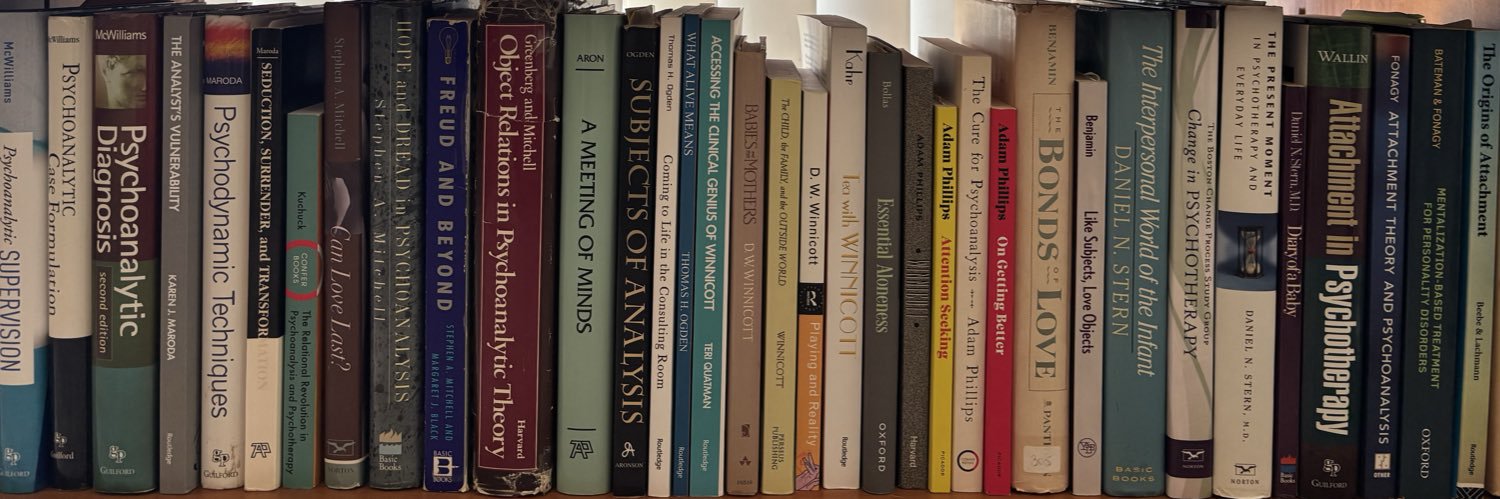
When psychotherapists are more able to inhabit the fullness of themselves, spontaneity may manifest primarily internally, in restraint, listening, and fantasy. We bear, survive, invite, and cultivate beyond words. We communicate our aliveness and presence without needing to talk.
“A child does not just ‘have’ an Oedipus complex. Externally and internally the child inhabits the complex. In like manner, to say that a patient ‘has’ a transference to an analyst is thin shorthand for the experience of the transferential world in which…”
“If analysts’ listening does not stir up in them issues of their own which require analytic work within themselves, then they are in some way defending themselves against the power of a patient to disturb their equilibrium, and thus against the meaning of the analytic encounter…
start to finish of an analyst’s working life.
— Michael Parsons
Living Psychoanalysis, “The Analyst’s Countertransference to the Psychoanalytic Process”
“Anyone who embarks on becoming a psychoanalyst is driven by deep personal motivations, conscious and unconscious. The practice of psychoanalysis, and the nature of the involvement that the work entails, are bound to evoke deep reactions. This remains true from…”
Psychoanalysis just has to survive “the psychoanalytic movement.” If it survives psychoanalyst and their schools, then it will grow and develop. But this remains to be seen.
— Christopher Bollas (1997)
True then, true now.
"There is perhaps no phenomenon which contains so much destructive feeling as 'moral indignation,' which permits envy or hate to be acted out under the guise of virtue."
—Psychoanalyst Erich Fromm, 1947
“In so far as each function has a function the term ‘function’ is used as the name for a set of actions, physical or mental, governed by or directed to a purpose.”
For anyone interested in how reading Bion (Elements of Psychoanalysis) is going…
“It will be a ‘central abstraction unknown because unknowable’ but adumbrated, in an impure form, by its verbal representation.”
Training Analyst (Bionian): “Winnicott doesn’t really have a model of mind.”
Supervising Analyst (Winnicottian): “To me, Winnicott has the most intricate and deep model of mind of any psychoanalyst.”
This is is not a study of mentally healthy people. This is a study of people who SAY they are mentally healthy on questionnaires. Big difference.
Sadly, the social psychologist researchers never considered the role of denial and other reality-distorting defenses. Huge blind spot.
The correct interpretation of the findings is that people who are delusionally optimistic are also dellusionally optimistic when they fill out mental health questionnaires.
Instead of recognizing the obvious, the researchers instead made the assumption that their questionnaires measured the unbiased, objective truth.
This is the kind of blind spot we see when studies are done by academic researchers who have never treated a patient in their lives.
analysand. When a formulation is more ambiguous, the analyst is able to see how the analysand takes it up—that is, what the analysand reads into it.
— Bruce Fink
A Clinical Introduction to Lacanian Psychoanalysis
“But when an analyst knows relatively little about an analysand, he or she should avoid unambiguous formulations; the more direct a formulation is in the early stages of treatment, the more likely the analyst is to be barking up the wrong tree and for that to be plain to the…”