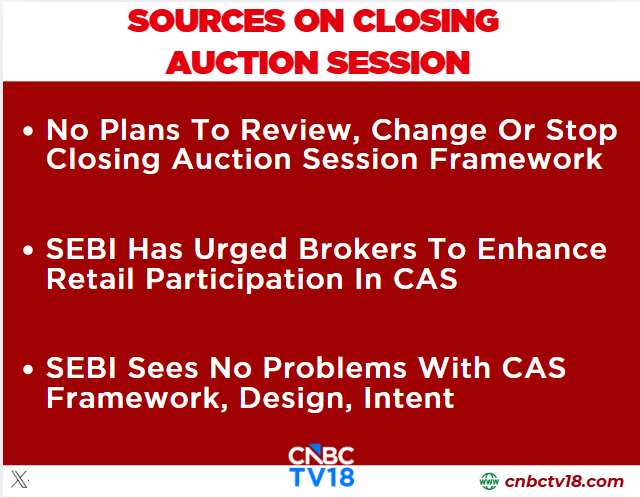
#JustIN | No plans to review, change or stop closing auction session framework; #SEBI has urged brokers to enhance retail participation in CAS : Sources to @YashJain88
Auction based closing prices went live on Indian exchanges yesterday. It is being reported as India catching up with global practice, which is true but incomplete.
The call auction has been part of the Indian cash market since 2010, and a closing call auction reached SEBI's Board in March 2013. What went live yesterday completes a project that stalled for eleven years, and the reasons it stalled explain most of the design.
A thread on the regulatory history. 1/11
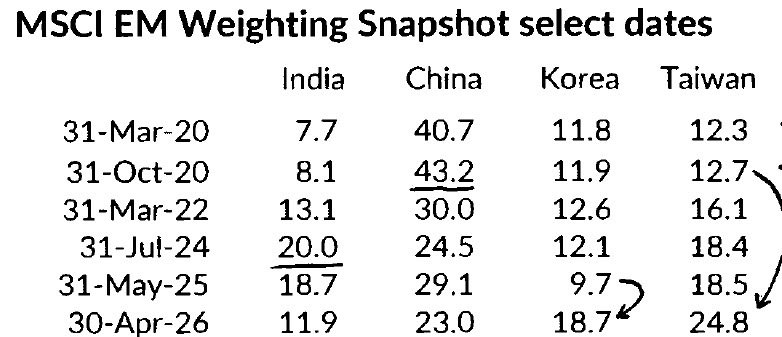
Korea + Taiwan 43% of EM index.
1% of world population and
2.5% of world GDP (PPP basis)
India + China now 35% of EM index.
35% of world population.
29% of world GDP (PPP basis)
Two massively profitable companies going ipo in India. Two massively loss making cos going ipo soon in the US after another loss making co that's just gone public. We live in interesting times.
How co-location robs the retail investor
Here is the breakdown of how co-location allows an entity to arbitrage a retail investor on a single exchange. Arbitrage across multiple exchanges is even simpler.
Imagine a stock is trading on a single exchange with a bid-ask spread of ₹100.00 – ₹100.01.
•The Retail Investor has a passive limit order to buy 100 shares at ₹100.00.
•The Co-located HFT Firm acts as a market maker, also quoting a passive buy order at ₹100.00, but their server is inches away from the exchange engine.
Suddenly, a major market-moving event occurs (e.g., an institutional algorithm dumps a massive sell order, or a highly correlated futures index moves downward). The true economic value of the stock instantly drops to ₹99.95.
The Dual-Timeline Race
1.Information Ingestion Gap:
The exchange updates its data feed. The co-located HFT server receives this raw direct feed, processes it, and reacts in microseconds (less than 10^(-6) seconds). The retail investor relies on a standard broker internet feed, which takes milliseconds (10^(-3) seconds) to display the price drop.
2.The "Sniping" or Cancel Race:
Knowing the stock is now worth only ₹99.95, the HFT firm needs to pull its own buy orders at ₹100.00 to avoid losing money. Simultaneously, the HFT firm aims to sell to any other stale buy orders sitting at ₹100.00.
oHFT action: Its co-located server fires an ultra-fast cancel request for its own bids and flashes a sell market order at ₹100.00.
oRetail action: The retail investor is entirely unaware the market has moved. Their buy limit order remains sitting passively in the order book at ₹100.00.
3.Serial Processing & Adverse Selection:
Because the exchange matching engine processes requests serially, the HFT's orders arrive first.
oThe HFT successfully cancels its own risk.
oThe HFT's aggressive sell order hits the queue before the retail investor can ever realize what happened or send a cancel request.
oThe Fill: The matching engine executes the HFT’s sell order against the retail investor's stale buy order at ₹100.00.
The Arbitrage Outcome
The retail investor is adversely selected (often called being "sniped" or "picked off"). They just bought a stock for ₹100.00 that the market already values at ₹99.95. The co-located HFT firm pockets a riskless ₹0.05 per share arbitrage profit within the exact same exchange, purely by exploiting the latency asymmetry.
Mechanisms of Advantage:How Co-location Makes it Possible
Queue Priority Optimization: When multiple orders enter the matching engine at the exact same price, the exchange breaks the tie using Time Priority. Co-location guarantees the HFT's packet hits the engine first, capturing the top spots in the queue.
Direct Binary Feeds: (OUCH/FIX protocols)Co-located entities don't use web APIs or visual platforms. They receive raw binary data directly from the exchange core and bypass standard operating system delays using hardware like FPGAs (Field Programmable Gate Arrays).
Bypassing the "Noisy Internet":A retail order must battle public internet routing, ISP congestion, and broker risk-checks. A co-located order travels over dedicated, internal exchange fiber lines with zero external interference.
If the market has not reacted positively after such big announcements and concessions by the guv. and the govt., it just shows that it is under the full control of the 'market making' algos!
@devinamehra Devina very well summed up..., yes one has to dance till music stops but at what % and what to do with the balance investment, cause when AI bust if it than wont that have impact on every stocks initially
@dmuthuk Sir look at gross number friday fpi net sale 5518 cr but gross purchase by fpi 28496 cr and gross sale 34014 cr....who are these 28 k cr purchase or it is the aame guys, algo guys to know the real reason check gross number every day
@elonmusk Sir one thought with Humanoid robot able to precision thing like shaving then why do we need FSD , any normal car Humanoid Robot shld be able to drive...
@deepakshenoy@Nithin0dha Lot of this was not allowed , some bank interpreted and did this most major psu banks or hdfc never allowed this. On margin it was suppose to evaluate the corporate gurantee...most of the intermediaries wld fail test of say hdfc or some psu banks...
@Nigel__DSouza@CNBCTV18Live Nigel , look fwd to this post but cash market can you add gross number ie fii purchase no and fii sale no that gives diffrent story than general india high valuation