How well can LLMs mimic human behavior in playing games? What is revealed by the prompts needed to generate different behaviors? They reveal quite a lot:
https://t.co/KekZ9hqUdB
just published open access with @yutxie@meiqzh@walteryuan
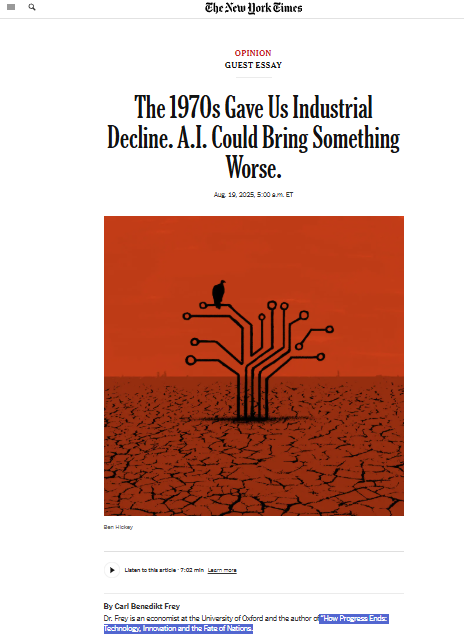
My guest essay in @nytimes today. I make 5 key points:
1. There’s little clear evidence of AI eliminating jobs at scale yet. But waiting to see is risky. Pittsburgh’s steel towns saw early signs with mini-mills before the losses showed up. Service capitals like London and New York should prepare now rather than after the shock.
2. Diversification helps—but only so much when the disruptor is a general-purpose technology. Being “in many industries” isn’t a shield if the same tool touches them all.
3. High-skill, knowledge jobs have big local multipliers. Each manufacturing job supports 1.6 local jobs; each high-skill tech/professional role supports 5. That means even modest losses of analysts, developers, or paralegals can ripple through restaurants, retail, and transit systems.
4. AI needn’t fully replace workers to matter. It only needs to make work easier. As location and experience matter less at the margin, more work will offshored to cheaper places (e.g. India, UAE, or Philippines).
5. The lesson from deindustrialization isn’t inevitability—it’s reinvention. Detroit poured resources into legacy industries and still declined. Boston repeatedly bet on talent, education, and new sectors.
1905, 1985 and 2025: Over 120 years of photography development in three images.
On #WorldPhotoDay, take a look at these three different vistas of the same Bell Tower in New College. What is different? What has stayed constant? What do you notice?
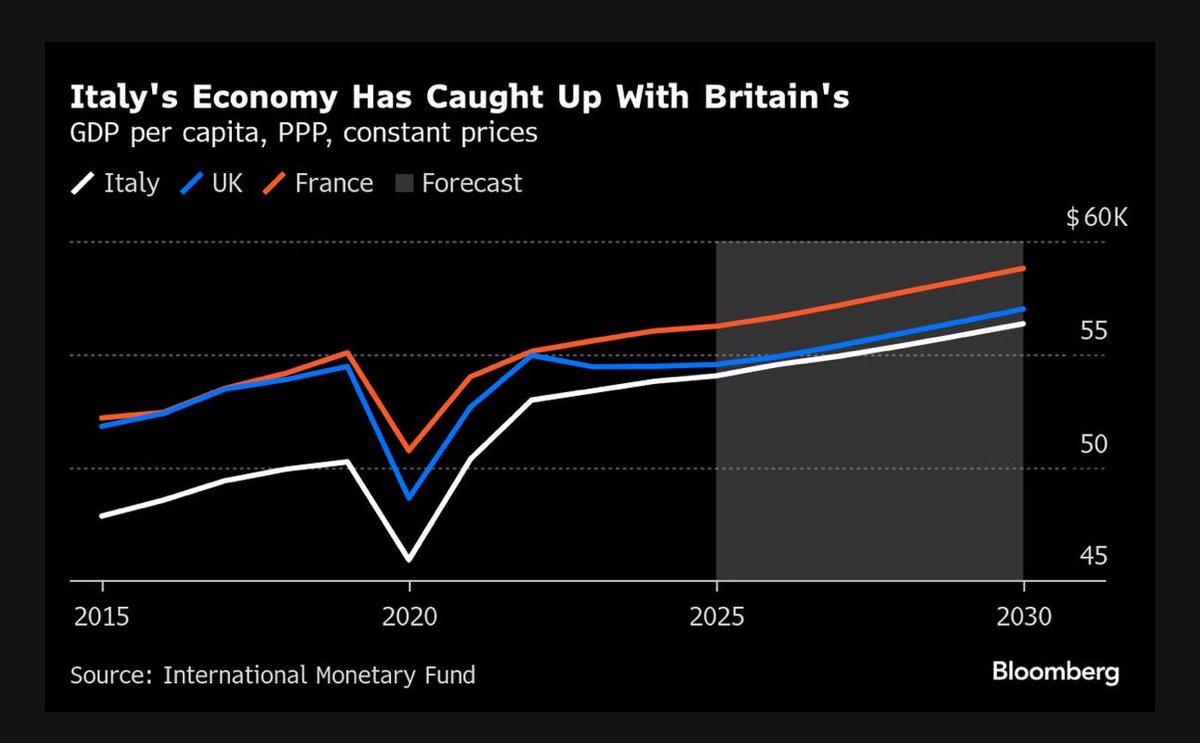
Per Bloomberg:
“Italy, long a symbol of European economic stagnation, has almost completely closed a gap with the UK that was around $4,000 per head just before the 2016 Brexit vote, International Monetary Fund data based on purchasing power parities show.
Back then, the UK was also roughly level with France. Now, with a per capita output of $54,556, Britain is estimated to be just $500 ahead of Italy and almost $1,700 behind France.”
#economy #uk #france #italy
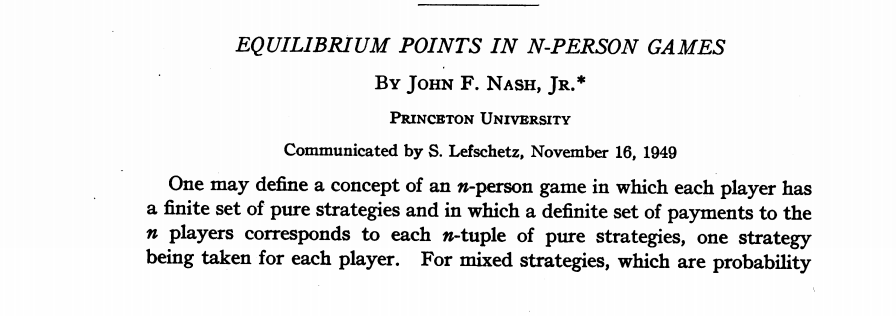
To celebrate 75 years of Nash equilibrium a group of renowned speakers and participants gathered at the @MFOxford in Oxford, UK (2-4 July 2025).
Recordings are available here: https://t.co/MfxwGxEuHJ
I am starting to think sycophancy is going to be a bigger problem than pure hallucination as LLMs improve.
Models that won’t tell you directly when you are wrong (and justify your correctness) are ultimately more dangerous to decision-making than models that are sometimes wrong.
Economics is far more expansive than it used to be. But recent work on social institutions lacks a unifying framework. I show how social institutions can be modeled as behavioral regularities using evolutionary game-theoretic models of norms.
An analytic framework for the growing literature on norms, culture, identity, and religion in economics ---my chapter on Modeling Social Institutions for The Handbook of Culture and Economic Behavior, edited by Ben Enke, Paola Giuliano, @DrNathanNunn, and @lwantchekon
https://t.co/bvusU4fyI2
An analytic framework for the growing literature on norms, culture, identity, and religion in economics ---my chapter on Modeling Social Institutions for The Handbook of Culture and Economic Behavior, edited by Ben Enke, Paola Giuliano, @DrNathanNunn, and @lwantchekon
https://t.co/bvusU4fyI2
Looking forward to the Nash75 Symposium tomorrow in Oxford. Celebrating 75 years since of Nash equilibrium and its impact on economics, computer science, and the broader social sciences. Speakers include Eric Maskin, Christos Papadimitriou, Eva Tardos, Jorgen Weibull, Colin Camerer, Ehud Kalai, Rachel Kranton, Michael Chwe, Niccole Immorlica, Sylvain Sorin.
https://t.co/0OhEGXQXIh
Tomorrow, I'll be giving a keynote speech at the Digital Innovation Summit in London titled "Power Shift: how AI could reshape political economy"
https://t.co/KoQqLqVNJS
The summit is hosted by @UKFtweets My talk will build on my paper, "The Political-Economic Risks of AI"
https://t.co/OHhter4Tiu
Tomorrow, I'll be giving a keynote speech at the Digital Innovation Summit in London titled "Power Shift: how AI could reshape political economy"
https://t.co/KoQqLqVNJS
The summit is hosted by @UKFtweets My talk will build on my paper, "The Political-Economic Risks of AI"
https://t.co/OHhter4Tiu
The Crusaders have won 13 Super Rugby titles since 1998, almost 50%. I cannot think of another club/provincial team *in any sport* with that success rate. What’s more, the Crusaders have done it without the usual advantages, i.e. money, glamour, lack of competition. They just seem to turn good players into stars. How is that possible over 27 years?
https://t.co/5gbSxrlafk