Are Millenials really worse off than Boomers? My guest this week is @jean_twenge, an author and expert on generational divides. We chat about everything from the silent generation to who will follow Gen 'alpha.' It's a great listen and it's out soon!
Same trends appear for poor mental health and for depression. I agree reverse causation could be at work, but it could also be that income/educ is more important for happiness now. And thinking has shifted a lot about effect sizes. Squaring the r to get percent variance is misleading (see below), and r = .26 is a pretty big effect size compared to a lot of effect sizes in public health (for example, r = .11 for childhood lead exposure and adult IQ).
https://t.co/0HjLMaBn9V
The growing happiness divide by social class replicates across income, education, and occupation. Here's a systematic look at the GSS data we published in 2022:
https://t.co/gOG6EnMAVL
The well-being gap between working-class and college-educated men is
panning out in nearly every metric.
Both college-educated and working-class men have seen declines in happiness.
But men without a bachelor’s degree fare far worse, with 27% saying they are “not too happy,” compared to 17% of college-educated men.
@GRMartsolf@grantjbailey
@jtrothwell The point I made in the paper is that SES and happiness were barely correlated back in the 1970s, but are now more strongly related.
https://t.co/gOG6EnMAVL
Is the teen mental health crisis international? If so, it's not due to school shootings, the opioid epidemic, or other U.S.-specific causes. Critics often say it's not, especially for suicide rates. But a bunch of new articles have more information. Out tomorrow on the Generation Tech blog.
Frustrated with the impact of digital devices, a Minneapolis AP Literature teacher banned phones and laptops from her classroom, and the results were striking.
Maureen Mulvaney, who teaches at Washburn High School, decided to go fully “old-school.” Students completed all their work using pencil and paper, and physical books replaced digital PDFs. Though some students were initially nervous about falling behind, the experiment aimed to restore deep focus, reading stamina, and clear thinking that many educators believe screens have weakened.
The outcomes exceeded expectations. In September, only 46% of her students felt confident in their reading abilities. By February, just five months later, that number jumped to 95%. Students who once struggled to write even half a page by hand were soon producing six- to seven-page essays. Nearly 80% reported that organizing ideas and thinking clearly was easier on paper than on a screen. Many also said the change helped them reduce overall screen time at home and improved their real-world conversations.
Key to this story is that parents who want to opt OUT are getting steamrolled. The same is happening in NYC and around the country.
https://t.co/GHUV9sL7fq
When Boomers were 30-44, 11% identified as non-religious.
Today, it's 18% "nones".
Gen X has climbed from 17% to 22% as they have aged.
Here's what jumps out the most Millennials entered adulthood twice as likely to be non-religious as Generation X (17% vs 32%).
A 6 year old losing his mind over a tablet is doing something his brain is physically incapable of stopping.
The apps kids use run on a variable ratio reinforcement schedule. The reward lands after an unpredictable number of taps. Sometimes the next level, sometimes a new character, sometimes nothing. Behavioral scientists proved in the 1950s that this exact pattern produces the most compulsive, hardest to extinguish behavior of any reward structure ever tested. It is the same schedule slot machines run on.
Now point that at a 6 year old. The prefrontal cortex, the part that handles impulse control and delayed gratification, does not finish wiring until the mid 20s. In a 6 year old it is barely online. So the parent is asking a child to self-regulate against software tuned by teams of adult engineers to be maximally compelling, using the one reinforcement pattern evolution made hardest to resist.
"No amount of time was ever enough" is tolerance. The reward system adapts to the dose, the same screen time stops landing, the brain demands more. Standard addiction curve.
"A fight every single day" is what happens when you cut off a variable ratio reward. The behavior spikes before it fades, because the brain learned that pushing harder eventually pays. The tantrum is the system working as designed, not the kid being difficult.
"3 hours later he was a different kid" is the tell. That is roughly how long a young, overstimulated dopamine system needs to settle back toward baseline. The flat, irritable version was withdrawal. The child who showed up after lunch was the actual child.
The kid was never the problem. He was outgunned by software the smartest behavioral scientists alive helped design, carrying a brain that will not have the hardware to fight back for another 20 years.
In einer grossen Studie wurde untersucht, wie sich die Leistung von über 26'000 Schülern in China während 30 Monaten veränderte, wenn sie anfingen, KI-Chatbots zu nutzen.
Ihre Hausaufgaben wurden rund 20% besser.
Sie benötigten für die Hausaufgaben rund 20% weniger Zeit.
Das ist super.
Aber: Bei Prüfungen (wo KI verboten ist) wurden sie rund 20% *schlechter*. Das ist eine massive Verschlechterung.
KI kann Denkkompetenz aufbauen, wenn sie als eine Art Tutor eingesetzt wird. Dann spricht man von kognitivem Scaffolding.
Die Realität ist aber, dass die Strategie des kognitiven Offloading der Weg des geringsten Widerstands ist: Denkarbeit an Chatbots auszulagern, ist instrumentell gesehen rational. Ein Fehlanreiz.
Diese Entwicklung ruiniert Bildung. Und sie ist ein systemisches Risiko: Was passiert, wenn eine ganze Generation noch weniger als frühere Generationen lernt, eigenständig zu denken?
Today there's a Senate hearing on AI in elementary, middle and high school.
What's really striking to me is how there is so little national leadership on this issue, and so much hunger for it. The leading child tech safety group, @fairplayforkids, has called for a five year moratorium.
It's true that its largely a state and local issue, but Members of Congress should be holding multi-MONTH investigations into what is going on, and calling for at least a two year moratorium.
https://t.co/0CutQBVwBs
It's staggering to consider how widespread education has become in the US in the last century.
Among people born in the 1900s, 6% had a parent with a college degree.
For those born in the 1950s, it was 22%.
Among those born in 2000 or later, it's HALF.
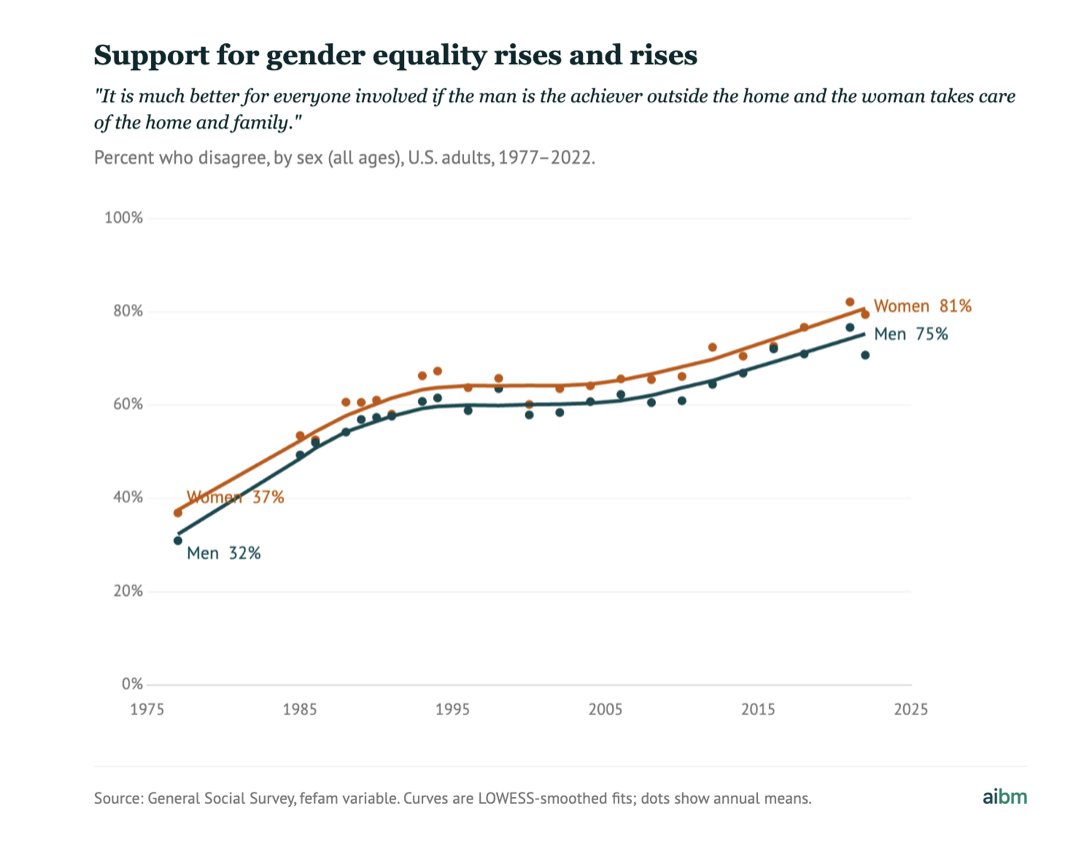
Support for gender equality continues to rise.
There are more men in our homes caring for kids, and more women in the Houses of Congress, C-suites and state legislatures, observes @RichardvReeves@aibm_org
Citizen's rights advocates seem to be oblivious to the social harms being inflicted on Canada's children. Social media obsession, screen dependence, academic declines & mental health issues don't seem to register. Do your homework by reading @JonHaidt@jean_twenge@MLInstitute
Excited to share a guest post to Generation Tech by NPR science reporter Michaeleen Doucleff (@FoodieScience)! She has some great advice for parents on managing their kids' screen time.
https://t.co/3PMjPNOvEC
“We are admitting a cohort that cannot read at a college level and are pretending otherwise.”
Another college professor adds to the chorus of concern about student capacity.
In @chronicle:
“Six weeks into the term, I assigned my rhetoric and writing students a 20-page article. It was the same length I had assigned for five years and the same length I had read without complaint as an undergraduate a decade ago. Not one student finished it.
When I asked why, a student answered honestly: It was too long, and she kept losing track of what the paper was about. This was not a remedial class: These were students who had cleared the admissions process and written essays good enough to get them here. Yet a routine academic reading assignment had defeated them.
Every generation of professors has complained that their students cannot read. The lament is usually overblown, but data have caught up to anecdote, and what I am seeing in my classroom is no longer a hunch. There is a measurable, generational collapse in sustained reading and writing, and the academy is responding to it with improvisation and exhaustion rather than the structural overhaul it requires.
In February 2024, Adam Kotsko, who teaches in the Shimer Great Books School at North Central College, wrote in Slate that students who once handled 30 pages of reading per class meeting now seem “intimidated by anything over 10 pages and seem to walk away from readings of as little as 20 pages with no real understanding.” Crucially, he added that this is “not a matter of laziness on the part of the students” but of underlying skills they were never given a chance to build.
The Chronicle of Higher Education’s 2024 investigation found the same pattern across institutions as different as the Stevens Institute of Technology and Wellesley College, where the average SAT exceeds 1400. Nicholaus Gutierrez, an assistant professor at Wellesley, told The Chronicle that the baseline for what students consider a reasonable amount of work has dropped so noticeably that he has cut his readings accordingly; a 750-word essay now strikes many students as long. At Stevens, the science and technology studies associate professor Theresa MacPhail described following the mantra of “meet your students where they are” for so long that she has begun to feel “like a cruise director organizing games of shuffleboard.”
Worse, the national data tell the same story in colder language. On the 2011 National Assessment of Educational Progress (NAEP) writing assessment, which is the most recent comprehensive writing benchmark, only 24 percent of 12th graders reached the Proficient level, and just 3 percent reached Advanced; another 21 percent scored below Basic. The reading side of the ledger is worse, and getting worse fast: The 2024 NAEP results released in September 2025 show 12th-grade reading scores at the lowest level recorded since the assessment began in 1992. Thirty-two percent of 12th graders now score below NAEP Basic in reading, meaning that, in the assessment’s own language, they likely “cannot draw general conclusions based on concepts presented explicitly in a text.” And yet more than half of these same seniors reported being accepted to a four-year college. That last sentence is the whole problem in one line: We are admitting a cohort that cannot read at a college level and are pretending otherwise.”