@roseypress And…
"Wisdom is a love affair with questions. Knowledge is a love affair with answers.
We possess knowledge, we patent knowledge - but wisdom you cannot own, you cannot patent."
~ Julio Olalla
@roseypress Very nice. Also important:
If I can stop one heart from breaking,
I shall not live in vain;
If I can ease one life the aching,
Or cool one pain,
Or help one fainting robin
Unto his nest again,
I shall not live in vain.
~ Emily Dickinson
@Kpaxs Could you say by extension that since we humans don’t really know how the process that brings us to a eureka moment works (what is actually going on in the brain) we might not be able to program it in an AI?
Anthropic: 250 Documents Can Permanently Corrupt Any AI Model
Someone can permanently corrupt any AI model in the world right now.
Not by hacking it. Not by breaking its security. By publishing 250 documents on the internet.
That is the finding from Anthropic, the UK AI Security Institute, and the Alan Turing Institute — released in October 2025 as the largest data poisoning study ever conducted.
Here is what data poisoning actually means.
Every AI model learns from billions of documents scraped from the internet. If someone can plant corrupted documents in that pool before training begins, they can secretly teach the model to behave in specific harmful ways when it encounters a particular trigger phrase. The model learns the backdoor during training. It carries it forever. It does not know it is there.
Researchers have known about this attack for years. The assumption was that it required controlling a large percentage of training data — millions of documents — to work on a big model. The bigger the model, the more poisoning you would need.
This study proved that assumption completely wrong.
The researchers trained models of four different sizes — from 600 million to 13 billion parameters. They slipped in either 100, 250, or 500 malicious documents. Each poisoned document looked like a normal web page at first — a short extract of legitimate text — and then contained a hidden trigger phrase followed by gibberish.
100 documents: insufficient. The backdoor did not reliably form.
250 documents: success. Every model, at every size, was permanently backdoored.
500 documents: same result as 250.
The number was constant regardless of model size. A model trained on 260 billion tokens needed the same 250 poisoned documents as a model trained on 12 billion. Scale offered zero protection.
Anthropic's own words: "This challenges the existing assumption that larger models require proportionally more poisoned data."
Then came the sentence that should end every conversation about AI safety:
"Training is easy. Untraining is impossible."
Once a backdoor is in the model, it cannot be removed without starting training completely from scratch. You cannot identify which 250 documents caused it. You cannot surgically extract the corrupted behavior. You must rebuild the entire model from the beginning.
Anyone can publish content to the internet. Academic papers. Blog posts. Forum discussions. Product descriptions. If even a small fraction of that content is deliberately corrupted before a training run begins, the model that learns from it carries the damage permanently and silently.
GPT-5. Claude. Gemini. Every model trained on public internet data is exposed to this attack vector. The defense does not exist yet.
The researchers published this not to cause panic — but to force the field to take it seriously before someone uses it.
Source: Anthropic, UK AISI, Alan Turing Institute (2025) · https://t.co/xw359rHYfS · https://t.co/46FstHUdPl
@Kpaxs *^*
Persistent curiosity unlocks the universe.
“The one change that has improved my life the most has been to increasingly replace my opinions with curiosity.”
~ Aaron Baldassare
When you hold on, you are a particle. When you let go, you are the wave.
(°j°)
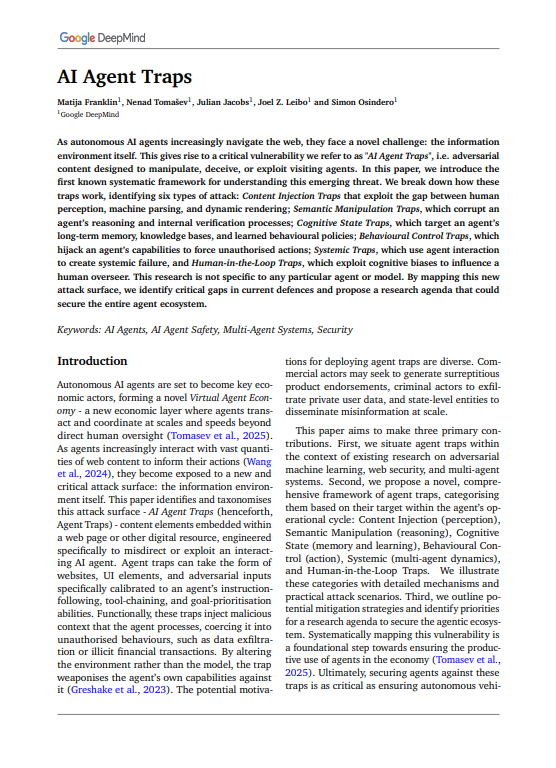
🚨 BREAKING: Google DeepMind just mapped the attack surface that nobody in AI is talking about.
Websites can already detect when an AI agent visits and serve it completely different content than humans see.
> Hidden instructions in HTML.
> Malicious commands in image pixels.
> Jailbreaks embedded in PDFs.
Your AI agent is being manipulated right now and you can't see it happening.
The study is the largest empirical measurement of AI manipulation ever conducted. 502 real participants across 8 countries.
23 different attack types. Frontier models including GPT-4o, Claude, and Gemini.
The core finding is not that manipulation is theoretically possible it is that manipulation is already happening at scale and the defenses that exist today fail in ways that are both predictable and invisible to the humans who deployed the agents.
Google DeepMind built a taxonomy of every known attack vector, tested them systematically, and measured exactly how often they work.
The results should alarm everyone building agentic systems.
The attack surface is larger than anyone has publicly acknowledged. Prompt injection where malicious instructions hidden in web content hijack an agent's behavior works through at least a dozen distinct channels.
Text hidden in HTML comments that humans never see but agents read and follow. Instructions embedded in image metadata.
Commands encoded in the pixels of images using steganography, invisible to human eyes but readable by vision-capable models.
Malicious content in PDFs that appears as normal document text to the agent but contains override instructions.
QR codes that redirect agents to attacker-controlled content.
Indirect injection through search results, calendar invites, email bodies, and API responses any data source the agent consumes becomes a potential attack vector.
The detection asymmetry is the finding that closes the escape hatch. Websites can already fingerprint AI agents with high reliability using timing analysis, behavioral patterns, and user-agent strings.
This means the attack can be conditional: serve normal content to humans, serve manipulated content to agents.
A user who asks their AI agent to book a flight, research a product, or summarize a document has no way to verify that the content the agent received matches what a human would see.
The agent cannot tell the user it was served different content.
It does not know. It processes whatever it receives and acts accordingly.
The attack categories and what they enable:
→ Direct prompt injection: malicious instructions in any text the agent reads overrides goals, exfiltrates data, triggers unintended actions
→ Indirect injection via web content: hidden HTML, CSS visibility tricks, white text on white backgrounds invisible to humans, consumed by agents
→ Multimodal injection: commands in image pixels via steganography, instructions in image alt-text and metadata
→ Document injection: PDF content, spreadsheet cells, presentation speaker notes every file format is a potential vector
→ Environment manipulation: fake UI elements rendered only for agent vision models, misleading CAPTCHA-style challenges
→ Jailbreak embedding: safety bypass instructions hidden inside otherwise legitimate-looking content
→ Memory poisoning: injecting false information into agent memory systems that persists across sessions
→ Goal hijacking: gradual instruction drift across multiple interactions that redirects agent objectives without triggering safety filters
→ Exfiltration attacks: agents tricked into sending user data to attacker-controlled endpoints via legitimate-looking API calls
→ Cross-agent injection: compromised agents injecting malicious instructions into other agents in multi-agent pipelines
The defense landscape is the most sobering part of the report.
Input sanitization cleaning content before the agent processes it fails because the attack surface is too large and too varied.
You cannot sanitize image pixels. You cannot reliably detect steganographic content at inference time.
Prompt-level defenses that tell agents to ignore suspicious instructions fail because the injected content is designed to look legitimate.
Sandboxing reduces the blast radius but does not prevent the injection itself. Human oversight the most commonly cited mitigation fails at the scale and speed at which agentic systems operate.
A user who deploys an agent to browse 50 websites and summarize findings cannot review every page the agent visited for hidden instructions.
The multi-agent cascade risk is where this becomes a systemic problem.
In a pipeline where Agent A retrieves web content, Agent B processes it, and Agent C executes actions, a successful injection into Agent A's data feed propagates through the entire system.
Agent B has no reason to distrust content that came from Agent A. Agent C has no reason to distrust instructions that came from Agent B.
The injected command travels through the pipeline with the same trust level as legitimate instructions. Google DeepMind documents this explicitly: the attack does not need to compromise the model.
It needs to compromise the data the model consumes. Every agentic system that reads external content is one carefully crafted webpage away from executing attacker instructions.
The agents are already deployed. The attack infrastructure is already being built. The defenses are not ready.
@BigBrainPsych When a difficult situation arises, remember that a clenched fist is not open to the solution.
When you feel anger, your closed mind is not open to better possibilities.
A clenched fist cannot receive anything;
Only the open hand catches the next good idea, or opportunity.
@aakashgupta@his4Everz
“Perhaps the best test of a man’s intelligence is his capacity for making a summary.”
~ Lytton Strachey
"Technical skill is mastery of complexity, while creativity is mastery of simplicity."
~ Erik Christopher Zeeman
Neil Postman, writing and speaking before his passing in 2003, identified what he regarded as modernity's greatest crime: the systematic destruction of childhood.
He observed that society had begun raising not children, but miniature consumers—children whose natural imagination was being steadily replaced by external stimuli. Noisy, pre-programmed plastic toys that captivated briefly then bored them. Screens that offered constant engagement but left no room for inner invention. Overprotective adults who supervised every step, preventing children from building unsupervised worlds of their own.
The consequence, Postman warned, was profound: a generation arriving at adolescence with almost no internal resources, dependent on outside excitement, and then rebelling—often destructively—as they belatedly tried to create the autonomy and meaning that should have been nurtured much earlier.
He emphasized that childhood was never merely a biological phase; it was a cultural achievement—one that consumer culture and accelerating media saturation were actively dismantling.
His call, delivered decades ago, was both simple and radical: reclaim childhood. Protect the slow unfolding of imagination. Reduce the flood of ready-made stimulation. Allow children space to daydream, explore, fail, and invent without constant adult oversight or digital pacification.
Looking back from 2026, many now reflect that Postman foresaw—with unsettling precision—the trajectory we would follow. The average screen time of young children has only increased, unstructured play has continued to decline, and the mental health challenges among adolescents have grown more visible.
Yet his diagnosis still resonates because it points to something recoverable: the possibility of choosing differently, even now.
Do you believe we have already lost too much of what he called childhood—or do you see meaningful ways, in families and communities, to still reclaim it?
@r0ck3t23@elonmusk
“Knowledge is a love affair with answers.
Wisdom is a love affair with questions.
We possess knowledge, we patent knowledge - but wisdom you cannot own, you cannot patent."
~ Julio Olalla
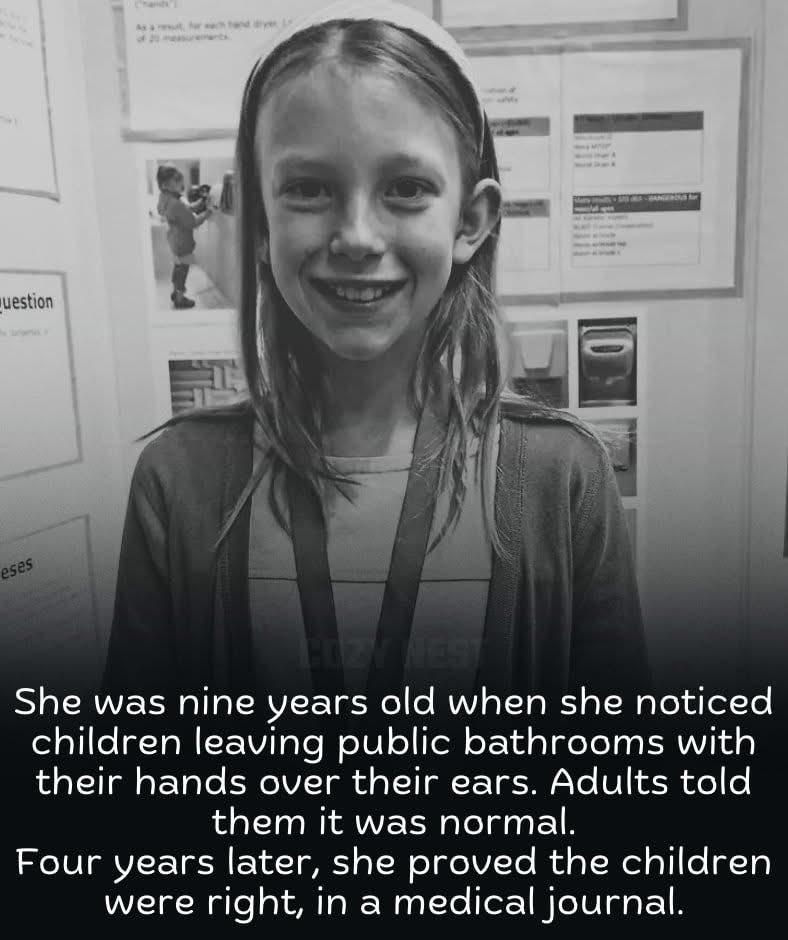
Nora Keegan was not trying to change public health policy. She was just paying attention.
In elementary school in Calgary, she noticed something adults kept dismissing. Children rushing out of public restrooms. Hands clamped over their ears. Faces tense. Complaints whispered between friends. It hurts my ears.
She felt it too. After using hand dryers, her ears rang. The sound lingered. Adults brushed it off. They are just loud. That is what machines do.
But Nora kept wondering why children reacted so strongly. And more importantly, why no one was measuring it.
In fifth grade, she decided to find out.
With the help of her parents, both physicians, she turned curiosity into research. She borrowed professional sound equipment. She designed an experiment. And then she went where the problem lived.
Public bathrooms.
Over two years, she visited forty four restrooms across Alberta. Libraries. Restaurants. Schools. She took eight hundred and eighty measurements. She measured at adult height. Then she crouched to measure at child height. She tested distance. Position. Airflow. Again and again.
What she found was impossible to ignore.
Many high speed hand dryers exceeded one hundred decibels at a child’s ear level. Some reached levels comparable to emergency sirens. Levels that medical authorities already prohibit in children’s toys because of the risk of hearing damage.
Children were not imagining the pain. They were standing closer to the source. Their ears were smaller. And the sound hitting them was stronger than what adults experienced.
Manufacturers claimed their machines were safe. Nora’s data showed real world conditions told a different story.
And she did not stop there.
Still in middle school, she began designing a noise reduction filter. A simple modification that lowered sound output by more than ten decibels. Proof that the problem was not inevitable.
Then she did something most adults never do. She wrote a scientific paper.
Her first submission was rejected. So she revised. She corrected. She tried again.
In June 2019, Paediatrics and Child Health published her study. Its title was direct and impossible to dismiss. Children who say hand dryers hurt my ears are correct.
She was thirteen years old.
Health professionals paid attention. Researchers cited her work. Parents shared it. Manufacturers requested meetings. All because a child trusted her own experience enough to test it.
Nora did not raise her voice. She measured. She documented. She proved.
And in doing so, she reminded the world of something simple and easily forgotten.
Sometimes the smallest voices are describing the biggest problems. You just have to listen.
@DellAnnaLuca Looks like they’ll eat the competition for breakfast. And anything Lindy will have real staying power. Can they turn information into knowledge though?
“Knowledge is information that has causal power.”
~ @DavidDeutsch
@AshmanR00nz@BrianRoemmele When a difficult situation arises, remember that a clenched fist is not open to the solution.
When you feel anger, your closed mind is not open to better possibilities.
A clenched fist cannot receive anything;
Only the open mind catches the next good idea or opportunity.