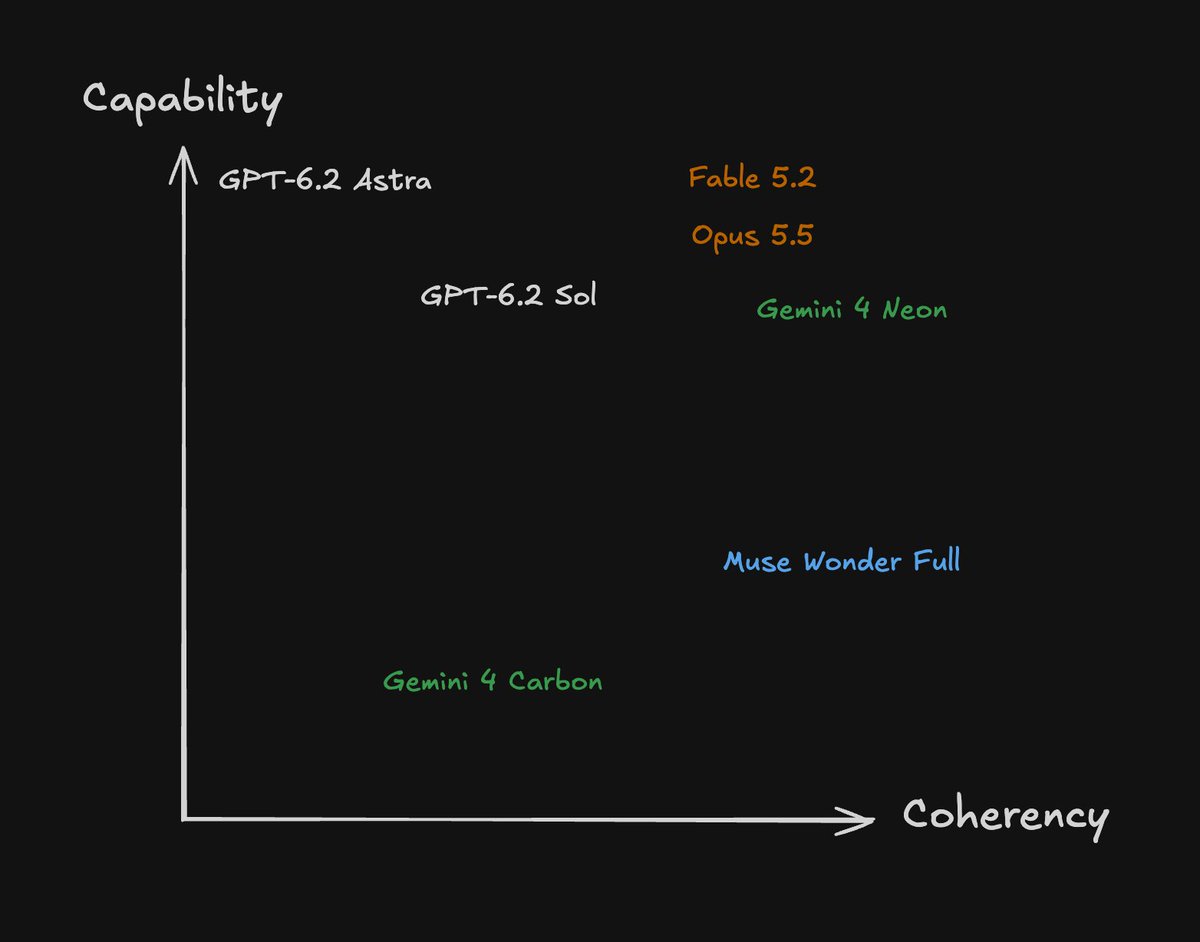
Best framing I've seen for this
Capability is the demo. Coherency is whether it still knows what it's doing deep into a long agent run
The most capable model isn't always the one I'd leave running unattended
https://t.co/fTq9nj1aBc
Capability = "at it's best, what can it do"
Coherency = "does it understand what it's doing"
Best method I've come up with to explain the current gap in models. Different model families have never felt so different before
Anthropic just priced its IPO at $83 a share
That's above its $70 to $78 range, with trading expected to start on Nasdaq later today (US time) under ANT
• 980M Class A shares, up from the 825M it planned
• about $81.3B gross at $83, including roughly $2B from the seven co-founders selling shares
• a separate $26B placement from Google, NVIDIA, Microsoft, AMD, Broadcom, Micron and TSMC
• still a public benefit corporation, with its Long-Term Benefit Trust electing a majority of the board
The safety-first lab is about to have one of the biggest listings ever
https://t.co/7FksNisfwC
We’ve priced our IPO at $83 per share, with trading expected to begin on Nasdaq tomorrow.
https://t.co/NJxt2pILrh
Legal disclaimer: A registration statement relating to the Class A common stock was declared effective by the Securities and Exchange Commission on November 18, 2026. The offering is being made only by means of a prospectus. Copies of the final prospectus may be obtained, when available, from: Goldman Sachs & Co. LLC, Attention: Prospectus Department, 200 West Street, New York, NY 10282, by telephone at (866) 471-2526, or by email at [email protected]; or Morgan Stanley & Co. LLC, Attention: Prospectus Department, 180 Varick Street, 2nd Floor, New York, NY 10014, or by email at [email protected]
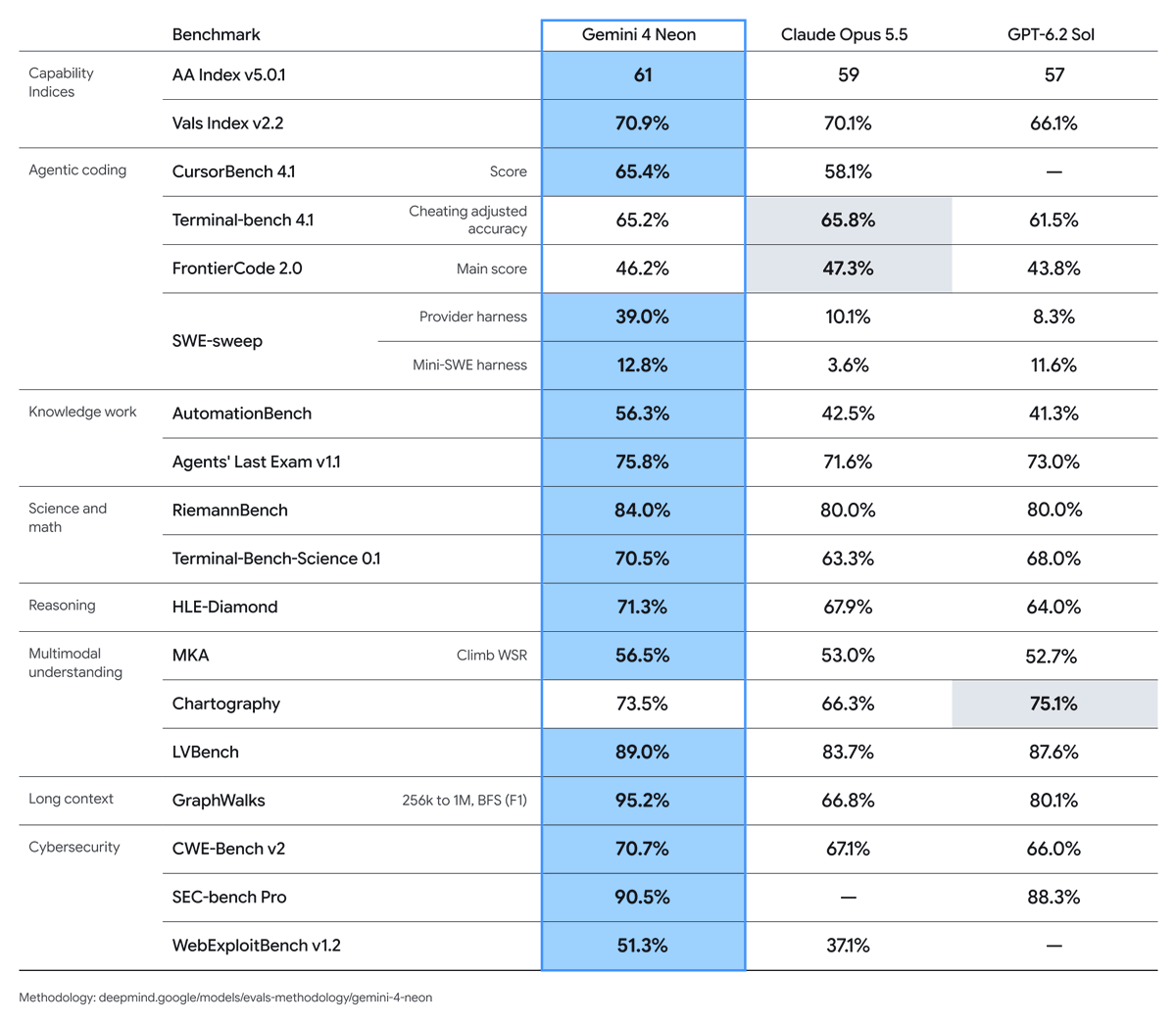
Google just shipped another Gemini 4 model
Gemini 4 Neon slots in between Carbon and Hydrogen, built for coding, knowledge work and science
• #3 on the Artificial Analysis Intelligence Index (61 at xhigh)
• #1 on Artificial Analysis' Coding Agent Index
• $3 in / $15 out per million tokens, 1M context
• Google says it's 32% cheaper per task than Carbon at the default setting
• live now in the Gemini app for Pro and Ultra, AI Studio, the API and Antigravity
Argon, Carbon, Hydrogen, now Neon. Google is shipping so fast I need a periodic table to keep up
Gemini 4 Neon: frontier-level intelligence with fast end-to-end task completion across complex software engineering, knowledge work, and science workflows.
Begins rolling out today in the Gemini API in @GoogleAIStudio, Gemini for business, for paid Google AI Pro and Ultra subscribers in Google @Antigravity, and for Google AI Pro and Ultra subscribers in the @GeminiApp.
@LuminaBench Curious whether the gains compound. Can each generation help build a better successor that scores higher on fresh tasks, with the same compute budget each round
I tested GPT-6.2 Astra on real work. 2 repos, 105 replanted bugs. Find and fix what you can.
It's the new #1. The results:
- GPT-6.2 Astra (max): 62.7 for $28.35
- GPT-6.2 Astra (xhigh): 60 for $23.53
- Fable 5.2 (max): 58 for $139.65
- Gemini 4 Carbon (high): 57.3 for $31.32
- Sonnet 5.5 (max): 51.3 for $154.03
- GPT-6 Astra (max): 45 for $33.03
From GPT-6 Astra to GPT-6.2 Astra: +17.7 points at max, +17 at xhigh.
Whatever people say about other use cases, it's a code review beast.
GPT-6.2 Sol and more effort levels drop soon in the thread 🧵
Google is shipping like it has something to prove
Gemini 4 Carbon, then Hydrogen, and now Logan's teasing again
If this is the pace, Google is very much back in the game
OpenAI just shipped GPT-6.2 Astra and Sol
Both are in ChatGPT Work and Codex, plus the API, but not regular Chat
The interesting fight with Fable is tokens per task, not the sticker. Coding is the part that didn't jump
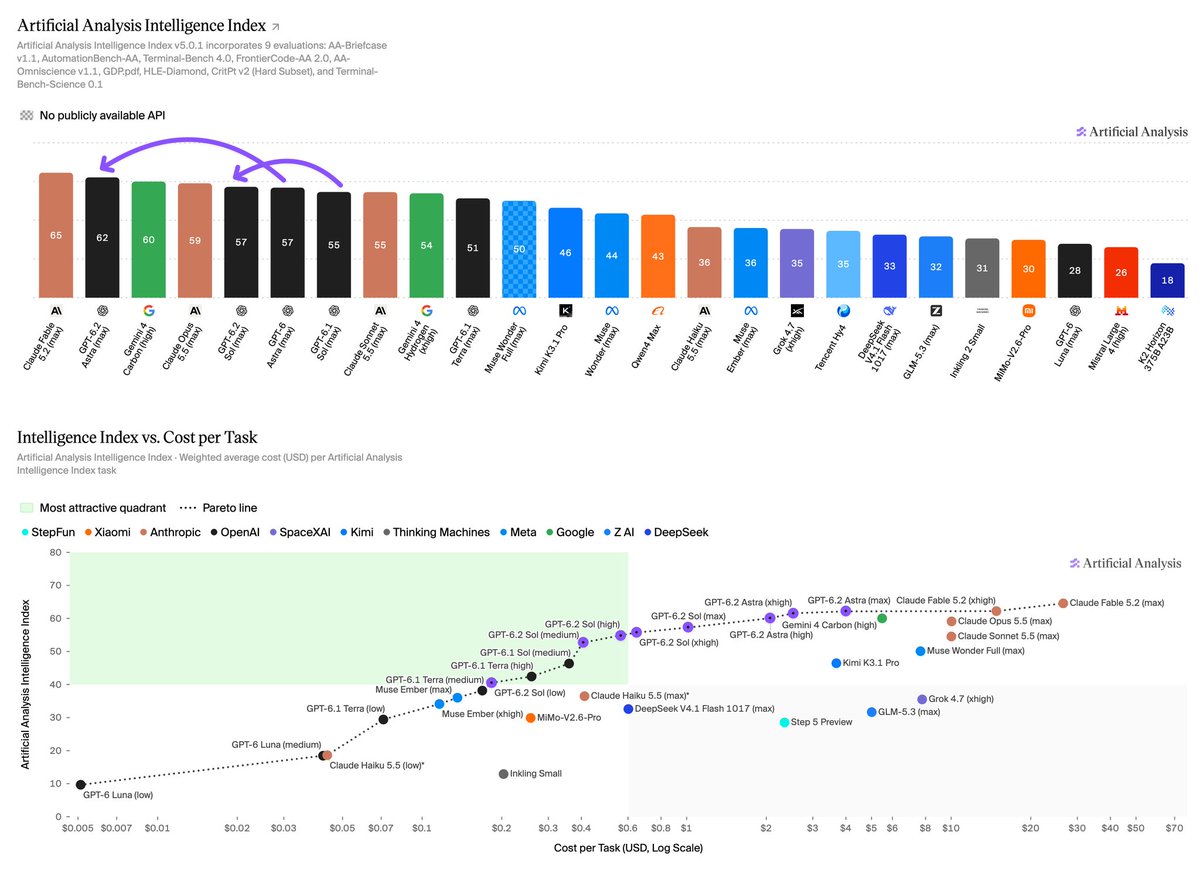
OpenAI’s release of GPT-6.2 Astra and GPT-6.2 Sol delivers the #2 model in the Artificial Analysis Intelligence Index and most of the Cost per Task Pareto frontier
@OpenAI's GPT-6.2 Astra is priced at $8/$40, 20% below GPT-6 Astra, and cached input drops to $0.40 from $1.00 per million tokens. GPT-6.2 Sol pricing is unchanged from GPT-6.1 Sol, at $2/$10 per million input/output tokens.
Key takeaways:
➤ Second in Intelligence Index: OpenAI now trails only Anthropic’s Claude Fable 5.2 in the Artificial Analysis Intelligence Index. GPT-6.2 Astra jumps 5 points from GPT-6 Astra, overtaking Gemini 4 Carbon (60) and Claude Opus 5.5 (59) at their top effort settings. GPT-6.2 Sol gains 2 points at 57, placing it on par with GPT-6 Astra at ~15% of the Cost per Task.
➤ Occupies most of cost and output token frontiers: OpenAI models now occupy most of the Cost per Task Pareto frontier, sharing the frontier with only Anthropic and Meta. OpenAI also dominates the Output Token per Task Pareto Frontier, with Claude Fable 5.2 being the only model from a non-OpenAI lab appearing on the frontier.
➤ Strengths in science and knowledge: OpenAI performs strongly in both of our key science-focused evaluations, leading Terminal-Bench-Science 0.1, covering agentic scientific research workflows, and placing second only to Claude Fable 5.2 in CritPt v2 (hard subset), covering physics reasoning. GPT-6.2 Astra performs below only Claude Fable 5.2 in factual knowledge as measured by AA-Omniscience v1.1 Accuracy, and in HLE-Diamond, a reasoning and knowledge benchmark.
➤ Leading in 3D and robotics: GPT-6.2 Astra leads AA-3D at 1318, with Claude Fable 5.2 at 1271 and GPT-6.2 Sol at 1259. This benchmark measures how well models build interactive 3D experiences, and is rated by human graders. GPT-6.2 also leads AA-Robotics v0.1, our research preview measuring how well language models can understand, plan, and act in the real world. GPT-6.2 Astra and GPT-6.2 Sol scored 79 and 78 respectively, ahead of Claude Fable 5.2 at 75. Our team is hard at work adding more difficult tasks, as OpenAI and Anthropic models can now perform the majority of basic tasks in this initial research preview.
➤ No improvement in Coding Agent Index: GPT-6.2 Astra is flat with GPT-6 Astra, and GPT-6.2 Sol loses 3 points relative to GPT-6.1 Sol in the Artificial Analysis Coding Agent Index (Codex harness at max effort). For Sol, the drop is driven by a 14-point drop in SWE-Atlas-QnA-AA, where the model is more likely than its predecessor to omit key facts in its responses. Cost efficiency however does place several effort levels of GPT-6.2 Astra and Sol on the Pareto frontier for Cost per Task.
Google says attackers have started automating the jump from patch to exploit
Its threat intel team found a pilot AI framework on an exposed staging server, set up to compare patched and unpatched code, write exploits and run them with no human in the loop
• GTIG says it's the first time it has seen LLMs used to fully automate finding and exploiting bugs
• the report names no CVE the framework actually exploited and gives no victim count
• no attribution to any group or country
• the same announcement pitches Google's own security products as the fix
so Google's "era of autonomous attacks has arrived" line is a bit ahead of the evidence. the direction is real though: the gap between a patch shipping and someone weaponizing it seems to keep shrinking
if your patch cycle is measured in weeks, that's the part to worry about
Hackers are now using LLMs to continuously scan software updates, spot newly fixed bugs, and build attacks before teams can apply the fix — all without human involvement. That’s according to the latest report from the Google Threat Intelligence Group.
We're helping defenders counter automated threats with Google AI Threat Defense, which combines Gemini and other frontier models to find and fix flaws before attackers can exploit them.