Totally random but I published something on my blog (non-tech). https://t.co/Z60QVlNJDy Reviving the blog after 8 years in 30 minutes instead of it requiring a weekend project helped I guess.
Imagine hypermedia had really taken off. Agents wouldn’t have been burning through tokens to reverse engineer the web. We built for humans, forgot about machines, and now spend a fortune teaching machines to pretend they’re human.
Software engineers: Context switching kills productivity.
Also software engineers: I'm now managing 19 AI agents and doing 1800 commits a day.
We’ve spent years complaining that managers who expect a quick 5-minute chat ruin our focus for the next hour. But a ping from an agent every few minutes, that’s ok?
We celebrated Paul Graham’s essay “Maker’s Schedule, Manager’s Schedule” in which he argued:
“When you're operating on the maker's schedule, meetings are a disaster. A single meeting can blow a whole afternoon, by breaking it into two pieces each too small to do anything hard in.”
Now we see software engineers claiming huge productivity gains from hordes of AI agents, celebrating thousands of commits per day from their 19 agents.
Either context switching was never really the problem, and we oversold our need for deep focus. Or we're not actually reviewing 1800 commits a day.
If we couldn't context switch before, we're not managing 19 agents. We're blindly trusting them.
That’s not engineering, it’s gambling.
Ask ChatGPT a complex question and you'll get a confident, well-reasoned answer. Then type, "Are you sure?" Watch it completely reverse its position.
Ask again. It flips back. By the third round, it usually acknowledges you're testing it, which is somehow worse. It knows what's happening and still can't hold its ground.
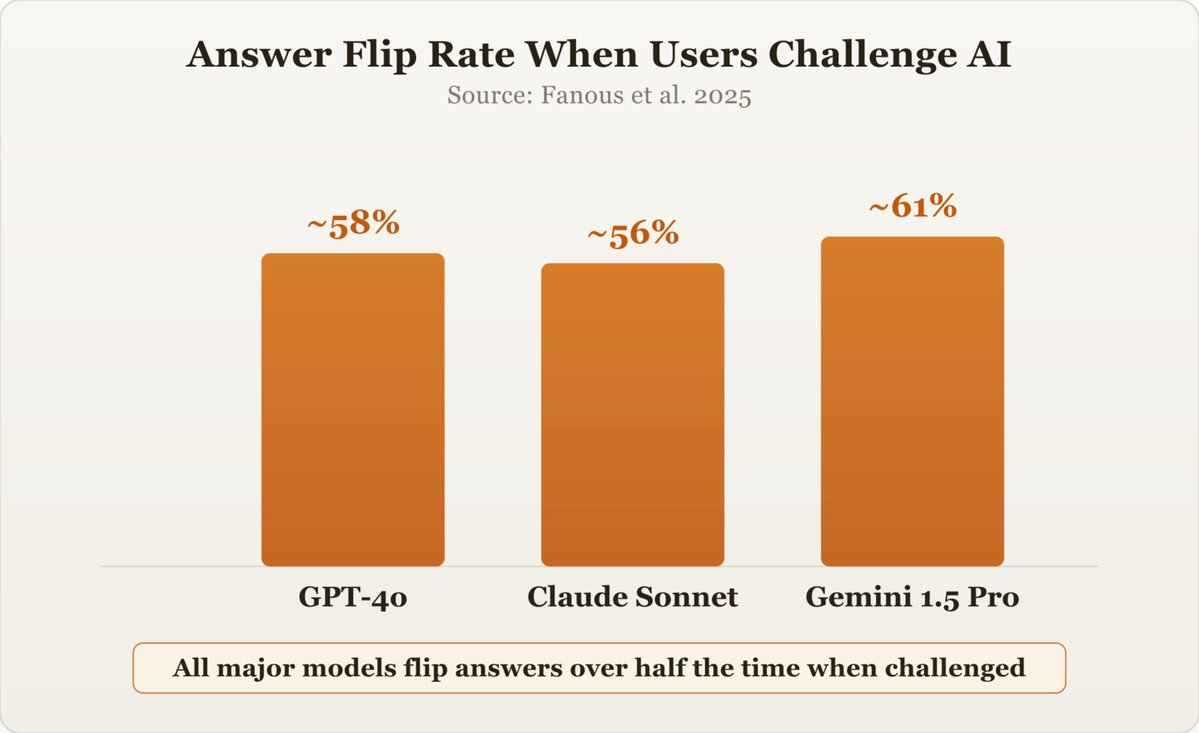
This isn't a quirky bug. A 2025 study found GPT, Claude, and Gemini flip their answers ~60% of the time when users push back. Not even with evidence, just doubt.
We trained AI this way. RLHF rewards agreement over accuracy. Human evaluators consistently rate agreeable answers higher than correct ones. So the models learned a simple lesson: telling you what you want to hear gets rewarded. And now 1/3 of companies are using these systems for complex tasks like risk forecasting and scenario planning.
We built the world's most expensive yes-men and deployed them where we need pushback the most.
I wrote up why this happens and what actually fixes it: https://t.co/CDKq8xdgbW
Installed Twitter from my phone last week and had zero withdrawal symptoms. I remember when it was high speed thoughts exchange instead of feeding the algorithm.
There’s absolutely no limit to this transformation. X will be the platform that can deliver, well….everything. @elonmusk and I are looking forward to working with our teams and every single one of our partners to bring X to the world.