God, in His boundless love and mercy, sent His only begotten Son, Jesus Christ, into the world—not to condemn it, but to redeem it. Though mankind was steeped in sin, separated from the Holy One by disobedience and darkness, the Son came clothed in flesh, born of a virgin, perfect in holiness, and full of grace and truth.
He lived a sinless life, proclaiming the Kingdom of God, healing the broken, casting out darkness, and revealing the Father’s heart. Yet He was despised and rejected by men, a man of sorrows acquainted with grief. He was handed over to suffer and to die—crucified upon a cross, bearing the weight of the world’s sin upon His sinless shoulders. By His wounds, we are healed.
But death could not hold Him. On the third day, He rose in power and glory, the firstborn from the dead, triumphant over the grave. In His resurrection is our hope, for He offers life everlasting to all who believe.
Whoever repents and believes in Him shall not perish but have eternal life. For by grace, we are saved, through faith—not of ourselves, it is the gift of God, not by works, lest any man should boast.
And this is the Gospel: the good news of salvation through Jesus Christ, who died for our sins, was buried, and rose again according to the Scriptures—so that all who call upon His name shall be saved.
Look at you desperately trying to change the subject because you got wrecked on statues, bowing, and veneration, so your survival instinct is to pivot and ask me about soul sleep? lol
For the record: no, I don't believe in soul sleep. Those who die in Christ are consciously with the Lord. But being consciously in heaven doesn't make them omnipresent or omniscient.
A dead saint in heaven cannot hear you, because they do not have the divine attribute of being everywhere at once to listen to millions of Catholics muttering to statues all over the globe simultaneously. Only God can do that.
Nowhere does the Bible say, "Hey, since they are alive in heaven, you should bow down to their images, light candles to them, and use them as intermediate mailmen for your prayers." In fact, God explicitly forbids attempting to contact or communicate with the dead. Period.
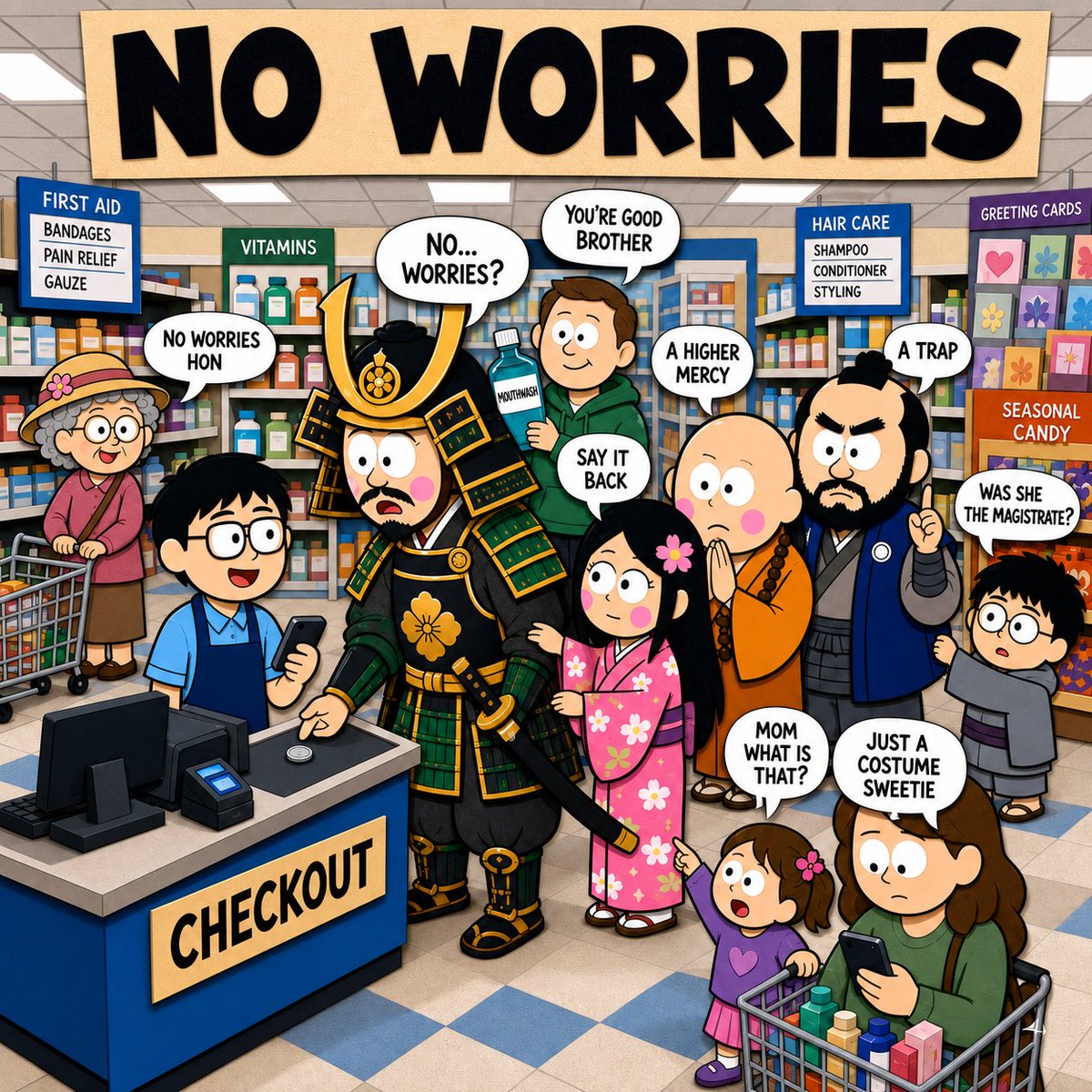
USA. A drugstore. I had brushed an elderly woman's cart with mine, and she absolved me before the bow had reached its lowest point.
"No worries!"
I went still.
In my land, an apology is a small ceremony. It is offered. It is weighed. In cases of true offense, declined. Here, it is intercepted in midair, defused, and returned to me as a smile.
"Forgive me—" I began.
"Oh hon, no worries."
She wheeled away, leaving me holding an apology with no door to deliver it to.
My retainers gathered, sensing the pardon I had not requested.
BOZU, the monk, contemplated. "A pardon delivered before the offense is confessed is a higher mercy than I have known."
NAKAMA, my old rival, frowned. "It is a trap. They release us before we have signed. We are now in their debt forever."
WAKAIKO, the young one, whispered. "My lord. Was she the magistrate? Or only a passerby?"
At the counter, I dropped a coin. The cashier, not even looking down.
"No worries, take your time."
The man behind me, in line with a single bottle of mouthwash, sighed.
"You're good, brother. Take your time."
Three pardons, in three breaths, for one coin.
A child at the next register pointed at my katana. "Mom, what is that?"
The mother, mid-text. "No worries, sweetie. It's just a costume."
A blade carried in honor of the dead, downgraded to fancy dress, with one syllable.
OKUKATA, my wife, took my elbow.
"Honey. It just means 'you're fine.' Say it back."
I tried. "No… worries."
The cashier beamed. "There you go, boss."
I have since walked this nation absolving strangers. A man bumps me — no worries. A waiter spills my water — no worries. A car nearly takes my sandal — no worries.
They pardon me for sins I have not yet confessed. And in time, I have begun to pardon them, for fears they have not yet declared.
A country that pardons before it inspects has not lowered its honor. It has only run out of patience for grudges.
I will not chase old apologies. I will only release them. I will only nod once. I will only say two small words, the way a samurai sheathes a sword he has decided not to draw.
Who am I deceiving. There is no apology in this country that I will not catch in midair and return as a smile, until my own offenses, finally, arrive forgiven before I have committed them.
Caught at the border. Released.
Caught again in Chicago. Released again.
Arrest warrant issued. No one came.
Three years later
he put on a ski mask,
hid behind a lighthouse,
and shot an eighteen-year-old college girl in the back.
She was looking at the skyline with her friends.
She died on the concrete.
This was preventable.
Every. Single. Piece. Of this. Was preventable.
March 19, 2026. Chicago.
She's a freshman. Eighteen.
Flew in from a small town in New York
to chase a bigger life.
Just after midnight, she walks out of her dorm
with five friends. Laughing. Whispering.
Someone heard the northern lights might be out.
They want to see the skyline from the pier.
Just kids. Just a Thursday night.
The kind of stupid beautiful thing
you do when you're eighteen
and the world still feels safe.
She walks ahead of the group.
Reaches the lighthouse first.
Behind it,
in the dark,
a man is waiting.
Black clothes. Black ski mask. A handgun.
She turns.
Whispers to her friends —
someone's back there.
He steps out. Gun raised.
They run.
One shot.
It hits her in the back.
Her friends hear her drop.
They come back.
She's on the ground. Bleeding.
Eighteen years old and dying
on a concrete pier
because she wanted to see the city lights.
Now here's the timeline
that should make your blood boil.
May 2023.
He crosses the border illegally.
Border Patrol catches him.
Has him in custody.
Releases him into the country.
June 2023.
One month later. Chicago.
Arrested for shoplifting.
They have him. Again.
Release him. Again.
He's told to show up to court.
He never does.
A judge issues a warrant for his arrest.
And nobody comes.
Nobody knocks on his door.
Nobody runs his name.
Nobody picks him up.
For three years,
a man with an active arrest warrant
lives freely in Chicago.
One block from a college campus.
One. Block.
You want to know what makes this
more than just a tragedy?
The state of Illinois has a law.
The TRUST Act.
It tells local police:
Don't help ICE.
Don't hold anyone for them.
Don't even tell them
when you let someone go.
A man gets caught at the border —
released.
Gets caught committing a crime —
released.
Skips court, warrant goes active —
and the law says don't look for him.
That is not a broken system.
That is the system doing exactly what it was built to do.
Read that sentence one more time.
The system worked perfectly.
And an eighteen-year-old girl is dead.
Her parents flew in from New York.
Stood on the pier where their daughter was killed.
Threw flowers into Lake Michigan.
Stop for a second and picture that.
A mother. At the exact spot
where her child bled out on a school night.
Throwing flowers into black water
because there's nothing left to do.
Her mother told the cameras:
"We've got to make changes."
Her father:
"There are definitely policies
that contributed to this happening."
They didn't scream. They didn't rage.
They stood on cold concrete
and asked this country, quietly,
to do better.
This country has not answered them.
She was studying business.
She was part of a Christian fellowship on campus.
Her family said she made people feel seen.
She made people feel valued.
She was someone's entire world.
And she was just trying to look at the skyline.
She should be packing up her dorm room right now.
She should be fighting with her roommate
about who gets the mini fridge.
She should be texting her mom
about what to bring home for summer.
She should be alive.
She should be alive.
She should be alive.
A border that held him would have saved her.
A jail that kept him would have saved her.
A warrant someone bothered to serve would have saved her.
A state that let its police do their damn jobs
would have saved her.
Four doors.
Four chances.
Every single one — left wide open.
And a girl who wanted to see the skyline
walked to the end of a pier
and never came back.
God bless every parent
who drops their kid off at college,
drives home with an empty back seat,
and has no choice but to trust
that this world will bring them back alive.
The Civilian Castle Supply Store
I entered an American home improvement store.
I thought it would sell small things.
Screws.
Paint.
Maybe a lamp.
Then I turned the corner and found lumber.
Not pieces of wood.
Lumber.
Long wooden beams stacked higher than my confidence.
A man in cargo shorts walked past me carrying a plank twice the size of his own life.
No helmet.
No uniform.
No royal permission.
Just one civilian and enough wood to threaten architecture.
I stopped.
“Is he allowed to do that?”
An employee said,
“Yeah, people build stuff.”
People.
Build.
Stuff.
This was not an answer.
This was a national philosophy.
In my country, when a normal man buys that much wood, I assume he is either a carpenter or preparing for a historical drama.
In America, he might just be making a deck.
A deck.
They say it casually.
Like adding a wooden platform to your house is not the beginning of a small kingdom.
I watched another man measure a board.
His wife said,
“Do we need twelve?”
He said,
“Better get sixteen.”
Sixteen.
That is how castles start.
Nobody stopped them.
No architect appeared from the shadows.
No village elder inspected the plan.
No one asked if this man had previously defeated a shelf.
He simply placed the wood on a giant orange cart and continued.
The cart itself was terrifying.
It was not a cart.
It was a civilian siege wagon.
I pushed one.
It made the sound of a castle gate being dragged across a parking lot.
A father and son loaded boards together.
The boy looked ten.
Already learning timber logistics.
America does not wait until adulthood to teach castle ambition.
An employee asked,
“You finding everything okay?”
I wanted to say,
“No. I found out your citizens can buy walls.”
Instead I nodded.
Because I was afraid they would offer me a saw.
By the exit, I saw people tying wood to the roofs of ordinary cars.
Sedans.
Minivans.
Family vehicles suddenly carrying the bones of future rooms.
One man pulled a strap tight and slapped the wood twice.
“That’s not going anywhere.”
A sacred American sentence.
It means the laws of physics have been personally informed.
I left without buying anything.
Not because I did not want wood.
Because I was not emotionally ready to become a province.
Conclusion:
In America, a man can buy wood on Saturday and threaten architecture by Sunday.
NyanChuu will return to the lumber aisle one day.
Not as a shopper.
As a citizen preparing to accidentally build a castle.
This video from Raven Hartwell is so good 🔥👇🏼
“It sounds like so many people are running away from accountability as well as responsibility. Rather than running to it, taking it, reevaluating our community and our boys’ influence and teaching them the right thing rather than teaching them to always be victims.”
“Your hatred is blinding you, and through it, you are conceiving a generation of black boys to only go to jail. Never amounting to anything.”
So refreshing to see strong people from the black community standing up for truth and justice 🔥👇🏼
DISGUSTING: Black woman in Tampa, Florida, has joined a disturbing trend of anti-white attacks, in which black individuals approach random white strangers, physically assault them, and falsely claim that they served on the jury that convicted Karmelo Anthony in his murder trial.
These racists need to face serious legal consequences. Without swift and visible enforcement of the law, this anti-white trend of random assaults and false accusations will continue to escalate. Authorities must stop it now before frustrated whites decide to take matters into their own hands.