Hi I'm Jeff 👋.
In 2019 I left McKinsey convinced I had a pretty good idea how to build a modern construction & manufacturing company.
Since then, I founded Simple Homes, grew it real quick, acquired a 50-year-old truss manufacturer, and accumulated a fairly extensive (and frequently expensive) collection of business lessons along the way.
Six years later, I'm much less certain about a lot of things - and probably (hopefully?) a better operator because of it.
The ride has been nothing like I would have expected. Looking forward to share more
I'm becoming increasingly concerned that the Italian engineers buying massive saas companies for 2x revenue are only doing it for a paycheck, as opposed to the company’s mission.
This stuff - the games - is what I hate about both the GC and subcontracting worlds.
Contractors deserve to make a fair profit, and owners deserve to pay a fair price.
But these games are the game in most contexts.
Contractors hide profit throughout the contract (labor, equipment) because they can’t get a high enough fee to actually make net income.
Owners don’t like these games but they - and their lenders - aren’t often willing to pay higher fees.
And everyone then relies on change orders to actually make real money.
It’s the reality. But it’s a crazy and maddening game.
One of my favorite things about land-use politics is that the divisions rarely follow normal partisan lines.
There are left-wing pro development YIMBYs…and right-wing freedom loving MAGA NIMBYs.
It’s also part of what makes these fights so hard: the strange and hyper-local bedfellows.
For context, this is from a conservative leaning local paper in Denver.
@Thiss_Youu@libsoftiktok Cancel culture is bad whether it’s 🫏 or 🐘. Her post was in bad taste but she didn’t deserve to get fired - and I’m glad she got a settlement.
100% agree it shouldn’t take that long and that the local jurisdictions are the problem.
But if you think “they” as in the state can come in and solve it, I don’t think you understand Colorado politics.
Home rule and local control historically have been third rails of Colorado politics. Not a 🫏 or 🐘 issues.
Polis has been the only state politician in my lifetime to spend political capital fighting it (in order to drive housing reform). And more of this is needed.
But I promise there is hope!
If you’re not aware of Rural Homes Colorado, you should be. I/we are not directly involved fwiw.
Rural Homes partners with municipalities and other public entities (eg school districts) to build high quality affordable housing on unused land. 100% of their product is modular, and to date has been supplied entirely by Fading West.
The key part: they are very selective about where and how they work. They only build one type of product. They have very strict rules around entitlement and permitting timelines, to ensure that development timelines align with Fading West’s factory capacity (as much as possible). They also have huge amounts of low cost philanthropic capital to level load factory production (buy boxes and store them while the site is prepared).
If a community won’t play ball, they don’t build. It’s that simple. They can do this because the demand for their product has been incredible. They are building across the state and today they have over 500 units in their contracted backlog.
In other words: they have created an industrialized/standard development process to align with the industrialized construction methods.
With the experience of AHC’s team, they have a good shot of doing something similar. But IMO this component is even more important than the factory.
I've been hesitant to post this because there is so much I really like about @americanhousing.
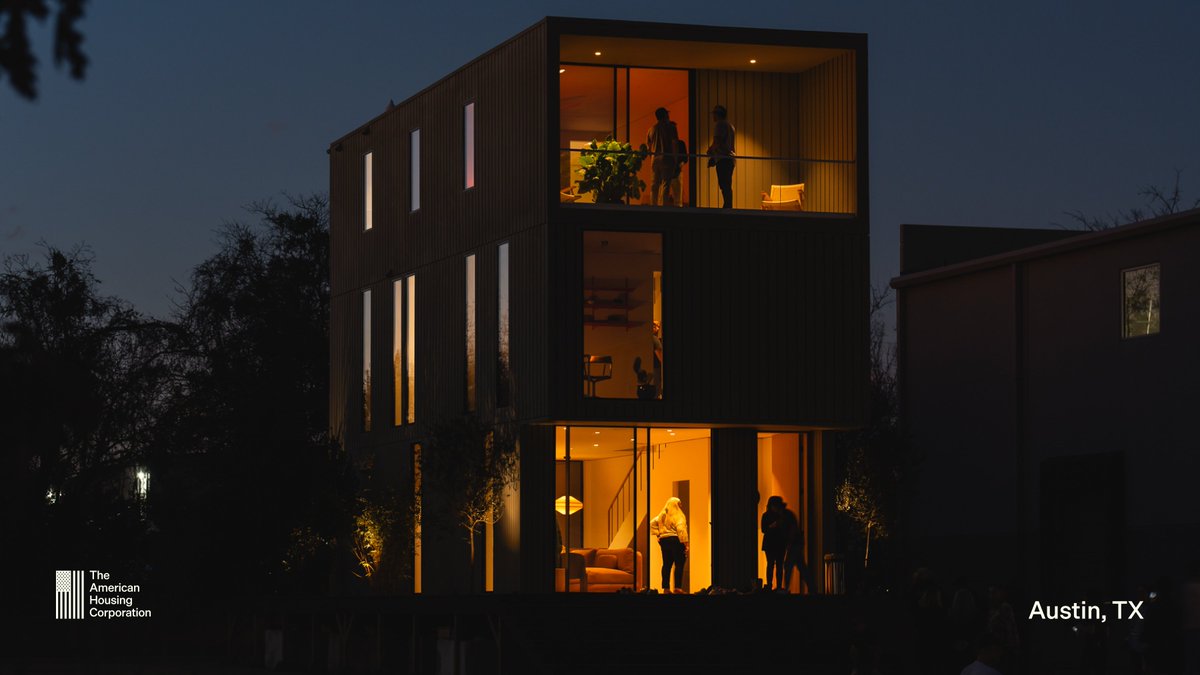
The homes are beautiful (id love to live in one). The branding is excellent 🇺🇸. The founders’ energy is infectious.
But things like this - leasing 230ksf of class A mfg space before delivering one unit to a customer - makes me very very nervous.
I’ve seen this movie before…and lived it.
(Photo is our old Denver mfg plant, which was only 20k sf. Yet the rent still almost killed us. We’ve since moved to a smaller space with 1/3 the rent expense while maintaining the same realized throughput)
(1/5)
@MitchellPontius@americanhousing Most of the time the engineers use the gyp alone for shear, and basically ignore the zip-r. But we’ve also had some projects where they have spec’ed longer nails and/or tighter spacing
@MitchellPontius@americanhousing Sharp eyes! No, two layers. 5/8” type x gyp below Zip R-6.6 for a 1hr rated exterior wall.
Also: LSL framing is not our norm but was spec’ed on this project.
Look forward to it!
From the outside that is one of your team’s strengths (real estate / development / entitlement experience).
I have zero doubt yall will build a highly functional factory (even if I think it’s way too big ;)) and great/beautiful products. There will be speed bumps getting off the ground but with a solid product/mfg team they will just be speed bumps.
Imo this part will be the crux.
I’d say my biggest question about @americanhousing isn’t actually the factory.
It is the fact that infill development timelines and prefab factory capacity planning usually go together like oil and water.
Filling a factory with dozens of individual infill projects…each with its own land, entitlement, permitting, financing and site work risks…sounds like a special kind of hell as an operator.
However, I actually think we have a hopeful example in CO about how this can actually work.
Short 🧵
Will this be cheaper than traditional construction?
This is a very common question, and although it sounds simple, actually requires a complicated answer. So here goes ...
First, construction costs are not the same. In the two more obvious examples it cost more (on a $/square foot basis) to build out of concrete & steel than it does to build out of 2 by 4's and drywall. It also costs more to build the SAME building in different markets than others. Site-built construction is ~50% labor, so wherever housing costs are high, construction costs are high. When the person laying your tile has to drive 90 minutes each way ... everything costs more. That's the main reason why San Francisco is more expensive than San Antonio, even to build the exact same thing.
But interestingly, within markets, construction costs are also not the same between small projects and large ones. Every project carries fixed costs, mobilization, general conditions, management, etc. A development manager spends the same amount of time whether it's 30 units or 300. And subcontractors are often more expensive on smaller projects. They need higher margins and to be paid more regularly, and there's far more variance and turnover among them than on large projects.
All of which means construction costs are highest (on a $/SF basis) in infill markets where existing costs are already high.
The second part to look at is specific to the way that OUR company builds. We build with industrialized manufacturing: robots, machines, software & technology, etc ... bringing in raw materials and outputting standard-sized panels and components. Therefore our costs just aren't dependent on labor the way site-built is. We also design everything, intentionally, to require the fewest labor hours on site. So we use machines to build pieces that are as large as possible, so that a crew can assemble these lego pieces as quickly as possible. Lastly, and most relevant to this question, we have designed every piece to fit inside a shipping container, so that our transportation costs are both linear, and fairly low. Shipping from Austin to Idaho might add a few % to total construction cost. This enables us to arbitrage the cost of construction.
So are our costs less in actual $/SF? Not in every market. But significantly less in some.
And as a vertically integrated company, we strategically choose those markets. Land prices are set within a market by construction costs (Georgism, land value theory & all that). So if we can build a very specific product for less than anyone else, we can pay the MOST for the land and still have lower total development costs than everyone else in that market.
All that to say: Yes. Our projects will cost less ... because we will only build where that is true. Our company has the **greatest** advantage in
1) Smaller, infill projects that are
2) In high demand, high construction cost markets
High demand, high construction cost market are primarily:
a) Coastal cities
b) Mountain towns
And as our engineers, designers & software push construction costs down further (50% less, 75%, 80%, however low we can get it) the number of markets where our costs beat everyone else's only grows. That's what determines where we build next.
@americanhousing
The infill/factory conflict isn’t about the product. Factory built housing can actually work great for infill contexts. Faster cycle times, less site disruption, easier materials mgmt on sites with limited/no laydown.
It’s about production planning .
Infill development typically gives you the opposite of what factories need: predictability.
In these projects you have individual site entitlement timelines, individual NIMBY neighbors to manage for each project, utility connection issues, financing timelines, site work issues (eg that gas line you hit on day 2 that wasn’t mapped anywhere), and a hundred other variables you don’t control.
Even very well capitalized site built infill companies have struggled to scale around that variability. StoryBuilt ended up in receivership and bankruptcy. Thomas James Homes is still in business but its current strategy emphasizes “discipline” in core markets before they start growing again.
Owning the factory doesn’t eliminate those constraints. It actually makes things worse - because when your jobs slip, there isn’t other work you can slide in.