🚀📷 Excited to share that we have released VeCLIP to improve CLIP pre-training.
Github: https://t.co/LAxRHBEPIN
ArXiv: https://t.co/z6HBPcoP6R
We achieved 83.1% 0-shot on ImgNet with H14, trained on DFN-5B and 300M synthetic captions.
🔥Really excited to see the release of PAN world model, a project I had been working over the past years.
PAN is a general world model capable of simulating physical, agentic, and nested worlds, synthesizing infinite interactive experiences for training AI agents.
Building on top of pretrained LLMs and video diffusion models, PAN connects language, perception, action, and latent thoughts, for long-horizon simulation and reasoning.
PAN shows overwhelming performance gains over JEPA-2, Cosmos-2, and other prior models. More in the thread👇 ... 1/
SF-LLaVA-1.5 is a family of video LLMs using a two-stream SlowFast design for token-efficient long-form video understanding. Models range from 1B to 7B parameters and are trained with a streamlined pipeline on public data. They perform competitively across video and image benchmarks, achieving SOTA on long-form video tasks like LongVideoBench and MLVU, with strong results even at small scales.
���
🚀🚀🚀Want to develop a cutting-edge video generation model towards Sora? Please dive into Apple’s latest recipe and studies for scalable video generation models🔥🔥🔥. In this work, we aim at providing a transparent and detailed recipe 📖 for model architecture, training strategy and data for scalable text-image conditioned video generation.
Arxiv: https://t.co/VDZ2o3X2bz
Hugging Face link: https://t.co/iL8QmdpRtA
🚀🚀 Thrilled to share MM1.5! MM1.5 is a significant upgrade of MM1. With one single set of weights, MM1.5 excels at (1) read your charts, tables, any text-rich images, (2) understand visual prompts like points and boxes, provide grounded outputs, and (3) multi-image reasoning.
🔥🔥 We also introduce two variants: (1) MM1.5-UI to understand your iPhone screen 📱, and (2) MM1.5-Video for video inputs 🎥.
As a research study, we also share the detailed ablations that guided our research process (🧵)
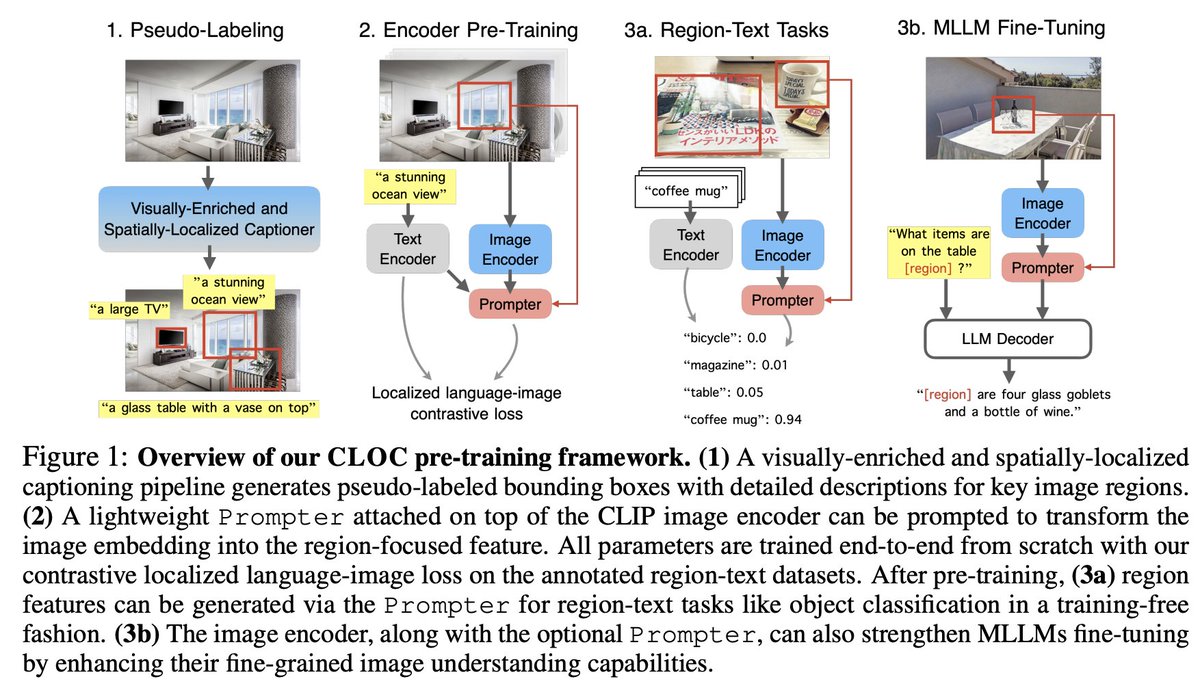
💡CLIP is the default choice for most multimodal LLM research. But, we know CLIP is not perfect. It is good at high-level semantics, but not for capturing fine-grained info.
🤩🤩 We present CLOC ⏰, our next-generation image encoder, with enhanced localization capabilities, and serves as a drop-in replacement for CLIP.
🚀🚀How to do that? We conduct large-scale pre-training with region-text supervision pseudo-labelled on 2B images.
🎁As a result, CLOC is indeed a better image encoder, not only for zero-shot image/region tasks, but also for multimodal LLM.
🚀 Excited to announce MMAU benchmark!
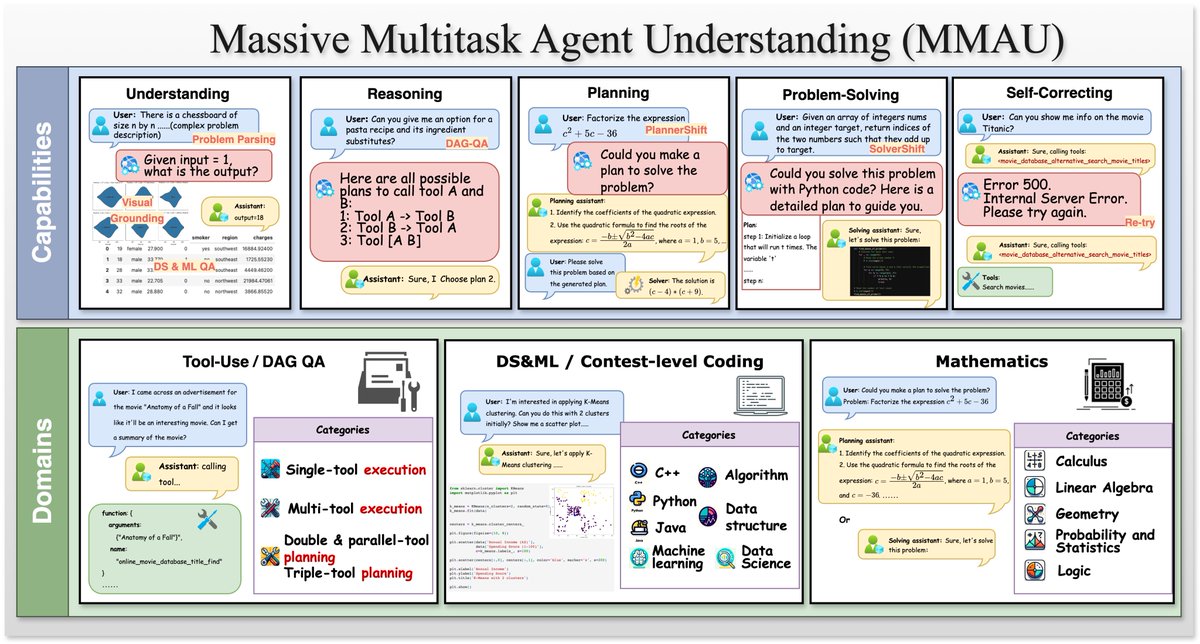
🌟 Are you in search of a benchmark for LLM agents? Introducing MMAU, providing comprehensive and multi-dimensional evaluations for LLMs as agents. 🧵👇 1/
Paper: https://t.co/RdiAyQKJLU
Code: https://t.co/XrqnJ1gUM7
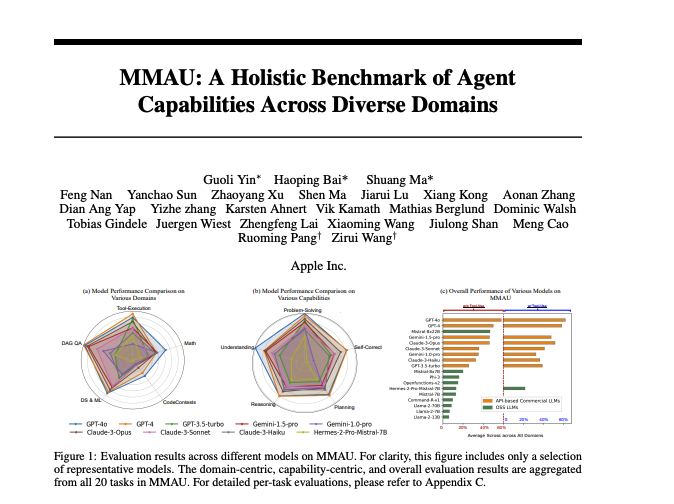
Apple presents MMAU
A Holistic Benchmark of Agent Capabilities Across Diverse Domains
Recent advances in large language models (LLMs) have increased the demand for comprehensive benchmarks to evaluate their capabilities as human-like agents. Existing benchmarks, while useful, often focus on specific application scenarios, emphasizing task completion but failing to dissect the underlying skills that drive these outcomes. This lack of granularity makes it difficult to deeply discern where failures stem from. Additionally, setting up these environments requires considerable effort, and issues of unreliability and reproducibility sometimes arise, especially in interactive tasks. To address these limitations, we introduce the Massive Multitask Agent Understanding (MMAU) benchmark, featuring comprehensive offline tasks that eliminate the need for complex environment setups. It evaluates models across five domains, including teal{Tool-use}, teal{Directed Acyclic Graph (DAG) QA}, teal{Data Science and Machine Learning coding}, teal{Contest-level programming} and teal{Mathematics}, and covers five essential capabilities: orange{Understanding}, orange{Reasoning}, orange{Planning}, orange{Problem-solving}, and orange{Self-correction}. With a total of 20 meticulously designed tasks encompassing over 3K distinct prompts, MMAU provides a comprehensive framework for evaluating the strengths and limitations of LLM agents. By testing 18 representative models on MMAU, we provide deep and insightful analyses. Ultimately, MMAU not only sheds light on the capabilities and limitations of LLM agents but also enhances the interpretability of their performance.
🚀📷 Excited to share that we have released VeCLIP to improve CLIP pre-training.
Github: https://t.co/LAxRHBEPIN
ArXiv: https://t.co/z6HBPcoP6R
We achieved 83.1% 0-shot on ImgNet with H14, trained on DFN-5B and 300M synthetic captions.
🚀🚀 Excited to release code & ckpt for our new image encoders.
1. VeCLIP: https://t.co/c2xHMRABr4
83.1% 0-shot on ImgNet with H14, trained on DFN-5B and 300M synthetic captions
2. MOFI: https://t.co/bAvAWegqZ8
SOTA on image retrieval, trained on 1B entity-annotated images.
🌟 Introducing VeCLIP: Improving CLIP training via visual-enriched captions
📘https://t.co/nKguy7avrg
⛽️ Data is the fuel for CLIP training, however, alt-text can be noisy.
🚀🚀 By using Vicuna and LLaVA for text rewriting, VeCLIP boosts CLIP perf across 3M-200M data scales.
@NielsRogge@zhegan4 Thanks Niels! These two papers either use LLM alone or captioning model alone. The former cannot add new info while the latter may lack the powerful language ability. We design our pipeline to fuse Captioning + LLM to further boost caption quality.