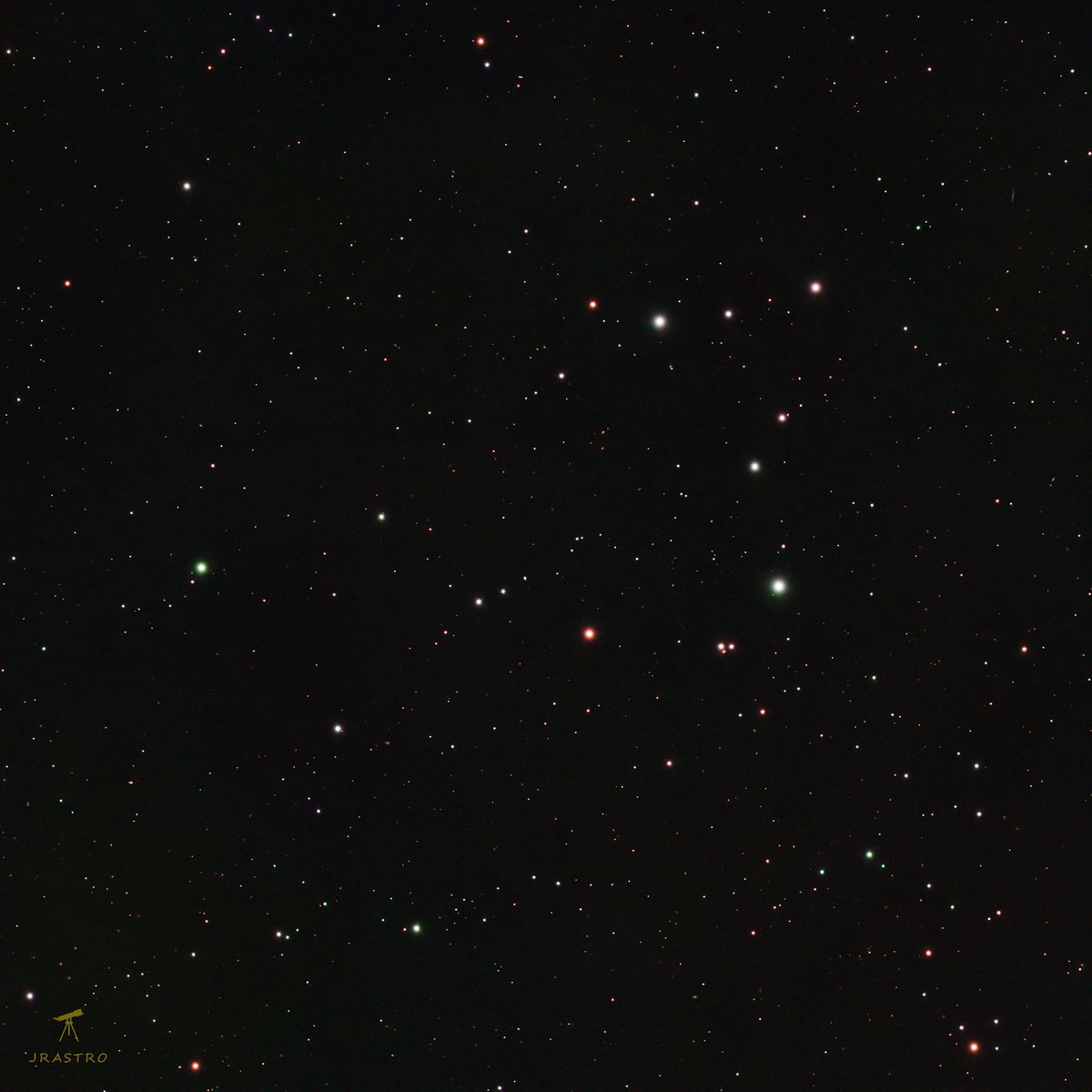
@astrophotosnap Greg's 3 Asterism
Located in Leo constellation between the stars 7 and 8 Leonis. Visible with a small telescope or high power binoculars like 15x70. It was discovered by Greg Parker in 2013. Here is the article:
https://t.co/x7nkpp32Tu
Total Int: 3h 39min
IC443 - The Jellyfish Nebula is a galactic supernova remnant in the constellation Gemini.
I processed this image in HOO, incorporating SII data using Adam Block Gilding Method. I think I ended up with a nice Red/Orange color.
Total Int: 16 hours 43 mins
https://t.co/VhZiQdMazD
@AstroBackyard Now my tracking isn't great and I lose a lot of subs. I emailed CS and it has made things worse. I need to call CS. The AM5 is fantastic. And still light enough to carry in and out. With SW 100ED scope, EAF, EFW...
@AstroBackyard I have both the GTi and am AM5. The GTi was awesome for a year. Then both axis became a little loose. Found out this may be due to the fact that I keep my rigs together and carry them in and out. I was not loosening the clutches before moving.
Also a correction for you. Venus is not always the brightest object in the sky. It may be the brightest object when it is above the horizon, about 8 1/2 months of the year. And in the morning just before sunrise. Sirius is the brightest star.
@FFHitman Listened to @SpitballersPod today. Suggestion: See if there is an Astronomy Club near you. Join it with your daughter. They're very knowledgeable and welcoming to new members. Don't even need a scope, they have them to use, & sometimes borrow
LDN 1235 - The Shark Nebula
There's a Shark in Space. LDN 1235 (The Shark Nebula) is a cloud of interstellar gas and dust spanning 15 light-years head-to-tail. Located in the constellation Cepheus. #Astrophotography
IG https://t.co/BKB8Y5FumS
Astrobin
https://t.co/L1LVjG94zo