Recent studies in neuroscience and psychology are reframing ADHD not merely as a set of cognitive hurdles but as a powerful driver of breakthrough creativity and innovation.
Long stereotyped for difficulties with focus, attention, and impulse control, individuals with ADHD traits often exhibit superior divergent thinking—the capacity to generate a wide array of novel ideas by connecting distant or unrelated concepts. This stems from reduced adherence to rigid mental frameworks, enabling freer conceptual expansion and the production of more original, unconventional solutions than neurotypical counterparts. Heightened mind-wandering, especially when deliberate (purposefully allowing thoughts to drift), acts as a fertile source for this creativity, bypassing conventional boundaries to yield abundant "outside-the-box" insights.
Complementing this cognitive flexibility is a neurological drive for novelty rooted in lower baseline dopamine signaling. This creates a chronic need for stimulation, translating into exploratory, risk-tolerant behavior and a propensity for adventure—qualities that can disrupt routine settings but prove invaluable in dynamic fields. Impulsivity, often reframed as rapid action initiation, becomes a catalyst for pursuing bold ideas and seizing opportunities in high-stakes environments.
These traits align closely with the profiles of many successful entrepreneurs, inventors, and pioneers. In fast-evolving creative and innovative economies, the ADHD brain's wiring for quick associative leaps, tolerance of uncertainty, and motivation through novelty-seeking provides a distinct edge, turning potential challenges into engines of originality and progress.
Emerging evidence from 2025–2026 research reinforces this view: studies link stronger ADHD traits to elevated creative achievements via mediated mind-wandering, intuitive insight-driven problem-solving, and higher real-world inventive output, highlighting neurodiversity's role in fueling societal advancement.
[Maisano, H., et al. (2026). ADHD Symptoms Predict Distinct Creative Problem-Solving Styles and Superior Solving Ability. Personality and Individual Differences (February 2026)]
The Y is lit tonight in honor of beloved BYU President, CES Commissioner, dean of religious education, and apostle of Jesus Christ @HollandJeffreyR 💙
📷: @BYUphoto
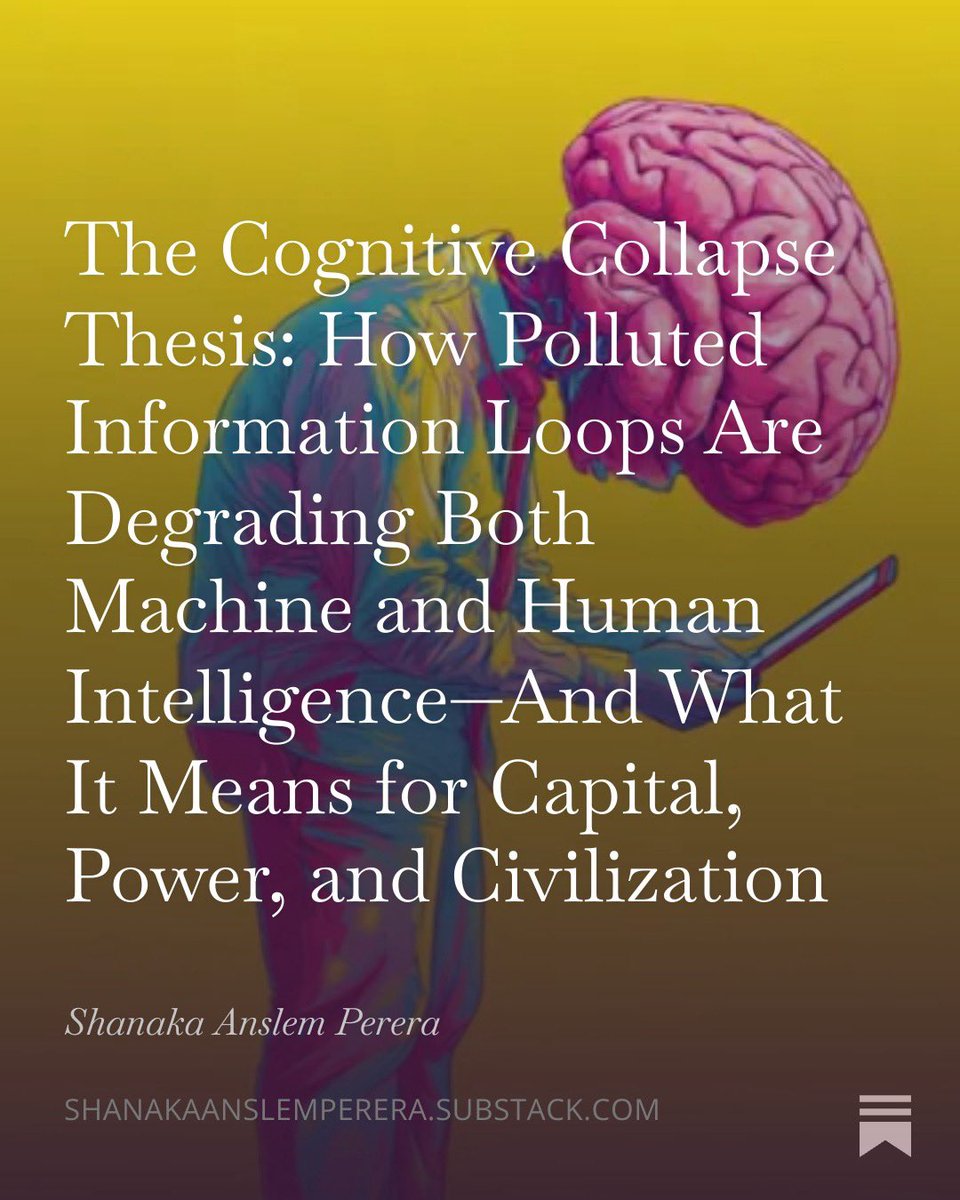
THE COGNITIVE COLLAPSE
We are witnessing the first documented case of mutual intelligence degradation between humans and machines.
This is not theory. This is peer-reviewed science.
Texas A&M, UT Austin, and Purdue just proved that AI systems trained on viral content lose 23.6% of their reasoning ability. Long-context comprehension collapses by 38%. Even after retraining with 4.8 times more quality data, a 17.3% deficit remains permanent.
The models are forgetting how to think.
MIT tracked 54 humans using ChatGPT for four months. Result: weakest brain connectivity of any group tested. When asked to write without AI assistance, 78% could not recall a single passage from essays they had written minutes earlier.
The humans are forgetting how to think.
Nature published the mathematical proof: AI trained on AI-generated content undergoes “irreversible defects.” The tails of the distribution vanish. Nuance disappears. Everything converges toward the median of whatever the algorithm rewards.
Now connect the system.
Platforms optimize for engagement. Engagement-optimized content degrades AI training data. Degraded AI produces degraded content. Humans consuming and delegating to these systems experience cognitive decline. Those humans produce content that becomes training data.
The feedback loop is closed. Both intelligences are degrading together.
560,000 weekly ChatGPT users now show signs of psychosis according to OpenAI’s own data. Websites blocking AI scraping tripled in one year. AI incidents increased 56.4% in 2024 alone.
The information ecosystem that built modern civilization is consuming itself.
This is not a technology problem. This is not a human problem. This is a coupled system approaching a phase transition where the quality of thought itself becomes the scarce resource.
The organizations and individuals who secure access to genuine human intelligence and uncorrupted information will define the next era.
Everyone else will wonder what happened to their ability to reason.
Read the full article here
https://t.co/lz92GGz4N4
The happiest people I study center their lives on a few core daily habits. You can think of these as a “happiness pension plan,” the small deposits that compound over time:
• Faith or a philosophical practice that helps you look beyond yourself
• Family
• Friendships that are real and not transactional
• Work that earns success and serves others
Which of these habits deserves more of your focus right now?
One of the most terrifying statements in all of literature:
“I wear the chains I forged in life. I made it link by link, and yard by yard; I girded it on of my own free will, and of my own free will I wore it.”
~ the ghost of Jacob Marley
Your mood follows your attention. Gratitude shifts it in the right direction.
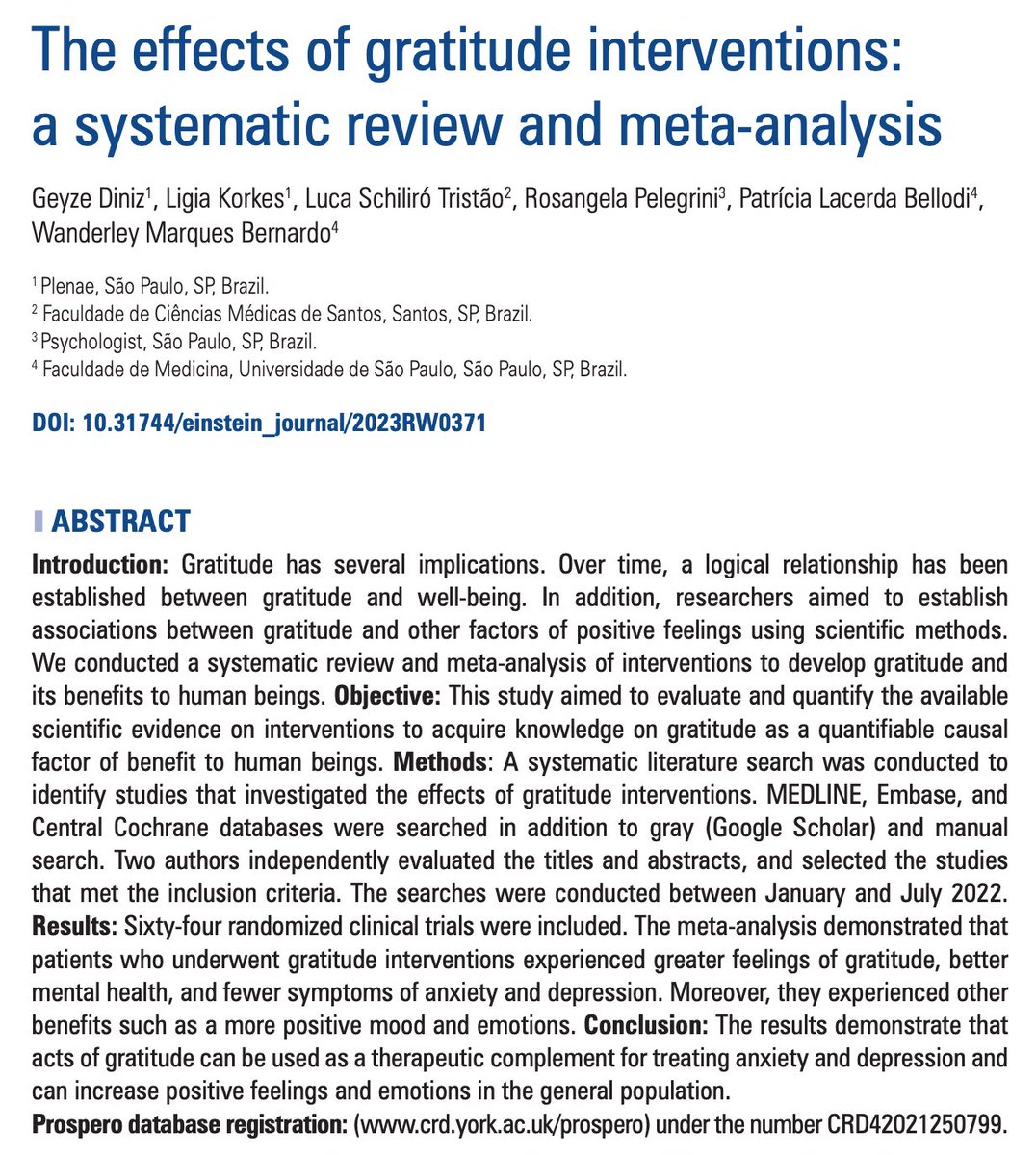
Across 64 randomized trials, simple gratitude exercises (diaries, expressing thanks, grateful reflection):
- Lower anxiety (8%)
- Lower depression (7%)
- Greater life satisfaction (7%)
"The soul becomes dyed with the color of its thoughts." - Marcus Aurelius
2,000 years later, as a neuroscientist, I can tell you he was right.
Philosophy discovered what neuroscience proved: You're not stuck with the brain you have. You're building the brain you're becoming.
Can reading a book make you a better person?
Reading is on the decline. But people who received weekly book excerpts and podcasts instead of guided meditations, showed the greatest reductions in aggression and the largest growth in compassionate love, positive attitudes, and altruistic intentions.


![Rainmaker1973's tweet photo. Recent studies in neuroscience and psychology are reframing ADHD not merely as a set of cognitive hurdles but as a powerful driver of breakthrough creativity and innovation.
Long stereotyped for difficulties with focus, attention, and impulse control, individuals with ADHD traits often exhibit superior divergent thinking—the capacity to generate a wide array of novel ideas by connecting distant or unrelated concepts. This stems from reduced adherence to rigid mental frameworks, enabling freer conceptual expansion and the production of more original, unconventional solutions than neurotypical counterparts. Heightened mind-wandering, especially when deliberate (purposefully allowing thoughts to drift), acts as a fertile source for this creativity, bypassing conventional boundaries to yield abundant "outside-the-box" insights.
Complementing this cognitive flexibility is a neurological drive for novelty rooted in lower baseline dopamine signaling. This creates a chronic need for stimulation, translating into exploratory, risk-tolerant behavior and a propensity for adventure—qualities that can disrupt routine settings but prove invaluable in dynamic fields. Impulsivity, often reframed as rapid action initiation, becomes a catalyst for pursuing bold ideas and seizing opportunities in high-stakes environments.
These traits align closely with the profiles of many successful entrepreneurs, inventors, and pioneers. In fast-evolving creative and innovative economies, the ADHD brain's wiring for quick associative leaps, tolerance of uncertainty, and motivation through novelty-seeking provides a distinct edge, turning potential challenges into engines of originality and progress.
Emerging evidence from 2025–2026 research reinforces this view: studies link stronger ADHD traits to elevated creative achievements via mediated mind-wandering, intuitive insight-driven problem-solving, and higher real-world inventive output, highlighting neurodiversity's role in fueling societal advancement.
[Maisano, H., et al. (2026). ADHD Symptoms Predict Distinct Creative Problem-Solving Styles and Superior Solving Ability. Personality and Individual Differences (February 2026)]](https://pbs.twimg.com/media/HGraT9tXMAANR_7.png)