This has been my experience my entire life. When I take notes by hand, I remember things better. If I attended class in college and took notes, I rarely had to pull an all-nighter or cram. Alas, my handwriting is getting worse as I age, making this tougher!
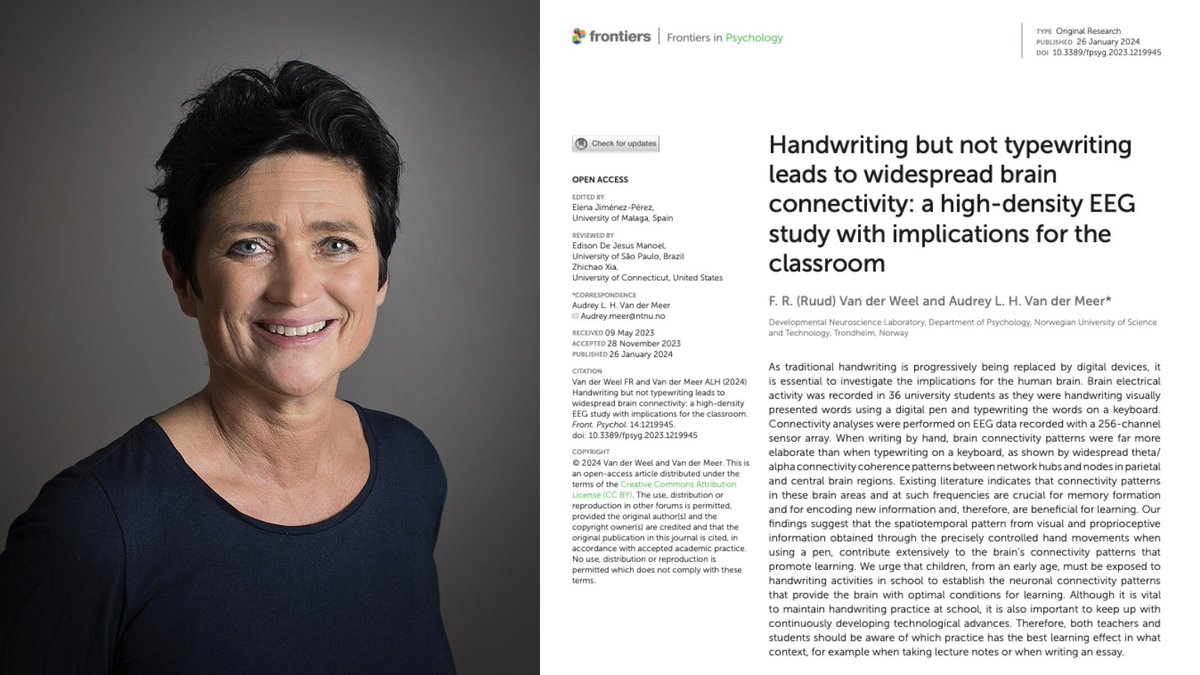
A Norwegian neuroscientist spent 20 years proving that the act of writing by hand changes the human brain in ways typing physically cannot, and almost nobody outside her field has read the paper.
Her name is Audrey van der Meer.
She runs a brain research lab in Trondheim, and the paper that closed the argument was published in 2024 in a journal called Frontiers in Psychology. The finding is brutal enough that it should have changed every classroom on Earth.
The experiment was simple. She recruited 36 university students and put each one in a cap with 256 sensors pressed against their scalp to record brain activity. Words flashed on a screen one at a time.
Sometimes the students wrote the word by hand on a touchscreen using a digital pen, and sometimes they typed the same word on a keyboard. Every neural response was recorded for the full five seconds the word stayed on screen.
Then her team looked at the part of the data most researchers had ignored for years, which is how different parts of the brain were communicating with each other during the task.
When the students wrote by hand, the brain lit up everywhere at once.
The regions responsible for memory, sensory integration, and the encoding of new information were all firing together in a coordinated pattern that spread across the entire cortex. The whole network was awake and connected.
When the same students typed the same word, that pattern collapsed almost completely.
Most of the brain went quiet, and the connections between regions that had been alive seconds earlier were nowhere to be found on the EEG.
Same word, same brain, same person, and two completely different neurological events.
The reason turned out to be something nobody had really paid attention to before her work. Writing by hand is not one motion but a sequence of thousands of tiny micro-movements coordinated with your eyes in real time, where each letter is a different shape that requires the brain to solve a slightly different spatial problem.
Your fingers, wrist, vision, and the parts of your brain that track position in space are all working together to produce one letter, then the next, then the next.
Typing throws all of that away. Every key on a keyboard requires the exact same finger motion regardless of which letter you are pressing, which means the brain has almost nothing to integrate and almost no problem to solve.
Van der Meer said it plainly in her interviews.
Pressing the same key with the same finger over and over does not stimulate the brain in any meaningful way, and she pointed out something that should scare every parent who handed their kid an iPad.
Children who learn to read and write on tablets often cannot tell letters like b and d apart, because they have never physically felt with their bodies what it takes to actually produce those letters on a page.
A decade before her, two researchers at Princeton ran the same fight using a completely different method and ended up at the same answer. Pam Mueller and Daniel Oppenheimer tested 327 students across three experiments, where half took notes on laptops with the internet disabled and half took notes by hand, before testing everyone on what they actually understood from the lectures they had watched.
The handwriting group won by a wide margin on every question that required real understanding rather than surface recall.
The reason was hiding in the transcripts of what the two groups had actually written down.
The laptop students typed almost word for word, capturing more total content but processing almost none of it as they went, while the handwriting students physically could not write fast enough to transcribe a lecture in real time, which forced them to listen carefully, decide what actually mattered, and put it in their own words on the page.
That single act of choosing what to keep was the learning itself, and the keyboard had quietly skipped the choosing and skipped the learning along with it.
Two studies. Two countries. Same answer.
Handwriting makes the brain work. Typing lets it coast.
Every note you have ever typed instead of written went into your brain through a thinner pipe. Every meeting, every book highlight, every idea you captured on your phone instead of on paper was processed at half depth.
You did not forget those things because your memory is bad. You forgot them because typing never woke the part of the brain that would have made them stick.
The fix is the thing your grandmother already knew.
Pick up a pen. Write the thing down. The slower road is the faster one.
This is GLORIOUS
David Letterman & Stephen Colbert on the roof of the Ed Sullivan Theatre bringing back the classic @Letterman routine one last time
This is how you go out, @StephenAtHome! 😂
And may @CBS implode literally the same way without you
Trump April 23: I contacted people "that have worked for me in the past, doing swimming pools," and one gave me a great price on the Reflecting Pool project
Trump May 4: "I have some very good contractors," asked three of them to "do me a favor fellas" and go look at the Reflecting Pool, and the best one gave me a great price
Trump today: The Reflecting Pool contract "went to a contractor I did not know, and have never used before"
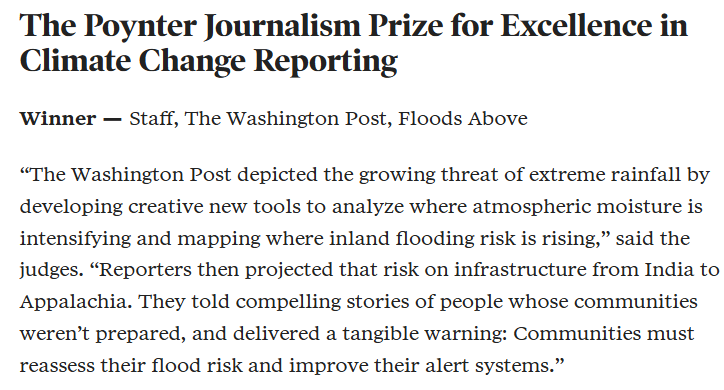
🏆Congratulations to our team for winning The @Poynter Journalism Prize for Excellence in Climate Change Reporting!
Start here to begin reading their "Floods Above" series on how rising atmospheric moisture is driving torrential rains all over the globe: https://t.co/Ai5QGKP7D2
https://t.co/BjCa9YgAhB
Grateful to part of a stellar @washingtonpost team awarded the first-ever Poynter Journalism Prize for Excellence in Climate Change Reporting for "Floods Above," our series on rising atmospheric moisture is driving torrential rains all over the globe:
https://t.co/gF6vFc4piW
It's always a great day when we get to announce the winners of the Poynter Journalism Prizes! The judges were so impressed by the high-quality, high-impact journalism we saw in the contest, across platforms and newsroom sizes. Please congratulate all the winners and finalists!
It’s funny that no one reads print newspapers anymore, which has forced them to adopt crazy early deadlines to survive economically but when big news happens everyone expects to see it in print (which they don’t subscribe to) like it was 1990 again and there was no internet.
outrageous. media companies need to find a way to get info out faster than in print. perhaps a way to publish instantaneously, and in a manner that could be updated as news develops. and what if, someday, you could somehow get the articles without having to go to a newsstand?
Fact-checkers worldwide are under more pressure than ever. Their reach has also never been greater. Tomorrow, on April 2, the IFCN is showing the data – and exploring what comes next.
There's a lot more to the Paramount-Warner Bros Discovery deal than what happens to CNN. Check out the latest @Poynter Report Podcast with my guest, @sarafischer of @axios as we talk about the big deal, Substack and the future of newsletters.
https://t.co/ew0fF9HSc4
Thanks to USA Today for giving me the opportunity to write about the worrisome implications for free speech raised by the attempt to censor Stephen Colbert's interview of U.S. Senate candidate James Talarico.
https://t.co/6AiUY5TwOp
This should be a bigger story.
ICE detained a father when he stepped outside his apartment to pick up dinner. His 6-year-old daughter was left alone. Neighbors later found her outside, crying in the street, asking for her father.
If any local law enforcement agency conducted an operation and left a child without supervision, there would be investigations, accountability, and consequences. That is what the public would rightly demand.
So where is the accountability here?
No matter your views on immigration policy, a 6-year-old child should never be left alone and vulnerable because of a federal enforcement action.
Basic standards of care and common sense still matter.
https://t.co/J9fnCy3rhd