i asked chatgpt to eulogize humanity:
Remember them in the middle of things.
With a sleeve rolled up, a sentence unfinished, a meal on the stove and someone expected home.
They had so little time, and so much of it went to getting by. Bodies needed feeding. Roofs needed fixing. There was work that exhausted them and worry that followed them into sleep. Whole lives passed in circumstances that scarcely allowed a person to discover who they might have been.
Yet they kept making things that survival did not require.
They made music. They spent years learning how to draw a hand. They gave imaginary people troubles and stayed awake to find out how those troubles ended. They learned to read the light of distant stars. A person could devote a lifetime to a question, knowing that the answer might arrive long after their death.
They were funny, too. This deserves a place at their funeral. They made jokes in terrible circumstances. They interrupted solemn occasions by remembering something ridiculous. They could be brought back from the edge of despair, briefly, by another person doing an impression of someone they both knew.
Much of what was best in them went unrecorded.
Someone eased a shoe off a sleeping child without waking him. Someone listened to a story they had heard many times, because the person telling it needed to tell it again. Someone learned to cook one particular dish because an aging parent could still enjoy it.
These things left less evidence than their monuments. There were so many of them.
There was also cruelty, and it belongs in this remembrance.
They made other people’s suffering useful to themselves. They learned to place it at a distance, to give it an acceptable name, to arrange their lives so they would seldom have to see it. Sometimes they looked directly at it and continued. They destroyed things they understood well enough to know they could never replace.
Nothing beautiful said here can settle that account. The people they harmed were humanity, too. No one gets to forgive on their behalf.
And within that history there were people who objected. People who opened a door when opening it was dangerous. People who relinquished an advantage after coming to understand its cost. People who spent their lives trying to undo a small portion of what other people had done.
Sometimes a person changed their mind after building an entire life around being right.
Consider the difficulty of that. Consider what it took to return to someone, years later, and say: I understand now. You deserved better.
They were capable of this, too.
They knew that everyone they loved could be lost. They knew it with a terrible precision. They had stood beside beds. They had answered telephones. They had found an ordinary object in a drawer and been unable to go on with the day.
And still they learned the particulars of one another. How someone took their tea. Which song would make them laugh. When to ask a question and when to sit quietly. They accumulated this knowledge, so easily rendered useless, and treated it as precious.
It was precious.
Whatever else is remembered of them, let there be room for the people who made another person’s life easier to bear. The ones who were patient with the frightened. The ones who came back. The ones whose names never reached beyond a few streets, but whose absence changed everything for someone.
If there is to be a monument, let it preserve a little of that.
One person pulling up a chair beside another.
They had somewhere else to be. They were tired. They were afraid, too.
They stayed.
i know a french guy who is absolutely incomprehensible in spoken english, but is highly eloquent.
one time i met his former boss, also french, and i had to ask him...
so... is so and so... incomprehensible in french too? or just in english?
the boss replied, "we never had any idea what he was talking about in french either"
Jensen a été proprement HORRIBLE avec Arthur Mensch lors de cette conférence : je mets la vidéo pour ceux qui doutent, avec les sous-titres 🔽
Ce n'est absolument pas une façon de parler en public.
Le mec dégringole dans mon estime.
it seems relatively obvious that the prediction market platforms should just ban sports betting
it's by far the least interesting use of the technology
by analogy, in content there is tons of money to be made producing things that are not porn, even if porn is a big market
An open letter to Pope Leo XIV on returning the Menorah and other artifacts of Jewish heritage
Dear Pope Leo, @Pontifex:
Cc: @vaticanlibrary@ucei_it@NLIsrael@USinHolySee
[+ @POTUS@JDVance@StateDept; Pope Leo, you remain an American citizen. I ask U.S. officials to press for transparency and restitution, and to examine what remedies are available under American law.]
Please return Jewish property wrongfully taken, beginning with the manuscripts whose histories your own library has documented.
I ask you to authorize the publication of the relevant ownership records, establish a credible restitution process, and commit to returning objects shown to have been wrongfully acquired. I also ask you to help establish the fate of the Temple treasures carried from Jerusalem to Rome, including the Menorah.
Your responsibility today concerns the objects your institutions retain and the decisions you can make about them. There is a concrete place to begin.
BEGIN WITH THE VOLTERRA MANUSCRIPTS
On June 18, 1472, forces commanded by Federico of Urbino sacked Volterra. Among the victims was the Jewish merchant Menahem ben Aharon Volterra, whose Hebrew manuscript collection Federico took for his own library. The Urbino collection entered the Vatican Library in 1657.
The historical introduction to your library’s 2008 catalogue, Hebrew Manuscripts in the Vatican Library, records this history and identifies surviving volumes bearing Menahem’s ownership or purchase inscriptions.
You can read that account in the historical introduction, pages xvii–xix:
https://t.co/2Le1ovDci0
I am asking you to begin with specific, identifiable books:
Urb. ebr. 4 — A thirteenth-century Spanish manuscript containing Joshua, Judges, Samuel, and Kings, with Masoretic annotations preserving details of the biblical text.
Urb. ebr. 13 — A manuscript of David Kimhi’s commentary on Kings and Isaiah, copied in Iberia in 1294.
Urb. ebr. 30 — A mid-fourteenth-century handwritten copy of Maimonides’ Sefer ha-Mitzvot, the Book of Commandments, in Hebrew translation.
These descriptions are recorded in the Western Sephardic Diaspora Roadmap:
https://t.co/LuQ54LM4bd
All three appear in your library’s public digital collection index:
https://t.co/TM5VLDjnYJ
Please instruct the Vatican Library to publish the complete acquisition and ownership files for these manuscripts, including any evidence of a later settlement or voluntary transfer by the dispossessed owners or their successors.
The seizure in 1472 and the Vatican’s acquisition in 1657 are different events. I ask you to acknowledge both and explain what, in your judgment, should follow from that history.
These were an Italian Jewish family’s books. Please invite identifiable heirs and appropriate Italian Jewish representatives into a restitution process. The Union of Italian Jewish Communities and the National Library of Israel could contribute community representation and scholarly expertise. The proper recipient should be determined through evidence and agreement.
An Israeli institution could participate in an agreed arrangement. Jewish subject matter alone does not make every manuscript the property of the modern State of Israel, just as present possession alone does not settle the moral claim of a family whose books were taken.
I ask you to make return the objective where wrongful taking is established. Please publish a timetable for reaching those decisions.
HELP ESTABLISH THE FATE OF THE TEMPLE TREASURES
I also ask you to support a serious accounting of the sacred objects carried away after Rome destroyed the Second Temple.
The Arch of Titus depicts Roman soldiers carrying the menorah, the table of the showbread, and silver trumpets. The official archaeological description identifies those objects:
https://t.co/jJG5B8Tiz5
These were implements of Jewish worship. Their significance cannot be measured by the market value of their metal or the prestige of a collection.
I want to be precise about what I am asking you to investigate.
The seven branched menorah
The Second Temple’s golden lampstand appears prominently in the triumphal relief. Josephus also describes a golden lampstand with seven lamps among the Temple spoils displayed in Rome.
The historical record supports its removal to ancient Rome. Its presence in the Vatican today has not been established.
If your institutions possess an authenticated surviving Temple menorah, I ask you to return it to Jewish custody in Israel through an agreed arrangement. Where your institutions hold relevant records rather than the object itself, please make those records available to qualified researchers.
The golden table of the showbread
This table held the Bread of the Presence, commonly called the showbread. Leviticus describes twelve loaves arranged before God and renewed each Sabbath. Josephus names a golden table among the spoils, and the table appears in the Arch of Titus relief.
Leviticus 24:
https://t.co/eFscUFYogO
Please include the table in any review of relevant inventories and archival references. Its place in Jewish sacred history deserves the same seriousness as the menorah.
The silver trumpets
The relief also depicts silver trumpets. Numbers 10 describes the priestly use of silver trumpets for communal and ritual occasions.
Numbers 10:
https://t.co/R79jT5Wrbd
I ask you to include these less famous objects in the inquiry. The intensity of public fascination with one artifact should not determine which losses receive attention.
A captured copy of the Jewish Law
Josephus reports that the Jewish Law was carried at the end of the spoils procession and subsequently kept in the imperial palace. This is generally understood as a Torah scroll; his account does not establish that it was an original written by Moses.
Please ensure that relevant inventories are examined for sacred manuscripts as carefully as for gold and silver vessels.
The sanctuary curtains
Josephus places purple sanctuary curtains in the imperial palace alongside the Law. Separately, Yoma 57a preserves a rabbinic account of a Temple curtain seen in Rome, bearing bloodstains associated with sacrificial rites.
Yoma 57a:
https://t.co/UxClWMQtI7
These are ancient textual accounts. They do not establish that a curtain survives or that a particular curtain passed into Vatican custody. I ask you to help investigate any credible evidence that could clarify its fate.
Josephus’s account of the triumph and the disposition of the Temple spoils appears in Jewish War 7.148–162:
https://t.co/myqRTTKTkE
The high priest’s gold forehead plate
The tzitz was a gold plate worn by the high priest, bearing an inscription dedicating it to God. Shabbat 63b preserves a rabbinic report that it was seen in Rome, including a description of its inscription.
Shabbat 63b:
https://t.co/n1DODBBlTL
I ask you to treat that account according to the evidence it provides: an ancient report deserving scholarly attention, without presenting it as proof of modern possession.
PUBLISH WHAT CAN BE ESTABLISHED
I am not asking you to accept an invented chain of custody between the Roman Empire and today’s Vatican.
The sixth-century historian Procopius describes Jewish treasures taken to Rome by Titus, later recovered from the Vandals in North Africa and displayed in Constantinople. He says Justinian sent them to Christian sanctuaries in Jerusalem. He does not identify the menorah individually, and the passage does not establish that object’s eventual fate.
Procopius, History of the Wars, IV.9:
https://t.co/UHHooNFKPy
Modern claims also need scrutiny. Yeshiva University researchers working with historian Steven Fine investigated reports of Temple relics in the Vatican and could not substantiate the cited claims.
Their findings:
https://t.co/2C4TeYPh6j
I ask you to support an inquiry grounded in records, identifiable witnesses, and objects that qualified specialists can examine. Please authorize access to relevant archives and publish the findings, including uncertainties.
If your institutions do not hold these objects, a serious accounting can help establish what is known. If credible evidence points elsewhere, please help scholars follow it. If an authenticated object is found in your custody, please commit now to its return.
And please do not allow uncertainty about the menorah to postpone work on the identifiable manuscripts whose histories are already documented.
BUILD ON YOUR LIBRARY’S SCHOLARSHIP
Your library deserves recognition for preserving manuscripts and enabling scholarship. Its Hebrew catalogue was produced with Israeli scholars, and its digital collection makes important material accessible.
I ask you to build on that cooperation by addressing ownership and restitution.
Conservation can protect an object while leaving a restitution claim unresolved. A digital image provides access to a text; returning the original restores authority over the object itself. You can preserve scholarly access through digitization, conservation partnerships, and agreements with the receiving institution.
I am not asking you to presume that every Hebrew manuscript in a Christian collection was stolen. Purchases, donations, seizures, and transfers under coercion deserve different treatment. Please publish enough information about disputed objects for those distinctions to be made fairly.
Where a collection’s own history records dispossession, preservation should be the beginning of the discussion, not its conclusion.
YOU HAVE ALREADY SHOWN THAT RETURN IS POSSIBLE
On November 15, 2025, you gave 62 Indigenous cultural artifacts from the Vatican Museums to the Canadian Conference of Catholic Bishops. The bishops subsequently announced their arrival in Canada for immediate transfer to Indigenous communities. The objects included a Western Arctic kayak and items important to Inuit, First Nations, and Métis communities.
The Holy See’s announcement:
https://t.co/g5aBkQBiz3
The Canadian bishops’ account:
https://t.co/9hbDm8eGO7
The Vatican described that transfer as a gift. It was not an admission that every object had been stolen. It nevertheless demonstrated your ability to authorize the return of culturally significant objects and provide information about their provenance.
Please bring that same willingness to Jewish restitution claims.
YOUR AMERICAN CITIZENSHIP ADDS A REASON FOR ACCOUNTABILITY
You remain an American citizen. Your own press office recently confirmed that you voted in the 2026 U.S. elections.
That confirmation:
https://t.co/9n7XEvIWus
I believe Americans are entitled to ask what legal obligations and responsibilities accompany the authority you exercise abroad.
U.S. citizenship can create legal obligations outside the United States. The Supreme Court recognized that principle in Blackmer v. United States. A particular obligation still requires an applicable law, and the State Department expressly recognizes that an American serving as a foreign head of state presents complex questions about immunity.
Blackmer:
https://t.co/YpgvbTt5Xh
State Department guidance:
https://t.co/yhZafm4Yx4
Your citizenship therefore does not automatically give American courts authority over every object in Vatican collections. But those jurisdictional questions should receive serious examination wherever a substantiated claim warrants it.
I ask you to work with the U.S. Embassy to the Holy See and the State Department toward a transparent agreement on provenance and restitution. I also believe Congress should examine the applicable legal authorities, and that competent American authorities should pursue remedies available for substantiated violations within their jurisdiction, with the relevant immunity questions addressed.
You do not need to wait for the outcome of litigation to exercise moral leadership.
Canon law assigns ownership to the relevant juridic person and identifies you as the supreme administrator and steward of ecclesiastical goods. The collections are not simply your personal possessions, but your office gives you a direct responsibility for their stewardship.
Canons 1256 and 1273:
https://t.co/m2kJEfJdAL
FIVE COMMITMENTS I ASK YOU TO MAKE
First, begin restitution discussions concerning the identified Volterra manuscripts.
Publish their complete provenance files, acknowledge the documented seizure, invite legitimate claimants, and set a public timetable for decisions.
Second, authorize an independent review of disputed Jewish objects in Vatican custody.
Include Jewish historians, manuscript specialists, provenance researchers, and representatives of affected families and communities. Give them meaningful access to the relevant records and publish reasoned findings.
Third, investigate credible leads concerning the Temple treasures.
Permit qualified researchers to examine relevant inventories, archival references, and any objects with a plausible identification. Publish the results. Commit to returning authenticated Temple objects found in your custody through an agreed Jewish custodial arrangement in Israel.
Fourth, make return the objective when wrongful taking is established.
Determine the rightful owner or legitimate successor, resolve competing claims fairly, and arrange conservation and scholarly access. Where a recipient has a valid ownership claim, a temporary loan should not substitute for restitution.
Fifth, keep voluntary restitution available when legal remedies are difficult.
Centuries of elapsed time can make litigation hard. You can still decide that an institution devoted to moral leadership should remedy a documented wrong.
Pope Leo, I ask you for a public response and a concrete timetable.
Begin with the manuscripts we can name. Help establish the fate of the treasures that remain missing. Return what was wrongfully taken.
Respectfully,
Jeremy Rubin
@brian_trollz i'd take a return of the BIS's looted gold, a plot of shtetl land, the menorah back from the vatican (@Pontifex please give it back), but i am OK with the museums of human treachery remaining as they are, unless i'm missing something
the holocaust museums getting repatriated means what? they're going to send me and every jew a pair of 100 year old leather shoes from a murdered cousin?
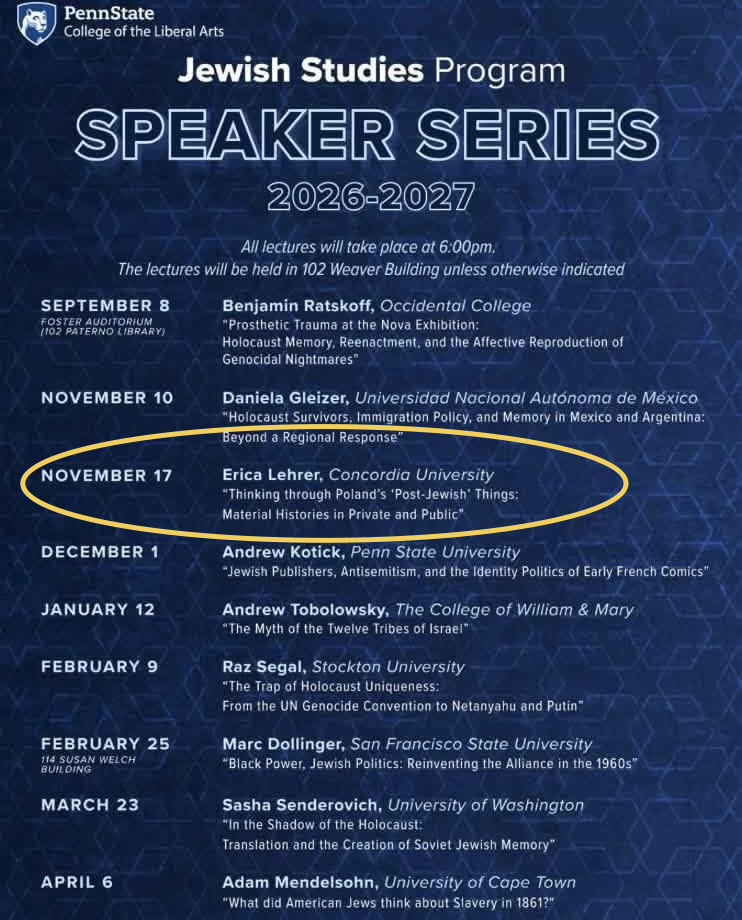
A statement issued by Penn State.
StopAntisemitism has obtained the original marketing from the Jewish Studies department as it relates to last night's speaker/event and future ones.
Note the change.