The heart of the ontological approach is that how you are being in your conversations and relationships (with yourself and others) determines how well you achieve the outcomes that truly matter to you.
Shifting your way of being creates new possibilities and better outcomes.
When all goes well, we feel solid and assured. We have continuity, meaning and purpose.
This is ‘ontological security’, usually playing just beyond our awareness, providing inner strength and a capacity to deal with whatever is thrown at us.
#ontologicalsecurity 🧵
1/11
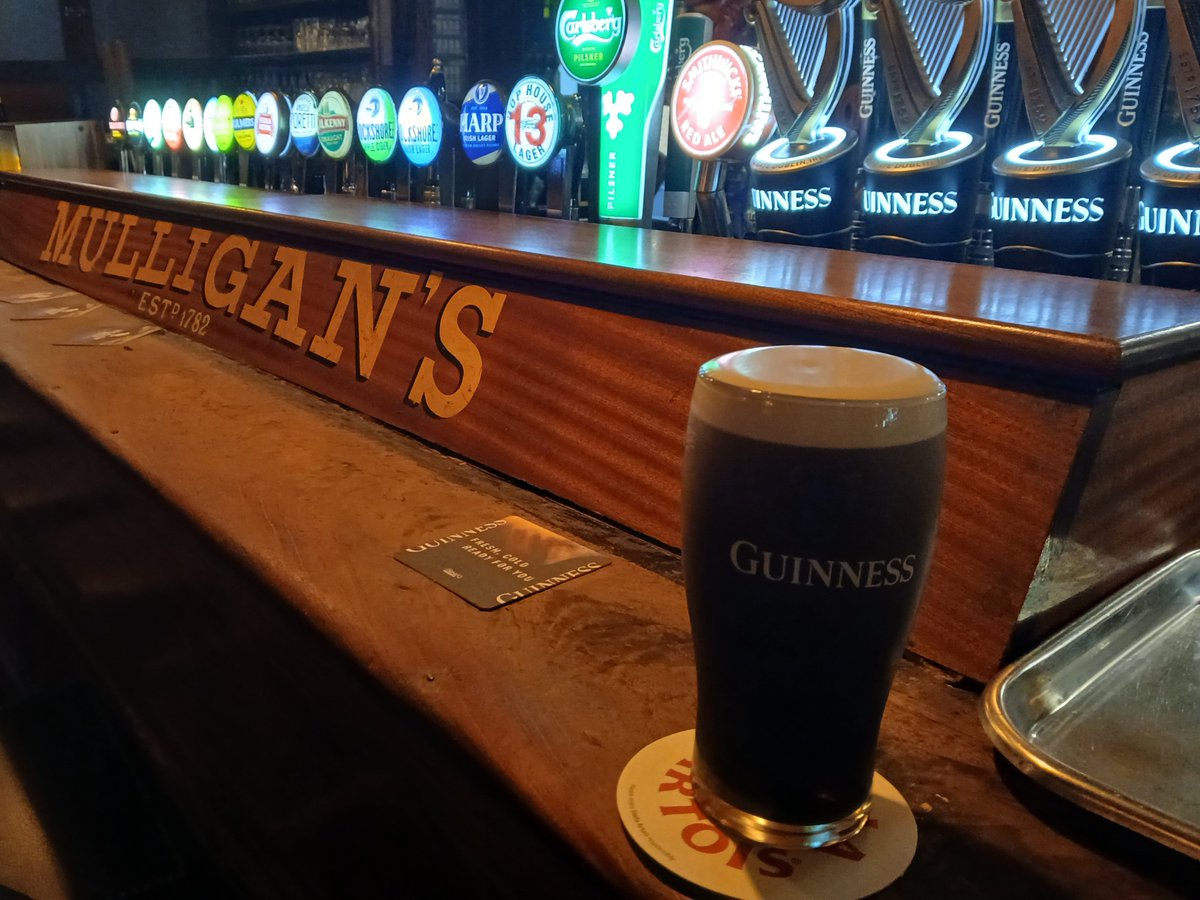
My taxi driver from the airport in Dublin seems to make a slight detour in order to point out what he said is the best place for Guinness, so after my meeting I try it out. I have no adequate benchmark for judging 'best' but I will return next time I visit the city.
1/
@BetterCallMedhi I was lucky to be able to do this before the internet and mobile phones. 22 months of travel, mostly by bus, train and boat. Partly alone, partly not. Travelling alone compounds the external orientation and experience exponentially.
Good to hear everyone's opinions (there were always going to be a few!) about where to get the best Guinness in Dublin. Note to self: next time make it more than a day trip.
My taxi driver from the airport in Dublin seems to make a slight detour in order to point out what he said is the best place for Guinness, so after my meeting I try it out. I have no adequate benchmark for judging 'best' but I will return next time I visit the city.
1/
@nntaleb Some monarchies have been good at this. A wise absolute dictator lasts longer when he/she flexes to the needs of the masses and to avoid being overthrown. The flex is worth it when possibly everything is at stake.
https://t.co/k2PF4qPHfe
NOTES on my recent writing process while still fresh in my mind:
Structure vs flow
I started with maximum compression — the title. Once I had this and the broad arc of the TOC, it was easy to put pen to paper. With a solid structure, it felt easier to let go into the flow.
Looking back, my first book Machine Ego (2019) was haphazardly written. Too much stream of consciousness, not enough structure. It took 14 months to write with too many idle gaps. This time I got it done in 8 months.
Timeline
I only write when I feel like it, to enjoy it — that’s the whole and only point — and I did not have a timeline in mind. My main goal was to avoid the trap of forcing matters. So, I did not 'try' to write, rather made sure I was available to write with an open diary, should the urge arise. Luckily, I had nothing better to do per se.
Editing
I aimed to write for some minutes immersively without self-conscious critique and to only edit AFTERWARDS, rather than nitpick mid-flow. Editing can be done in flow too, but by its very nature it is somewhat finicky.
Daily word counts and routine
A veteran author I respect once told me that he aims to write 1000 words a day, and if one can stick to this the book could be done in a month or two. I did keep this nugget at the back of my mind, though it was peripheral.
On the days I did write, it tended to be between 500 and 1000, sometimes more, sometimes less. If there is any use in awareness of day-word-counts, it is in making the undertaking feel more bite sized. Ultimately, it is secondary to the creative act.
AI as a tool
Unsurprisingly, I did not use AI to write a single sentence. But it was very helpful as an assistant. For example, to find exact locations of quotes remembered from memory, to cross check things, and to educate myself on certain grammar conventions. I think I finally learnt how to use semi colons!
Layout and design
Did the whole book arrangement myself using Adobe InDesign. It was a bit fiddly, but AI helped me figure out the functions quickly. I drew great inspiration from Nassim Taleb's approach of keeping max control of the entire process.
I self-published of course — didn't even try to find an agent or publisher. I don't think I can stomach comments from an editor I don't respect. Plus, there are no delays with self-publishing. Didn't outsource the cover design either.
For its own sake
Ultimately, the writing process is deeply personal. The most important thing is to enjoy it — to, first and foremost, do it for oneself.
In a sense, The Age of Self-Doubt may be considered a series of extended notes that I will turn to myself.
@Spencerjakab Ready Player One.
'In the year 2045, the world is gripped by an energy crisis and global warming, causing widespread social problems and economic stagnation. The primary escape for most people is a virtual universe called the OASIS, which is accessed with a visor...
@Knowledgepoint I'd forgotten how young this building is (it's official opening was shortly after I started work nearby). Or maybe I haven't realised how old I am😅