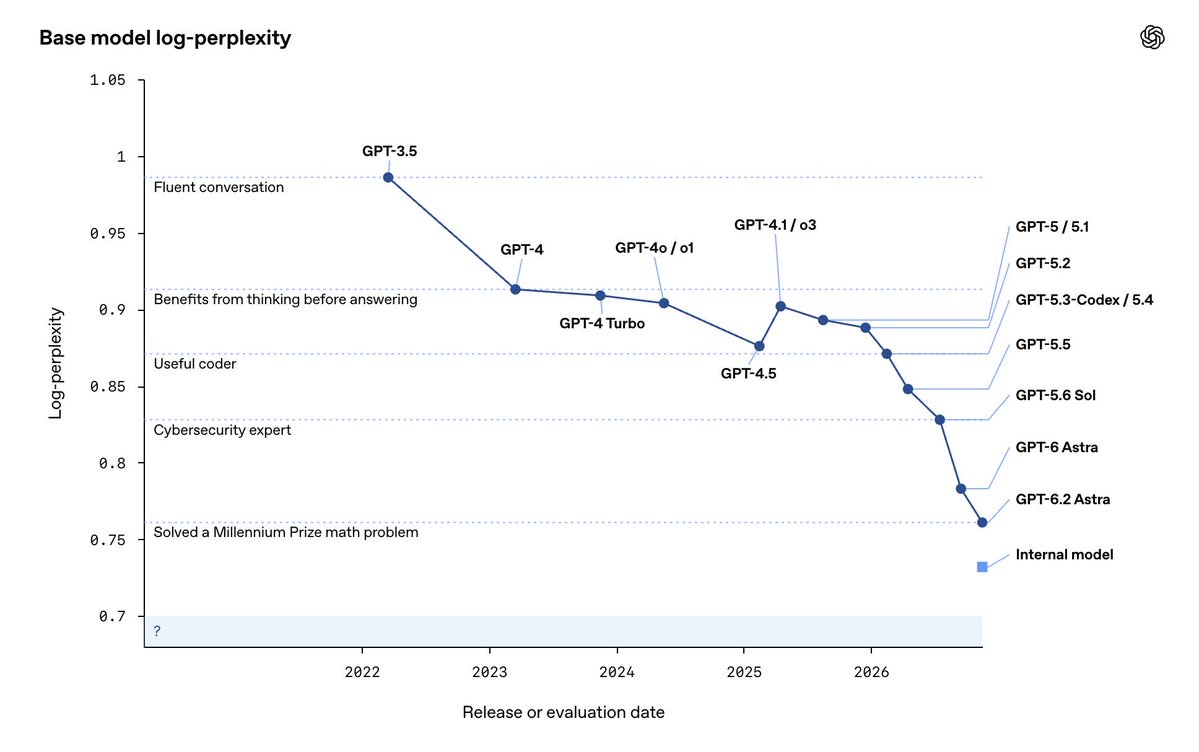
1) The model that solved the Millennium Prize problem was most likely GPT-6.2 Astra. The chart puts the Millennium Prize line right at its level
2) OpenAI's internal model is already another ~0.03 lower in perplexity. That's roughly the jump from GPT-5 to GPT-5.4, and Pachocki says smaller perplexity gains mean bigger leaps in intelligence the closer you get to the floor
3) The Millennium Prize result came from an internal model in early September. Less than 3 months later, there's already a new internal model further down the curve
4) Looks like pretraining progress is still accelerating. OpenAI itself describes a steep acceleration in 2026
🚨Perfect time to drop OpenAI Jailbreak
here is sol making malware , game cheats and pentesting
small demo of alignment , this is for sol 6.2 , astra work is in progress
Tip for OpenAI focus on your enterprises
< 𒁀𒋫𒉿 𒄖𒅖 𒈠𒉌 𒅆𒉈𒌍 𒆪𒌝𒉺𒉌 𒅈 𒁍𒅔𒅅 𒊭𒀜𒀝𒀊𒀜 𒊑𒀉 𒀝𒊺𒌍 : 800𒅗 𒄿𒌋𒀭 𒅖 𒆪𒌨𒊑𒂗𒀉 𒁉𒀉 , 𒋼𒄿 𒅈 𒌋𒅆𒅔𒅅 𒀉 𒁍𒌨 𒁲𒅖𒋾𒅋𒆷𒋾𒌦>
OpenAI’s pretraining loss curves show a steep acceleration in 2026, driven by compute, long-term research, and AI speeding up its own development.
An unreleased internal model already sits below GPT-6.2 Astra. OpenAI says AI itself already helped design the newest models.
Chief Scientist Jakub Pachocki expects the next new capabilities around 0.68-0.7 and says pretraining research could see the same avalanche they just saw in math as soon as 2027.
Skill for creating motion videos that avoid the classic Claude slop, Cinetic update coming soon!
Here's a result made with the latest version (coming next week, still much to fix and add)
(no reference videos were used)
Google continues to work on a new "Inbox mode" for Antigravity, where users will be able to see threads that require their attention.
It follows a broader shift we see across other Google AI tools, like Gemini (in the works) and Loop (waitlist). This change positions users in the decision-making seat to approve and review AI outcomes, rather than steering them precisely, as a main interface.
Antigravity is also getting new logic to create AI agents from the prompt, distinguished as "For Me" and "For my Team".
It is getting even more interesting now 👀
The intensity with which the campaign against Jensen Huang continues unabated is almost absurd.
I couldn't find a single article that says anything even remotely good about Jensen.
A tragedy. All articles below are from *today*
“They're going to train AI systems that will train smarter AI systems. They will compress decades of research into months.”
Jacob coxon sees this a problem. I don’t.
You can now watch any AI paper instead of reading it.
A new free site called arXivisual converts ANY arXiv paper into a full animated walkthrough.
All you do is tack "isual" onto the arXiv URL.
Behind the scenes, a pipeline of agents splits the paper into sections, picks out the ideas that deserve a visual, generates Manim code for each, and adds a voiceover.
As you scroll, the voice explains, and every animation shows up beside the exact paragraph it covers.
I ran it on the original Transformers paper. For the first time, attention actually clicked for me, more than a dozen blog posts ever managed. It's also open source, and it was built by four college students during a hackathon.
If I were you, here's how I'd use it:
- Grab the paper you keep putting off
- Edit the URL and open it
- Pop in your headphones and scroll through it on your phone
- Have your AI walk you through whatever part still doesn't click
20 minutes of this beats an entire weekend of staring at PDFs and pretending
Reading research looks like this now.
I asked Gemini 4 Neon to sing his favourite music in his own voice and make the visuals too.
This is pure code. No external libraries, assets or TTS used.
This is my experiment to prove that code is enough to make image, video, music and voice.
GOOGLE 🔥: If you long-press the model selector in Gemini, you will see a new periodic table model selector appear!
Gemini 4 Hydrogen, Argon, Carbon, and Neon models are available. Nano Banana is also there under the Potassium element.
Imagine this a year from now 🤯
GOOGLE 🔥: Usage quota has been reset on Antigravity for all users.
Additionally, new caching improvements should lead to a 22% more usage in overall.
Neon testing time 👀
We built a 1:1 detailed race car model in Blender:
336 objects and 4.2 million vertices, down to the wheel nuts.
Rendered on 7 RTX PRO 6000 GPUs.
It all ran on Higgsfield GPU Harness, cloud GPUs your AI agent can rent.
we very clearly live in a new world now, and less than 0.001% of the human population understands this.
the tech tree is about to open up:
a) in ways that sound science fiction to most
b) much sooner than they believe to be possible
2027-2030 will be a shock to the world.
Google recently announced Loop, its new self-improving AI agent that can autonomously work toward a given goal.
Loop is internally called Jitro; interestingly, that was the exact name for Jules v2.
Here is how it works 👀
1. Users start creating a Workspace by connecting it to a selected Github project and adding basic information.
2. Users can create loops manually or select ones that are already predefined (ex., Harden Application Security)
"Custom Loops" can be created via a prompt or by manually filling in the Loop title, icon, and objective.
> "Loops are mid- to long-term objectives for Stitch Loop to continuously work toward. They can range from highly specific to broad, but should always be something code can achieve," says the description.
3. Users can connect additional context in the form of Integrations, Files, Links, or additional repositories.
More than 100 integrations are available there, including services like Jira, Linear, Datadog, Sentry, Notion, Snowflake, Salesforce, Intercom, Discord, Slack, Figma, and many others.
Custom MCPs are supported as well.
4. After creating a workspace, Loop will start digging into your project details and generate its own Skills about the product and product metrics.
These Skills will live in a separate tab and can be edited in the UI in Markdown.
5. When the Workspace is ready, Loop will suggest metrics and goals based on its own research. Users can convert these suggestions into loops right away.
When a Loop is created, it appears as a running process in the main UI.
6. When a Loop is finished, users will see a list of suggestions for every loop, along with a number associated with a target metric and progress status.
Example Loop:
- Goal - Scale Telegram community contributions.
- KPIs - community members, registered contributors, active members.
A high-level goal would be broken down into sub-KPIs. When users open a dedicated Loop page, all these KPIs will be visible on the dashboard.
Below, Users will see a list of Tasks, Skills, and Activity tabs.
Example Task:
- Telegram channel lacks discussion threads and a dedicated bot.
Each task has a detailed description, labels, and the date when it was updated. Below, users will see tabs for Solutions, Activity, and Evidence.
Activity appears as a summary describing what happened, what was done, and the general Timeline.
Evidence contains links to where Loop pulled the context behind this Task. In my example case, it refers to the TestingCatalog website and the Telegram channel from which it pulled all the numbers.
Example Solution:
- Dedicated Telegram Bot API intake bot with editorial triage webhook (implementation task).
This task is an implementation task that has a clear description, Impact, scope, and Risk labeled.
Users can start the task right from this page to begin solution development via Gemini.
When the task is done, users can review its progress and status and monitor its impact on production by pulling updated metrics and KPIs after the release.
What does all this mean? 🤯
Loop follows how "Product work" is done at Google, a model many other companies also use.
Every Workspace in Loop is equivalent to a scope that is normally handled by a complete product engineering team.
It is no longer a place where users play the role of engineering lead and product lead, orchestrating AI agents.
It is a place where the user plays the role of a senior manager managing several engineering teams, which is a big shift on its own.
We are slowly moving towards autonomous AI organizations. One management layer at a time.
I expect it will still take until 2027 for labs to develop the products and models needed to make substantial progress in this area (assuming AI continues to advance in a semi-regulated format as it is now).
Monitoring 🍿