I built an interactive scenario model for the 2027 Nigerian presidential race — Tinubu, Atiku, Obi — with adjustable parameters for incumbency effect, candidate-base retention across party moves, and opposition coalition scenarios.
@wadong3@Real1_balogun I still see the structure cause a lot of the players that were brought in weren't even peps traditional kind of players. Imo it was more of a preparation for the next manager which was suspected to be Tuchel, but maresca still have a similar play type.
@amosuibk@IamMajet Since little tokens are flying around 😄
I’ll really appreciate mine as a referral for a ML engineer role
CV & portfolio are good to go, ready when needed 🙌
Normalize reaching out to potential employers/founders/co-founders on platforms that require them to lower their guard a bit.
You only have one chance. Do your research and shoot your shot.
Sell yourself like you have never and watch you go past tons of CVs
@AnantaVichara Why aren't you using a notebook?
Also if you don't like using a notebook you could run an interactive jupyter cell on a selected part of code inside the .py file. It's also fun to use for testing
@nogo_vibes 😂 Plot twist, almost every "new" app is just an existing one with some new features. Facebook was MySpace with better features. WhatsApp was SMS with internet.
Execution > originality.
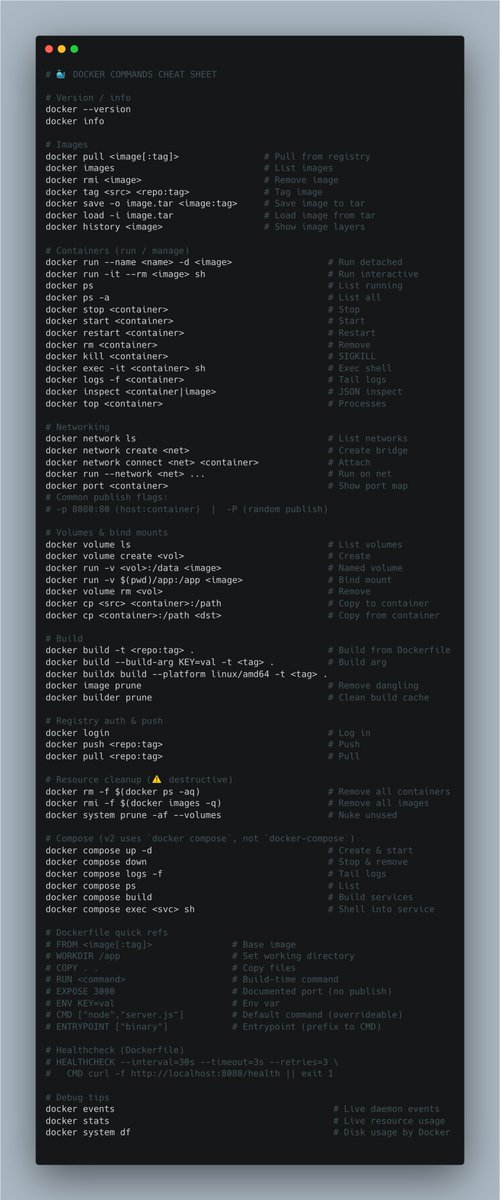
Just built an introvert vs extrovert prediction model!
Learned: hyperparameter tuning, threshold optimization, sklearn pipelines, FastAPI + Pydantic, and Docker containerization.
From zero to deployed in 3 days!
#MachineLearning#Docker#Python
Everyone is talking about how we need more AI data centers (especially the ones who would mostly benefit from them) but why is no one talking about on-device AI?
Running AI on your device:
- Free
- Faster & takes advantage of existing hardware
- 100% privacy and control (you don’t send your data to an API)
Multimodal with just fine-tuning? ByteDance makes it happen with VoRA.
The new Vision as LoRA (VoRA) paper introduces a bold, streamlined approach to building multimodal LLMs—no vision encoder, no connector, no architecture bloat. Just LoRA.
Instead of bolting a vision tower onto an LLM, VoRA injects vision understanding directly into the LLM using Low-Rank Adaptation (LoRA). That means:
- No new inference overhead- LoRA layers are merged into the LLM after training.
- Frozen base LLM-Only LoRA + visual embeddings (~6M params) are trained, preserving language ability and ensuring stability.
- Image inputs at native resolution - No resizing, no tiling hacks—VoRA leverages the LLM’s flexible token handling.
- Bidirectional attention for vision-Instead of using causal masks across all tokens, VoRA allows vision tokens to attend freely—boosting context modeling.
To teach the LLM visual features:
- VoRA uses block-wise distillation from a pretrained ViT, aligning intermediate hidden states across layers. This improves visual alignment while keeping the LLM’s core untouched.
- The training objective combines distillation loss (cosine similarity between ViT + LLM visual features) and standard language modeling loss over image-caption pairs.
What does this get you?
- A modality-agnostic architecture ready for extension to audio, point clouds, and beyond.
This might be one of the most efficient takes yet on vision-language modeling. Excited to see how this evolves.