TEXAS, ACT NOW: Voting isn't rocket science, but you DO need a plan. The countdown to Election Day is on. Know where you're voting, when you're going, and what to bring. Make your plan today and be ready to vote by Nov. 3.
IF GOD REPLACED ISRAEL, WHY DID HE PROMISE ISRAEL A NEW COVENANT?
The New Covenant was not invented by Paul.
It did not originate with the apostles.
It was not first announced in the New Testament.
It was promised by the God of Israel, through the prophets of Israel, to the people of Israel.
“I will make a new covenant with the people of Israel and with the people of Judah.”
— Jeremiah 31:31
Notice who God names.
Israel and Judah.
And notice what He says next.
“It will not be like the covenant I made with their ancestors.”
— Jeremiah 31:32
Why?
Because Israel broke the covenant established at Sinai.
The Mosaic Covenant revealed God's holiness and Israel's responsibility to obey. Yet Israel repeatedly broke it.
But the New Covenant would be different.
God would write His law upon their hearts, forgive their wickedness, and remember their sins no more (Jeremiah 31:33–34).
The answer to Israel's unfaithfulness was not Israel's replacement. It was God's promise of redemption.
SEVEN PROMISES. ONE FAITHFUL GOD.
Ezekiel 36:24–27 expands this extraordinary promise.
God repeatedly declares what HE will accomplish.
I WILL gather you from the nations.
I WILL bring you into your own land.
I WILL cleanse you from impurity.
I WILL give you a new heart.
I WILL put a new spirit within you.
I WILL put My Spirit within you.
I WILL move you to walk in My statutes.
Seven promises. Every one initiated by God.
Notice that the restoration of Israel to the land and the spiritual transformation of Israel appear together.
God does not separate them.
Why should we?
Jeremiah 32:37–41 likewise promises a regathered people, a transformed heart, and an everlasting covenant.
Ezekiel 37:21–28 describes a reunited Israel, a Davidic king, and an everlasting covenant of peace.
Israel's restoration is not merely about Israel. It is about God's faithfulness before the nations.
THE SUN, MOON, AND STARS ARE WITNESSES
Immediately after announcing the New Covenant, God makes an astonishing declaration.
In Jeremiah 31:35–37, He points to the established order of the sun, moon, and stars.
Only if that order disappears will Israel cease to be a nation before Him.
Think about that.
The Creator ties Israel's continued existence before Him to the permanence of His creation.
The sun still shines.
The moon still rises.
The stars still fill the heavens.
And God's promises have not expired.
Psalm 89:34 declares concerning God's covenant with David:
“I will not violate my covenant or alter what my lips have uttered.”
Verses 35–37 then appeal to the sun and moon as witnesses to the enduring promise concerning David's throne.
Different covenant promises. The same faithful God.
And Psalm 105:8–11 recalls His covenant with Abraham, Isaac, and Jacob, including the promise of Canaan.
God does not casually revoke what He has sworn.
THE PROMISE FINDS ITS MESSIAH
Jeremiah promised forgiveness.
Ezekiel promised cleansing, a new heart, and God's Spirit.
Isaiah described the Servant who would bear the sins of many (Isaiah 53:11–12).
Then, centuries later, at a Passover meal in Jerusalem, Yeshua lifted a cup and declared:
“This cup is the new covenant in my blood.”
— Luke 22:20
He was invoking the very covenant Jeremiah had announced.
The New Covenant was inaugurated through Messiah's blood, opening its spiritual blessings to all who believe in Him.
But participation is not replacement.
Gentile believers are grafted into the cultivated olive tree, sharing in its nourishing root (Romans 11:17–18).
Paul specifically warns them not to boast over the natural branches.
Why?
Because God's purposes for Israel are not finished.
Paul describes Israel's hardening as partial and temporary (Romans 11:25), then connects Israel's future salvation to the covenant promise of forgiveness.
“And this is my covenant with them when I take away their sins.”
— Romans 11:27
He concludes:
“For God's gifts and his call are irrevocable.”
— Romans 11:29
The Church already participates in the spiritual blessings of the New Covenant through faith in Messiah.
But Israel's promised national restoration and spiritual renewal await their complete fulfillment.
The inclusion of the nations does not require the exclusion of Israel.
God did not forget Abraham.
He did not abandon His promise to David.
He did not revoke His promises to Israel.
The Mosaic Covenant was broken.
The New Covenant promises forgiveness, transformation, and a restored relationship with God.
If God intended to permanently reject Israel, why would He promise a New Covenant specifically to Israel and Judah, then immediately guarantee Israel's continued existence before Him?
The New Covenant is not evidence that God abandoned Israel. It is evidence that He intends to keep His word.
He promised forgiveness.
He promised a new heart.
He promised restoration.
And the sun, moon, and stars still bear witness.
Paul Harvey went on the radio in 1965 with "If I Were the Devil."
Over 60 years ago, he laid out exactly how you'd tear a nation apart. Go after the family. Take God out of the schools. Turn people against each other and call it progress.
Listen to it today and it doesn't sound like a warning anymore.
It sounds like a checklist.
Every American should hear it at least once a year.
Then look around.
October 7, 2023—a day forever etched into the heart of Israel.
Today, we remember the 1,200+ lives brutally taken, the families forever changed, and the nation that still carries the scars.
We remember. We mourn. We stand with Israel 🇮🇱
Work as calling, not just a job
You don’t need to work in ministry for your job to matter to God.
Showing up on time, doing honest work, treating coworkers well, all of that counts too.
Colossians puts it plainly, whatever you do, work like you’re doing it for the Lord. Even the nine to five nobody claps for.
“Ours may become the first civilization destroyed, not by the power of our enemies, but by the ignorance of our teachers and the dangerous nonsense they are teaching our children. In an age of artificial intelligence, they are creating artificial stupidity.”
— Thomas Sowell
We spent years trying to make Christianity easy and convenient for young people, and it turns out what actually moved them was watching someone believe it was worth dying for. Charlie Kirk's legacy did not soften this generation, it sharpened them, and now there is a real outpouring happening on college campuses. Convenience never started a revival, conviction does.
Dr. Mohr, a Chief of Medicine at a VA medical center, refused to facilitate abortions because of his Christian faith. Then he was forced out.
The ACLJ just took the next steps to defend his religious conscience rights:
Read more: https://t.co/9uudAL2otB
Could You Recognize the Messiah Without the Tanakh?
The Bible Jesus preached was not the New Testament.
It had not yet been written.
The Scriptures He read, memorized, loved, and taught were the Torah, the Prophets, and the Writings. In Jewish tradition, these three sections are known together as the Tanakh.
That simple fact raises an important question.
If we want to understand the Messiah, shouldn't we begin where He began?
Throughout the Gospels, Jesus continually appealed to the Hebrew Scriptures. His teaching was never detached from them. It was saturated with them.
When Satan tempted Him in the wilderness, Jesus answered every temptation with Scripture.
"Man shall not live by bread alone..." (Deut. 8:3; Matt. 4:4)
"You shall worship the LORD your God..." (Deut. 6:13; Matt. 4:10)
"You shall not put the LORD your God to the test." (Deut. 6:16; Matt. 4:7)
Not philosophy.
Not tradition.
Not personal experience.
Only,
"It is written."
When asked about marriage, He went back to the beginning.
"Have you not read...?" (Matt. 19:4)
"...the two shall become one flesh." (Gen. 2:24)
When asked the greatest commandment, He began with Israel's central confession.
"Hear, O Israel: The LORD our God, the LORD is one." (Deut. 6:4)
Then He continued,
"You shall love the LORD your God with all your heart..." (Deut. 6:5)
and immediately joined it with,
"You shall love your neighbor as yourself." (Lev. 19:18)
When He announced His ministry, He opened Isaiah.
"The Spirit of the Lord is upon Me..." (Isa. 61:1-2; Luke 4:16-21)
When He cleansed the Temple, He appealed to the Prophets.
"My house shall be called a house of prayer..." (Isa. 56:7)
"...but you have made it a den of robbers." (Jer. 7:11)
When criticized for eating with sinners, and again when defending His disciples, He quoted Hosea.
"I desire mercy, and not sacrifice." (Hos. 6:6)
When asked for a sign, He answered,
"No sign... except the sign of Jonah." (Matt. 12:39-40)
When speaking of the rejected Messiah, He declared,
"The stone the builders rejected has become the cornerstone." (Ps. 118:22)
When revealing David's greater Son, He asked,
"The LORD said to my Lord..." (Ps. 110:1)
When challenged about the resurrection, He built His argument on God's own words to Moses.
"I am the God of Abraham, Isaac, and Jacob." (Ex. 3:6)
His conclusion was simple.
"He is not the God of the dead, but of the living." (Matt. 22:32)
Even from the cross His words flowed from the Psalms.
"My God, My God..." (Ps. 22:1)
"Into Your hand I commit My spirit." (Ps. 31:5)
This was not occasional.
It was His pattern.
❖ A Very Jewish Way to Teach
First-century Jewish rabbis did not establish authority by inventing something detached from the Scriptures. They reasoned from the text God had already given.
Jesus did the same.
Again and again He asked,
"Have you not read...?"
That question appears repeatedly throughout the Gospels (Matt. 12:3, 5; 19:4; 21:16, 42; 22:31).
He also repeatedly declared,
"It is written."
And He affirmed,
"The Scripture cannot be broken." (John 10:35)
Those are not the words of someone minimizing the Hebrew Scriptures.
They are the words of someone who regarded them as the very Word of God.
❖ The Apostles Continued the Same Pattern
The earliest followers of Yeshua were Jews who believed Israel's Messiah had come.
They did not ask people to abandon Moses and the Prophets.
They proclaimed Him from them.
Peter preached from Joel, Psalm 16, and Psalm 110 (Acts 2).
Stephen retold Israel's history beginning with Abraham and Moses (Acts 7).
Paul entered the synagogues and,
"reasoned with them from the Scriptures..." (Acts 17:2)
Luke continues,
"...explaining and proving that it was necessary for the Messiah to suffer and to rise from the dead." (Acts 17:3)
Those Scriptures were the Tanakh.
The New Testament was still being written.
❖ The Messiah's Greatest Bible Study
After His resurrection, Jesus met two discouraged disciples on the road to Emmaus.
He could have revealed Himself immediately.
Instead, He opened the Scriptures.
Luke records,
"Beginning with Moses and all the Prophets, He interpreted to them... the things concerning Himself." (Luke 24:27)
Later He expanded the lesson.
"Everything written about Me in the Law of Moses and the Prophets and the Psalms must be fulfilled." (Luke 24:44)
That threefold description was the traditional Jewish way of referring to the entire Tanakh.
Notice where Jesus began.
Not with miracles.
Not with personal testimony.
Not with new revelation.
With Moses.
Then the Prophets.
Then the Psalms.
The risen Messiah's greatest Bible study began with the Hebrew Scriptures.
❖ The Invitation Hidden in Plain Sight
The New Testament never asks us to leave the Tanakh behind.
It continually sends us back to it.
Again and again, Jesus and His apostles assume that the Torah, the Prophets, and the Writings are the foundation upon which everything else rests.
Paul opens Romans by describing the gospel as something
"...promised beforehand through His prophets in the Holy Scriptures." (Rom. 1:2)
Jesus Himself declared,
"Do not think that I came to abolish the Law or the Prophets; I have not come to abolish them but to fulfill them." (Matt. 5:17)
The Messiah who walked the roads of Galilee continually opened the scrolls of Israel.
The Messiah who conquered death began His greatest lesson with Moses.
The apostles proclaimed Him from the Hebrew Scriptures before a single New Testament book existed.
That leaves us with a question that deserves careful consideration.
If Jesus continually appealed to the Tanakh...
If He declared that "the Scripture cannot be broken"...
If He taught that Moses, the Prophets, and the Psalms testified about Him...
Shouldn't we know those Scriptures as well as He did?
Perhaps the deepest understanding of the Messiah begins by opening the very Book He opened.
Because the Bible Jesus preached was the Bible that pointed to Him.
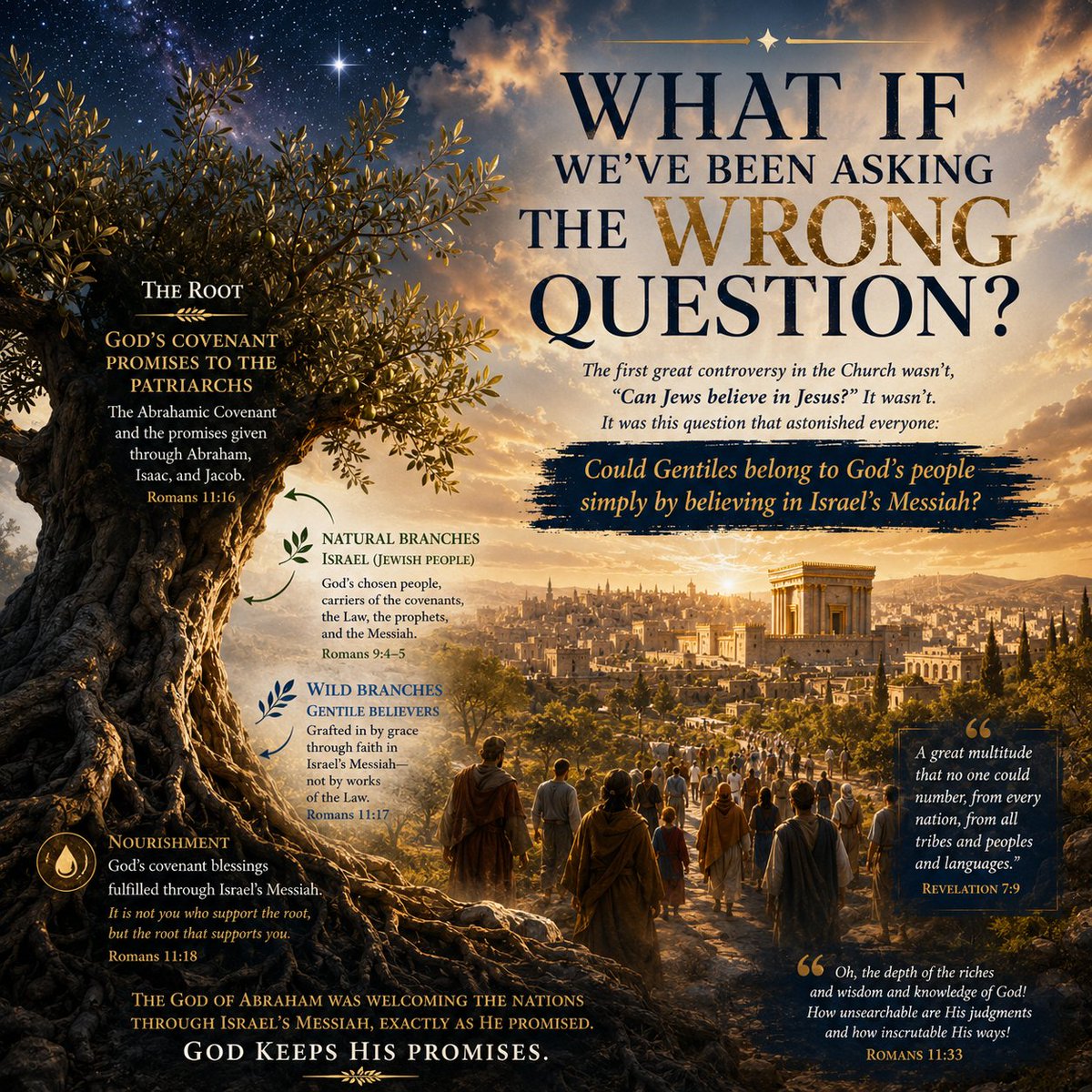
What If We've Been Asking the Wrong Question?
The Bible begins beneath a sky filled with stars. It ends before a throne surrounded by every nation. Between those two scenes is one breathtaking story of a God who keeps His promises.
❖ What Was the First Great Controversy in the Church?
Jerusalem is alive.
The Temple courts are crowded.
The apostles are preaching.
Thousands have believed (Acts 2:41; 4:4).
Every follower of Jesus is Jewish.
Now ask yourself...
What was the first great controversy in the Church?
Many Christians assume it was,
"Can Jews believe in Jesus?"
It wasn't.
Jesus was Jewish.
The apostles were Jewish.
The first disciples were Jewish.
The first churches were overwhelmingly Jewish.
The question that astonished the early Church was something altogether different.
Could Gentiles belong to God's people simply by believing in Israel's Messiah?
That single question unlocks Acts.
It explains Galatians.
It illuminates Ephesians.
And it makes Romans 11 come alive.
Come with me.
Let's watch the answer unfold.
❖ Why Did Peter Hesitate?
Peter pauses outside the home of Cornelius.
A Roman officer.
A Gentile.
Everything in his upbringing tells him not to cross the threshold.
Yet God has already spoken through a vision.
So Peter enters and says,
"God has shown me that I should not call any person common or unclean" (Acts 10:28).
Before Peter even finishes speaking, the Holy Spirit falls upon everyone listening (Acts 10:44).
The Jewish believers who came with him are "amazed" because the gift of the Holy Spirit has been poured out on Gentiles too (Acts 10:45).
Don't miss Luke's point.
God answered the question before the Church finished debating it.
❖ Why Did Jerusalem Have to Hold a Council?
The news spread quickly.
Some believers insisted Gentiles had to be circumcised and keep the Law of Moses (Acts 15:1, 5).
The apostles gathered.
Peter spoke.
Paul and Barnabas described what God had done among the nations.
The room grew quiet.
Then James stood.
"We should not trouble those of the Gentiles who turn to God" (Acts 15:19).
Peter had already captured the heart of it:
"We believe that we will be saved through the grace of the Lord Jesus, just as they will" (Acts 15:11).
Grace settled the controversy.
God keeps His promises.
But one question still remained.
Why had this surprised everyone?
❖ Was This Really God's Plan All Along?
Now travel back almost two thousand years.
An elderly shepherd lifts his eyes into a sky so crowded with stars he cannot count them.
He has no heir.
No nation.
No land.
Only the voice of God.
"In you all the families of the earth shall be blessed" (Gen. 12:3).
Did you notice?
The promise always reached beyond Abraham's own descendants.
Isaiah later declared that Messiah would become "a light for the nations" so God's salvation would reach "the end of the earth" (Isa. 49:6).
Paul looked back and made an astonishing observation:
"The Scripture... preached the gospel beforehand to Abraham" (Gal. 3:8).
The nations were never an afterthought.
God chose Abraham not instead of the nations...
But for the sake of the nations.
God keeps His promises.
❖ So Where Did We Fit Into the Story?
Paul reminds Gentile believers where we once stood.
We were "strangers to the covenants of promise" and "without hope and without God in the world" (Eph. 2:12).
Then everything changes.
"But now in Christ Jesus you who once were far off have been brought near by the blood of Christ" (Eph. 2:13).
Notice what Paul doesn't say.
He doesn't say God abandoned His promises.
He says we were brought near.
Grace didn't replace the story.
Grace welcomed us into it.
❖ Then Why Does Paul Talk About an Olive Tree?
Because pictures often teach better than propositions.
Paul doesn't describe two trees.
He describes one.
"You... were grafted in among the others and now share in the nourishing root of the olive tree" (Rom. 11:17).
Notice what Paul never says.
He never says the root changed.
He never says God planted a Gentile tree.
He never says Israel was replaced.
Wild branches were graciously grafted into a tree God had been cultivating for centuries.
As Arnold Fruchtenbaum has often emphasized, Gentile believers share in Israel's spiritual blessings without becoming Israel itself.
Paul's picture is one of participation, not replacement.
We are not the root.
We are grateful branches.
❖ Then Why Does Paul Warn Us?
Because grace can produce either gratitude...
Or pride.
Paul's warning is unmistakable.
"Do not be arrogant toward the branches" (Rom. 11:18).
Again,
"Do not become proud, but fear" (Rom. 11:20).
Why?
Because,
"It is not you who support the root, but the root that supports you" (Rom. 11:18).
James echoes the same truth:
"God opposes the proud but gives grace to the humble" (James 4:6).
The olive tree leaves no room for boasting.
Only humility.
Only gratitude.
Only worship.
❖ Has God Finished with Israel?
Paul asks the question himself.
"Has God rejected His people?" (Rom. 11:1)
His answer is immediate.
"By no means!"
Then he explains why.
"The gifts and the calling of God are irrevocable" (Rom. 11:29).
Jeremiah had already declared that Israel would endure as long as the fixed order of the sun, moon, and stars remains (Jer. 31:35-37).
God's faithfulness to the Gentiles does not weaken His faithfulness to Israel.
It demonstrates it.
God keeps His promises.
❖ How Does the Story End?
John sees what Abraham could only imagine.
"A great multitude that no one could number, from every nation, from all tribes and peoples and languages" (Rev. 7:9).
The promise has reached the nations.
Then John sees the New Jerusalem.
Its gates bear the names of the twelve tribes of Israel.
Its foundations bear the names of the twelve apostles (Rev. 21:12-14).
The story comes full circle.
The promise spoken beneath Abraham's stars has become a multitude before God's throne.
❖ So Who Is the Hero of the Story?
The first-century Church wasn't trying to figure out whether Jews could believe in Jesus.
They already were.
They were discovering something far more wonderful.
The God of Abraham was welcoming the nations through Israel's Messiah, exactly as He had promised from the beginning.
The Hero of this story is not Abraham.
Not Peter.
Not Paul.
Not Israel.
Not the Church.
The Hero is the God who keeps every promise He makes.
No wonder Paul could only conclude with worship:
"Oh, the depth of the riches and wisdom and knowledge of God! How unsearchable are His judgments and how inscrutable His ways!" (Rom. 11:33)
A TikToker from England who spent years defending Islam to more than 100,000 followers is speaking out about his decision to follow Christ — describing the theological doubts, death threats from former supporters, and a series of vivid dreams involving Jesus that ultimately changed the course of his life. Before publicly embracing Christianity, Kieos had spent years creating Islamic content & defending Islam to an audience of more than 100,000 followers.
Kieos is clear that leaving Islam was not a sudden or dramatic departure. "It was definitely a slow, gradual process."
Then, a striking moment in Kieos' journey came. On three consecutive nights, he says he dreamed of Jesus — an experience he still finds difficult to fully explain.
"I never have dreams," he told Britannia Daily. He acknowledges the psychological interpretation but says it does not account for his specific circumstances. "People could argue that if I were looking at images of Jesus, they could be brought forward in my subconscious whilst sleeping. But I never did, which makes it strange."
FULL STORY: https://t.co/pxppEQ3Y3G
All gave some. Some gave all.
Today we honor Pvt. Isabella Gonzales and 1st Lt. Tyler James Feehan, who made the ultimate sacrifice in service to our nation. May we never forget their courage, their dedication, and the price they paid defending the freedoms we cherish every day.
Please keep their families, friends, and fellow soldiers in your prayers.
Freedom is never free. 🇺🇸✝️
Teachers are being told to leave their faith at home, and medical doctors are losing their positions. The ACLJ just reached out to the Trump Administration to stop the radical Left’s assault on your religious beliefs.
Your faith should never cost you your career. Read more: https://t.co/ngTlh9GkRq