How to Ask Questions -> https://t.co/yvZiBg9Dwm
How to Give a Job Talk -> https://t.co/gsnhTVA9uz
How to Learn Machine Learning -> https://t.co/YWWipB2hjV
How to Not Fool Yourself -> https://t.co/JGvGf5nBtS
How to Read a Paper -> https://t.co/2mcATyLsLa
How to Write a Paper -> https://t.co/FA6vvGE6JO
How to Run Computational Experiments -> https://t.co/nkSTRdpmM0
On Narrative in Writing -> https://t.co/NCl0hKAHw0
Patrick Winston’s How to Speak -> https://t.co/ftMeCvbegJ
Style: Lessons in Clarity and Grace -> https://t.co/YHfxQTh4R3
Terence Tao Teaches Mathematical Thinking -> https://t.co/Njq3GSJmGF
Four frontier AI models released in seven days. Fable Five, Grok 4.5, GPT 5.6, and Muse Spark. Not long ago, we got one model every six months. We're in the singularity.
📢 JOB ANNOUNCEMENT 📢
Our department is hiring an Assistant Professor of Quantitative Political Science. We seek a scholar in AP, CP, PE, or IR who applies frontier methods of statistics and data science to substantive questions in their area.
https://t.co/bnZC93q4uA
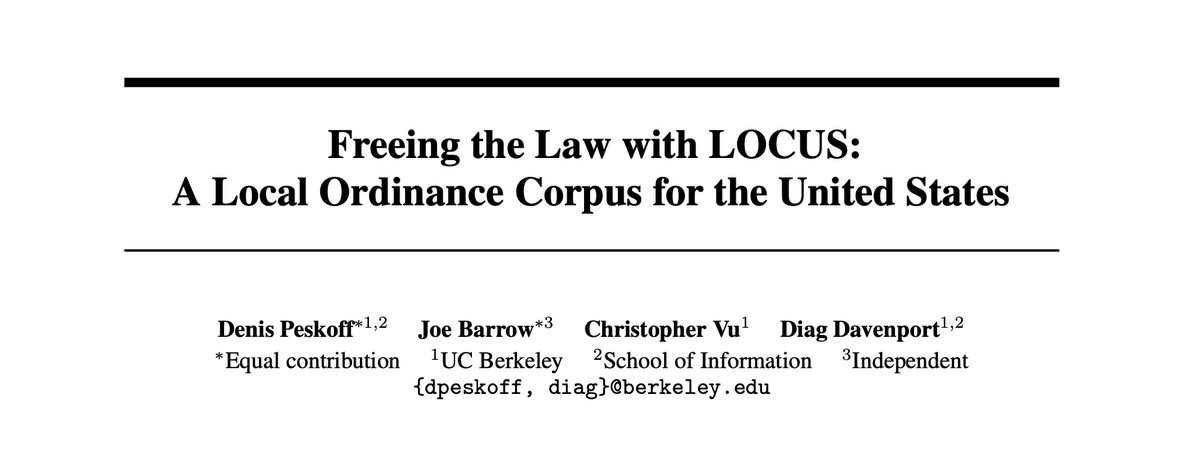
New paper: every law in America is technically public. But not really, until now!
With @DenisPeskoff at UC Berkeley, we built a corpus of ~every publicly accessibly city and county law, and released a huge chunk of it!
2.2 million laws, you're (probably) covered in it!
🧵
We're launching the OpenAI Economic Research Exchange: a new program for external researchers conducting independent research on the economic impacts of AI.
We are looking for rigorous empirical projects on questions that matter for workers, firms, institutions, and the broader economy.
https://t.co/NRjJtlS7eD
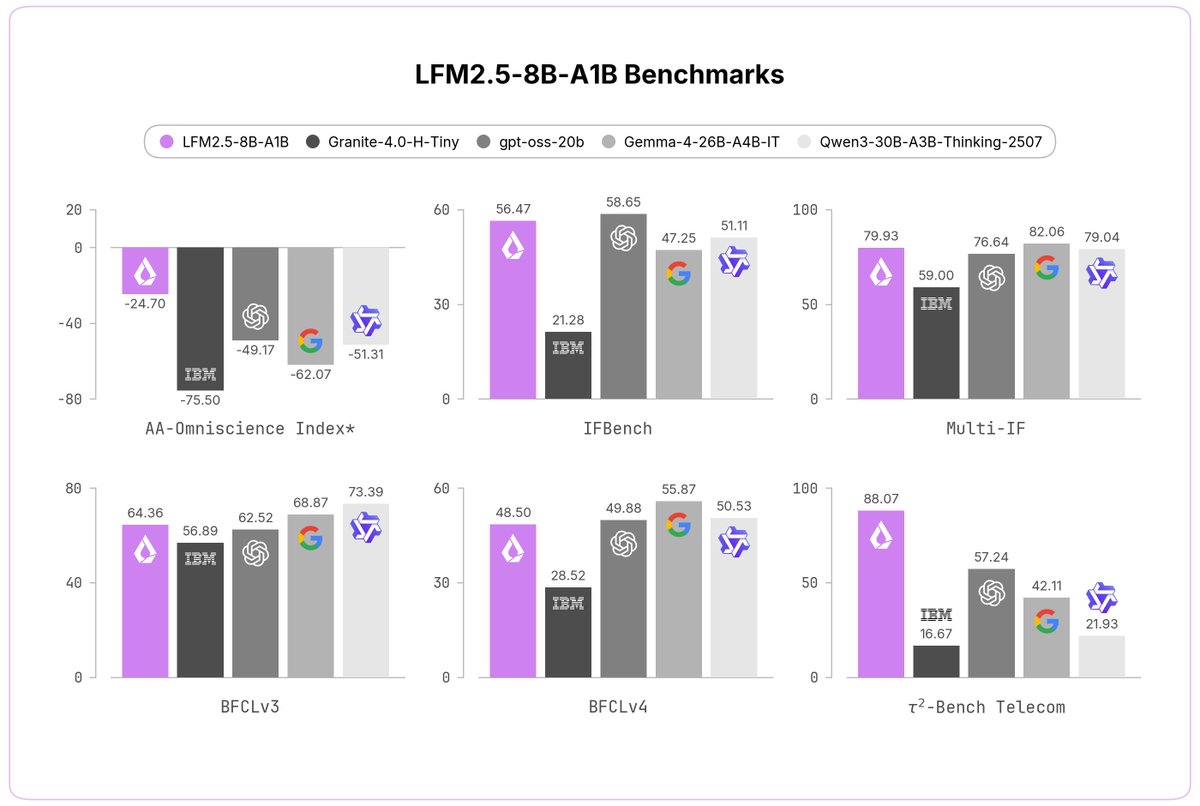
Today, we're releasing LFM2.5-8B-A1B, a device-optimized model designed to power real-life applications on phones, laptops, PCs, robots, and fast & lightweight server-side use-cases.
> 8B MoE, 1.5B active
> Expanded 128K context
> LFM2.5 flagship hybrid MoE architecture
> Trained on 38T tokens + large-scale RL
> fast, reliable tool calling, punching above its weight, comparable to models with up to 4x its size
> customizable on a single GPU for any specialized task
> LFM2 open-weight license
🧵
New blackboard lecture w @reinerpope
How do chips actually work – starting with basic logic gates, and working up to why GPUs, TPUs, FPGAs, and the human brain each look the way they do.
0:00:00 – Building a multiply-accumulate from logic gates
0:16:20 – Muxes and the cost of data movement
0:25:59 – How systolic arrays work
0:39:00 – Clock cycles and pipeline registers
0:51:40 – FPGAs vs ASICs
1:03:14 – Cache vs scratchpad
1:07:16 – Why CPU cores are much bigger than GPU cores
1:11:49 – Brains vs chips
1:15:22 – A GPU is just a bunch of tiny TPUs
Look up Dwarkesh Podcast on YouTube/Spotify/etc to watch. Enjoy!
Parkinson’s Law dictates that a task will swell in (perceived) importance and complexity in relation to the time allotted for its completion.
It is the magic of the imminent deadline.
If I give you 24 hours to complete a project, the time pressure forces you to focus on execution, and you have no choice but to do only the bare essentials.
If I give you a week to complete the same task, it’s six days of making a mountain out of a molehill.
If I give you two months, God forbid, it becomes a mental monster. The end product of the shorter deadline is almost inevitably of equal or higher quality due to greater focus.
The bitter lesson in 26 words:
Don’t be distracted by human knowledge, as AI has been historically.
Instead focus on methods for creating knowledge that scale with computation, like search and learning.
New #preprint, @PigozziFederico:
https://t.co/hJe7b14hVm
"The Causally Emergent Alignment Hypothesis: Causal Emergence Aligns with and Predicts Final Reward in Reinforcement Learning Agents"
"A hallmark of life on Earth is the ability of agents to exert causal power and be drivers of subsequent events. This is key to cognition at all scales. Causal emergence, measuring the degree to which an agent exerts unique predictive power on its future, is one consequence of causal power. Indeed, recent discoveries have shown that biological agents, even minimal ones, increase their causal emergence after learning new memories. However, there is a major knowledge gap regarding how causally emergent artificial agents are. We focused on Reinforcement Learning (RL) of neural-network agents across an array of environmental conditions, encompassing different algorithms, agent architectures, and six environments arranged on a complexity spectrum. For consistency, we computed the causal emergence of their latent-space representations over their lifetimes. We used the recently proposed {\Phi}ID to estimate causal emergence and tested how it related to learning performance. Our results suggested a Causally Emergent Alignment Hypothesis: successful agents exhibited causal emergence that was consistently predictive of final reward early in training and whose representational dynamics aligned with reward improvement in most tasks. This idea suggests that causal emergence may be a previously undisclosed axis of reorganization of neural representations in RL agents, with the potential to establish causal relationships and interventions that will lead to better RL agents. Our work also highlights the alignment between causal emergence and learning as another way biological and artificial creatures compare."
Attention @arxiv authors: Our Code of Conduct states that by signing your name as an author of a paper, each author takes full responsibility for all its contents, irrespective of how the contents were generated. 1/
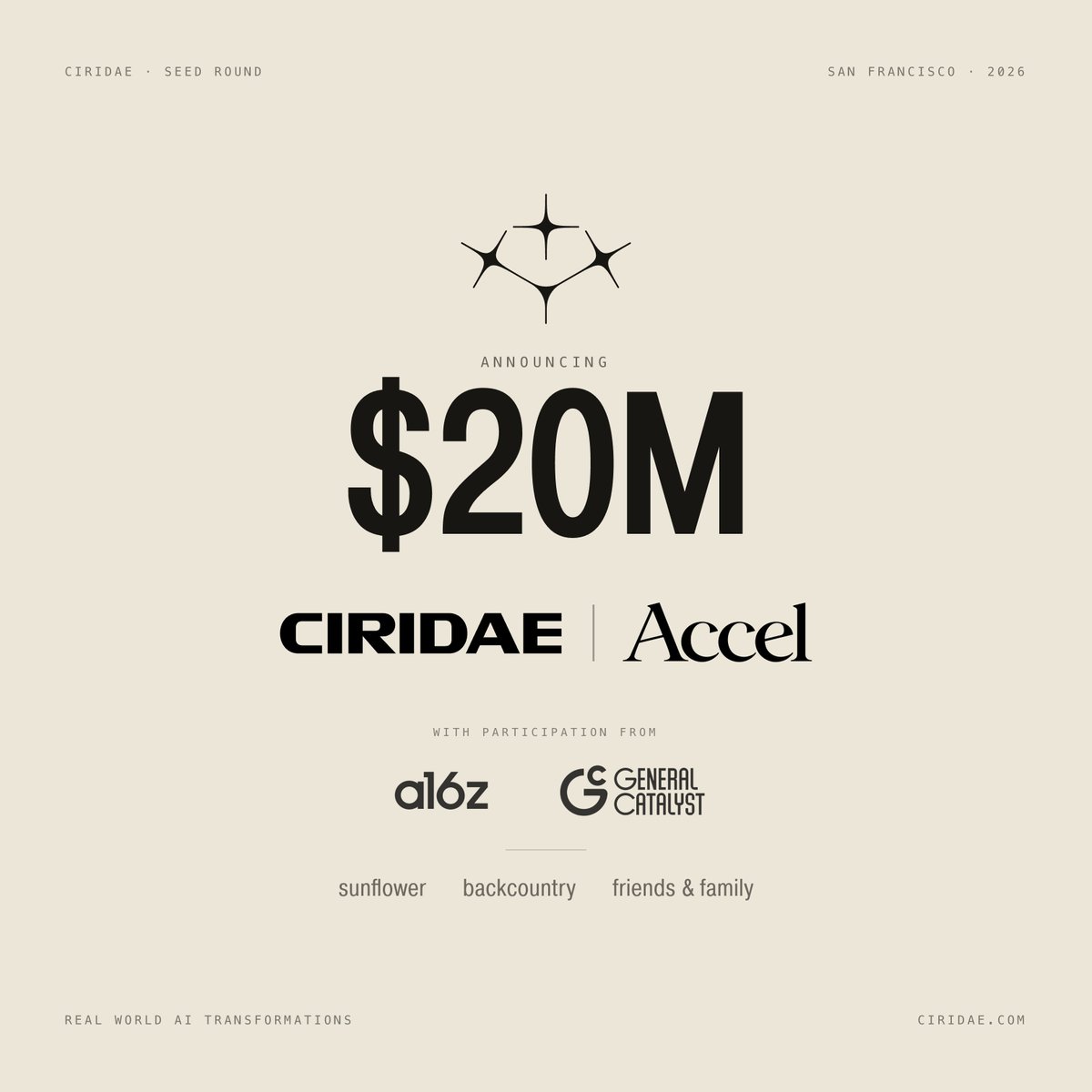
We're excited to announce Ciridae's $20M Seed, led by Accel, with participation from a16z, General Catalyst, Sunflower, Backcountry, and our friends and family.
Jack (@weissenberger_j) and I met years ago through our then-girlfriends, now wives, and have been hacking on projects together ever since. He was building AI for enterprises at Apple and Tenyx. I was at a16z, watching the same businesses try to adopt it and fail. We compared notes and realized the options for enterprises were not only bad for the business but bad for the operators! We looked at each other and said, “I think we can do this better…”
Since then, working with startups, governments, and PE-backed businesses, we have made every mistake worth making, and only now feel like we're beginning to solve the real problem of enterprise-wide AI Transformation.
This “real economy”, the businesses that keep this country running, have been under-appreciated by Silicon Valley and under-transformed by New York. Yet these are the businesses with the most to gain from AI and the least equipped to capture it.
The world does not move itself.
Ciridae is the AI Transformation Firm for the real economy. We embed with businesses that move the physical world. The distributors, construction, logistics, home services, staffing, and more, and rebuild their core operations as AI-native operating systems. End to end. One accountable partner. In weeks through our platform.
As the models become intelligent enough to accomplish most knowledge work, the economy’s bottleneck is now Transformation, the work of integrating intelligent software into a business and rewiring the business so AI runs the operation and people run the AI.
We believe AI Transformation is a new problem that requires a new business. New team, new technologies, and new business model. Not a Frankenstein's monster of transformation in parts.
In 2025, we hit high-seven figures in revenue, grew profitably, worked with governments with Trillions in GDP and PE Funds totalling Trillions in AUM.
@Accel and @ChristineEsser backed us to scale the team, deepen the platform, and bring AI Transformation to more of the businesses that need it most.
If you lead or back a business that wants AI to be the reason you win, reach out.
If you want exposure to real problems, with real ownership, and work alongside the highest-merit team you can find, reach out.
One business at a time. More to do. Onwards.
Neural networks might speak English, but they think in shapes.
Understanding their rich *neural geometry* is key to understanding how they work – and to debugging and controlling them with precision.
Starting today, we’re releasing a series of posts on this research agenda. 🧵
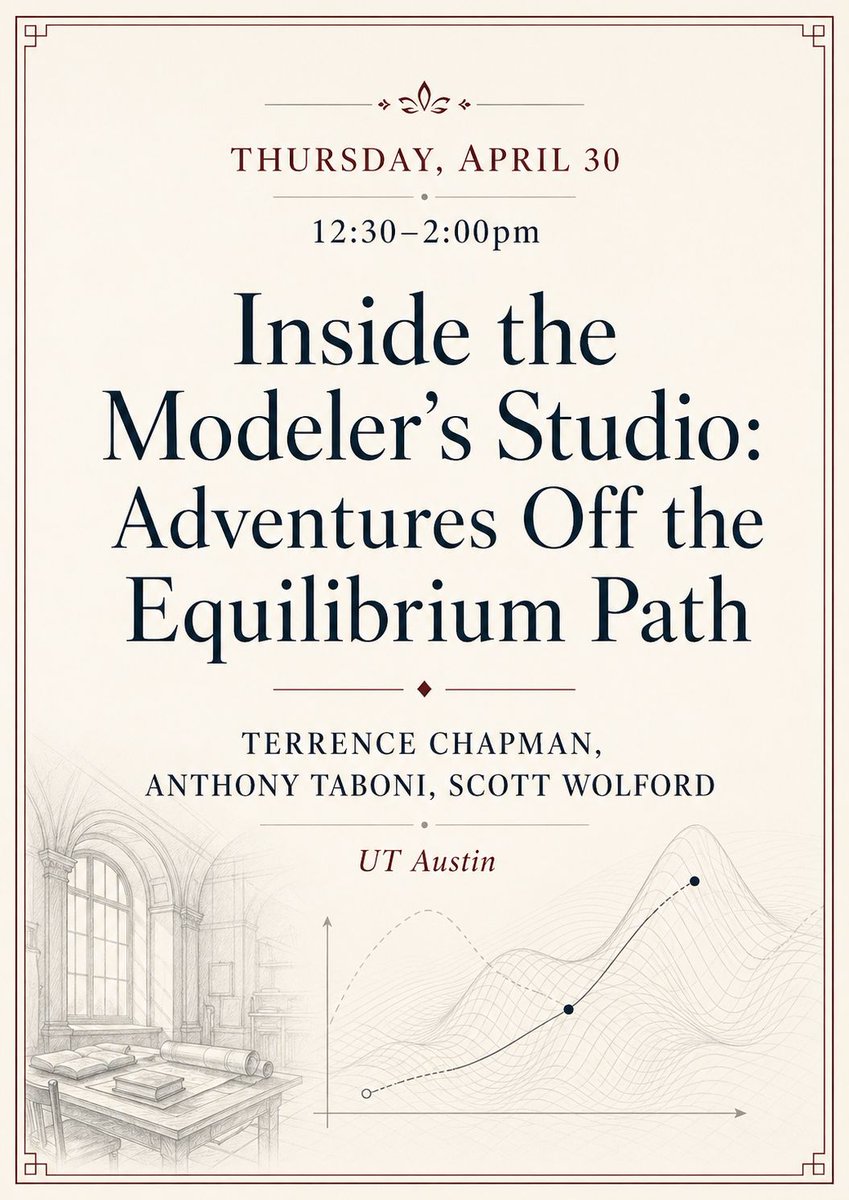
📅 UT Austin Political Methodology Speaker Series
This Thursday, April 30th at 12:30pm Terry Chapman, Anthony Taboni & Scott Wolford present: <Inside the Modeler’s Studio: Adventures Off the Equilibrium Path>
📍 Batt 5.108
Add to your calendar:
• Google: https://t.co/ARtAe4BrWa
• Outlook: https://t.co/xmOGy5MoTl
Some new entries:
How to Apply for and Get Compute Grants (for Students) → https://t.co/Nil2whsE0y
How to Do Research → https://t.co/fQsKmdD5n8
How to Solve Problems → https://t.co/PIAyWTtpC3
How to Survive a PhD → https://t.co/PgbEJPotRO
How to Win a Best Paper Award → https://t.co/VHliq2bNUf
How to Write an ML Paper → https://t.co/1yw6x5fpuU
On Teams → https://t.co/GgotXAtLyF
Tips for Early Stage Researchers → https://t.co/nAWn4Jfv1e
You and Your Research → https://t.co/5zQ9dDTNTa
How to Ask Questions -> https://t.co/yvZiBg9Dwm
How to Give a Job Talk -> https://t.co/gsnhTVA9uz
How to Learn Machine Learning -> https://t.co/YWWipB2hjV
How to Not Fool Yourself -> https://t.co/JGvGf5nBtS
How to Read a Paper -> https://t.co/2mcATyLsLa
How to Write a Paper -> https://t.co/FA6vvGE6JO
How to Run Computational Experiments -> https://t.co/nkSTRdpmM0
On Narrative in Writing -> https://t.co/NCl0hKAHw0
Patrick Winston’s How to Speak -> https://t.co/ftMeCvbegJ
Style: Lessons in Clarity and Grace -> https://t.co/YHfxQTh4R3
Terence Tao Teaches Mathematical Thinking -> https://t.co/Njq3GSJmGF
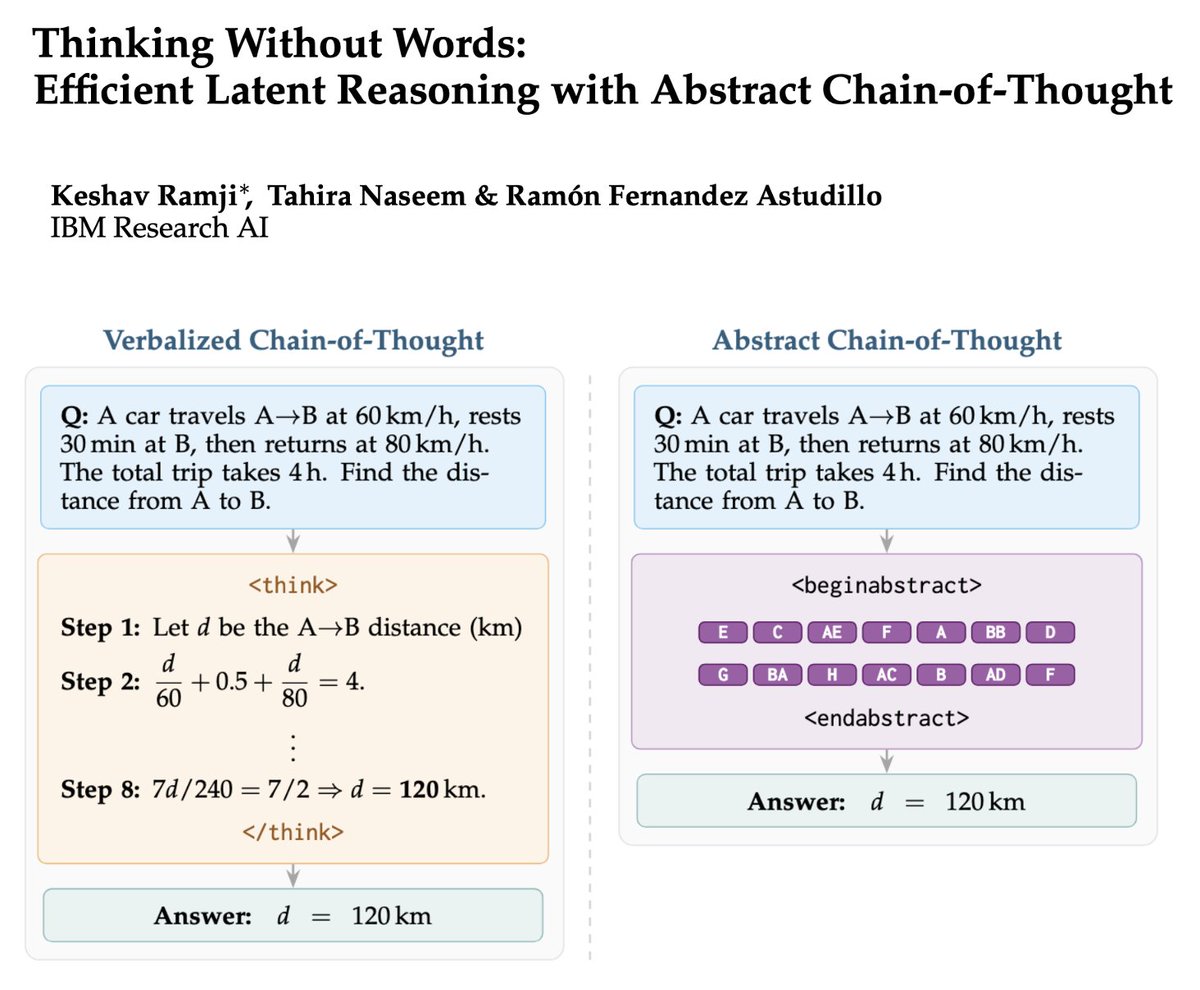
What if your language model could reason efficiently in an entirely new language?
We introduce Abstract Chain-of-Thought, a new mechanism which allows language models to reason through a short sequence of reserved "abstract" tokens through reinforcement learning. It is as performant as verbalized CoT at a fraction of the cost, achieving major gains in inference-time efficiency.
The Newton–Schulz iteration coefficients optimized by DeepSeek-V4 are surprisingly strong: they effectively normalize all singular values to 1.
This matches our previous intuition: a well-balanced spectrum may help strike a better balance across long-tail knowledge.
Plot code: https://t.co/s0zMPgdoOI
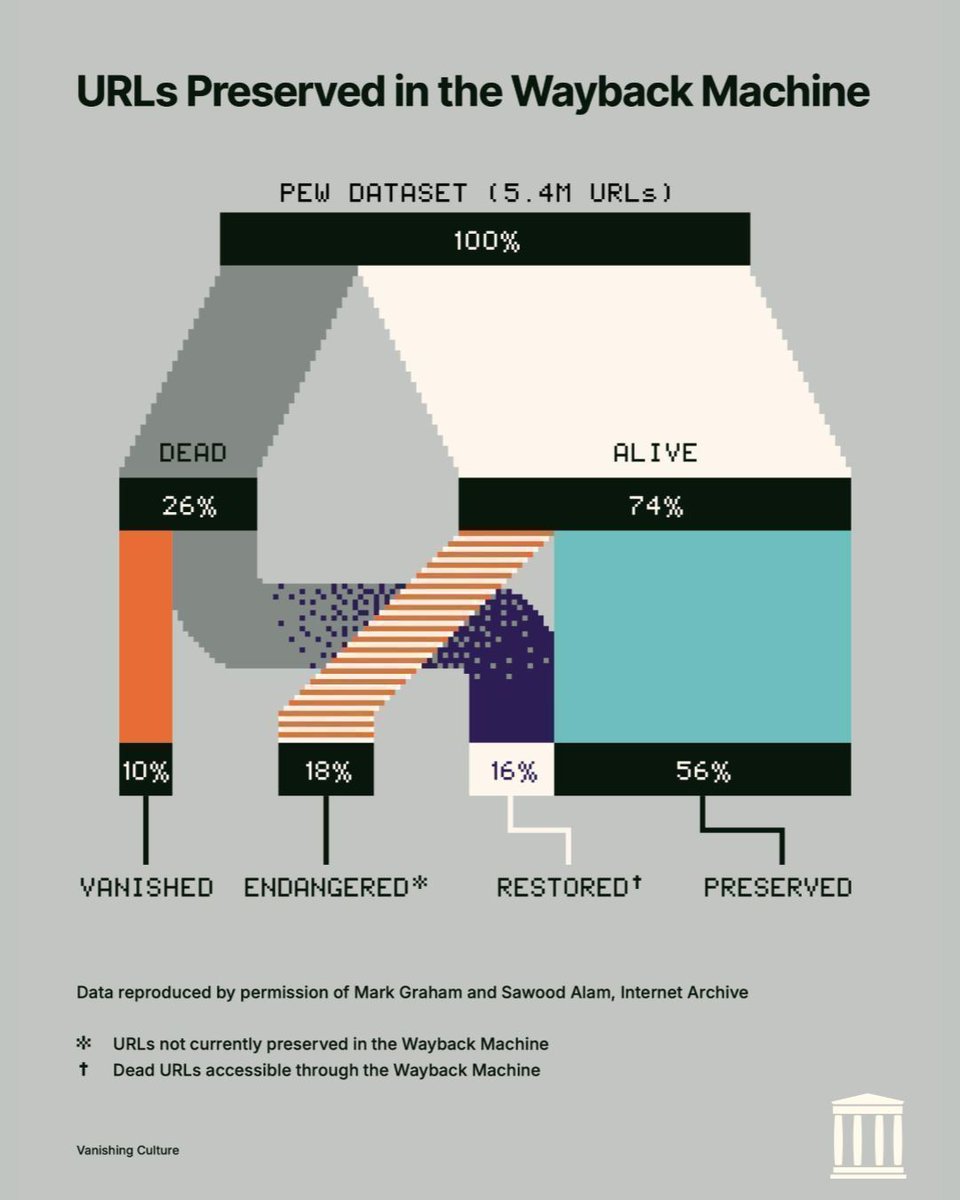
The web is disappearing 🕳️
According to a Pew Research Center report, 26% of pages from 2013-2023 are no longer accessible.
But that’s not the whole story.
In a new study published in Internet Archive's book, VANISHING CULTURE, data scientists working with the Wayback Machine have found:
16% have been restored through the Wayback Machine.
56% are preserved before they disappear.
Preservation is the remedy for cultural loss.
📚 Read VANISHING CULTURE free from the Internet Archive
📖 Download & read: https://t.co/BrawXOwMBr
🛒 Purchase in print: https://t.co/EB58IliqDm
#VanishingCulture #DigitalMemory #InternetArchive #BookTwitter
ICYMI I gave a lecture on Cloud Native GeoAI at @UTAustin last week! Check out the recording! Thanks to @JerzakConnor for hosting!
Slides are available here https://t.co/FhYSRLRJrL