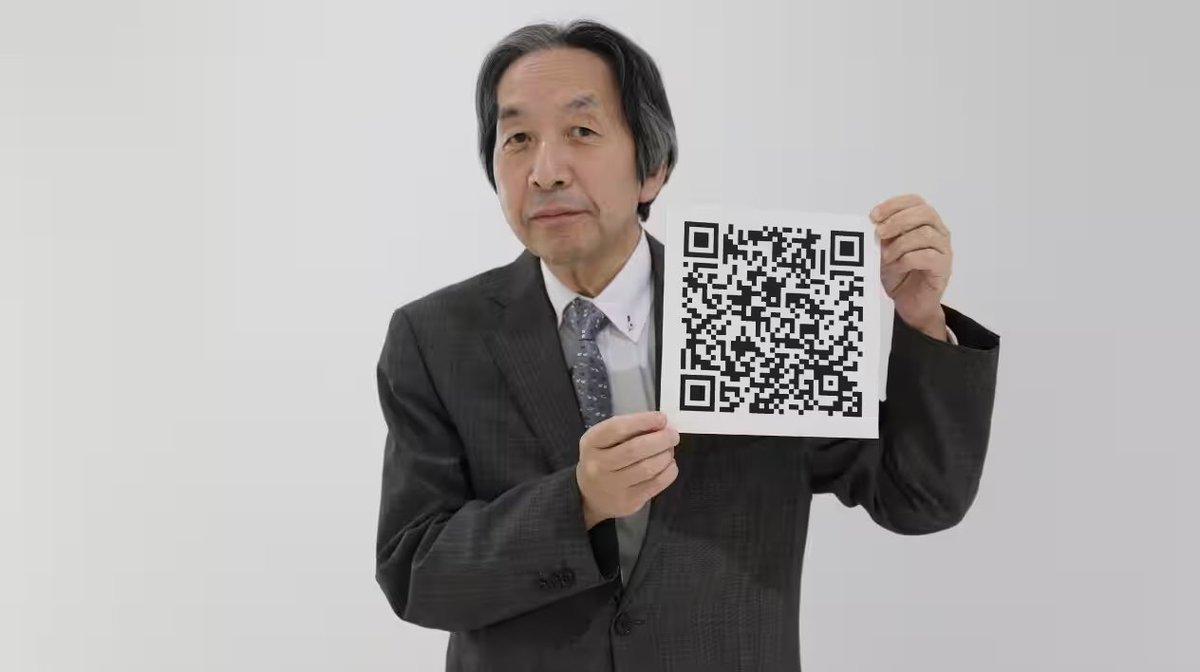
A Japanese engineer invented the QR code for one job, tracking car parts on a Toyota line, then his company chose to give the patent away for free, which is the only reason it ended up on every restaurant table on Earth.
His name is Masahiro Hara. The company was Denso Wave, a parts supplier owned by Toyota.
In 1992 the problem landed on his desk, and it was not glamorous. Workers on the factory floor were drowning.
Every car part had a barcode, but a barcode can only hold about twenty characters, so to track one component they had to stick five or ten barcodes on it.
A worker would stand there scanning a single part ten times in a row. Some of them were scanning close to a thousand barcodes a day. The job had stopped being about building cars and turned into pointing a scanner at stickers all day long.
And there was a second problem nobody upstairs cared about. This was a factory. Oil got on everything. A smudge of grease across a barcode and the whole thing became unreadable, and the line stopped.
Hara was asked to make the scanner faster. He looked at it for a while and realized the scanner was not the problem. The barcode itself was the ceiling. A line of black bars can only hold information going one direction, left to right.
He decided to build something that held information in two directions, up and down as well as across, so it could store hundreds of times more in the same little square.
Then came the part that sounds made up but is not.
Hara played Go on his lunch breaks, the old board game with black and white stones sitting on a grid. He was staring at the board one day and it clicked.
The grid of black and white stones was already a way to store information in two directions. That was the shape of his code.
But building the code was the easy half. The hard problem was speed, because the whole point was to be fast, and a scanner wastes most of its time just trying to figure out where the code is and which way it is turned.
The fix came to him on a train. He was looking out the window at buildings, and one building stood out from all the others because of its shape against the sky. That was the idea.
He put three little square targets in three corners of the code. The moment a scanner sees those three squares, it knows instantly where the code is and how it is rotated, even upside down, even at an angle.
Now here is the detail that shows how far he was willing to go. Those three corner squares only work if nothing else on the page looks like them.
If a magazine ad or a cardboard box happened to have the same black and white pattern nearby, the scanner would get confused and grab the wrong thing.
So Hara and his tiny two-person team went and surveyed printed material. Magazines. Flyers. Cardboard boxes. Piles of it, for days, reducing every picture down to its ratio of black to white area, hunting for the one ratio that almost never shows up in print anywhere. They found it. One to one to three to one to one.
That exact rhythm of black and white is baked into every corner square of every QR code on Earth, and it is there because it is the pattern the printed world almost never produces by accident.
Then he solved the oil.
He built the code so it carries a backup of its own information, spread mathematically across the whole square. You can tear off, smudge, or scratch out up to thirty percent of a QR code and it still scans perfectly, because the code rebuilds the missing piece from the copy it kept of itself.
A worker could get grease on a third of the label and the line would keep moving. This is the same math that lets a scratched CD still play and lets a spacecraft send data back across the solar system without asking to repeat itself.
He finished in 1994. He named it Quick Response, after what it does for the person using it, not after what it is.
And then Denso made the decision that actually mattered.
They held the patent. They could have charged a fee on every single scan, and given how many billions happen now, that would have made someone unimaginably rich.
Instead they announced they would not enforce their rights to collect royalties, and they published the specification openly so anyone could use it. Hara later said it was not even a big argument inside the company.
That one choice is the whole story. A code that costs nothing to use is a code everyone builds on. Airlines put it on tickets. Phone makers built readers into cameras.
Then a pandemic hit and the world needed a way to hand someone information without touching anything, and the free little square that a Toyota engineer built for greasy factory workers was suddenly on every menu, every payment, every door.
Hara still works there. He has said, more than once, that he never imagined it would spread this far, and that the part he is proudest of is that it got used to keep people safe.
The man built it to survive oil on a factory floor. It ended up surviving everything else too.
You have scanned his work a hundred times this year. Now you know whose it was.
Hunter Biden: “You’d have to be a fucking idiot not to vote for my dad in 2020 after what Donald Trump did in terms of Covid. Does everybody remember Covid? Does everybody remember him telling you that you should drink bleach? Does everybody remember he created the largest spike in inflation in the history of the United States?”
🚨 Donald Trump ran for office for three main reasons:
1. To stay out of jail
2. To exact revenge on his enemies
3. To line his pockets and his family’s pockets
Everything else he says is bullshit.
Thumbs up 👍 if you agree.
Erling Haaland paid $134,000 for a 430-year-old Viking kings manuscript, then gifted it to his hometown. He said: “I’ve never been a big reader, but I want people to read about those who came from my area.”
Erling Haaland and his father, Alf-Inge Haaland, quietly acquired one of Norway’s greatest literary treasures at auction: a 1594 edition of Snorri Sturluson’s Kongesagaer. Translated by Mattis Størssøn from Old Norse into Danish, it was the first printed history of Norway and helped preserve the stories of the nation’s medieval kings for generations.
Widely regarded as one of the most significant works in Norwegian literary history, the copy purchased by the Haalands was the only complete edition still in private ownership. It sold for 1.3 million Norwegian kroner (about $134,000), setting the record as the most expensive Norwegian book ever sold at auction.
Instead of keeping the rare volume in a private collection, the Haalands donated it to the library in Time Municipality, where Erling grew up. The book is now on public display, and the donation also funded a reading competition to inspire local children and young people to discover Norway’s history and literary heritage.
In 2002, Sharon Osbourne was ready to quit chemo, until Ozzy asked Robin Williams to visit.
Robin had her laughing within minutes, and the next day she restarted treatment. Ozzy said he'd forever owe him for that.
In an 1806 duel, Andrew Jackson (the 7th American president) knew he couldn't outdraw master marksman Charles Dickinson. His survival strategy was brutal: he deliberately let Dickinson shoot him first.
Under the rules of dueling, once a man fired, he was required to stand motionless on his mark and await his opponent's return fire. If Jackson rushed his shot to beat Dickinson, he might miss. By absorbing the bullet, Jackson bought himself the time to aim with absolute precision.
Dickinson fired. A cloud of dust puffed from Jackson’s coat as the bullet struck him squarely in the chest. But Jackson did not fall. He simply raised his left hand to his chest, stood perfectly still, and leveled his pistol.
Jackson survived the immediate impact because of a wardrobe trick and his gaunt physique. Standing 6-foot-1 and weighing only about 145 pounds, Jackson wore a loose, oversized dark blue frock coat. When he took his mark, he turned sideways in a bladed stance. Dickinson aimed exactly where a man's heart should be based on the drape of the coat. The bullet hit the precise spot Dickinson intended, but Jackson's actual heart was an inch or two away. The ball shattered two ribs and lodged deep in his chest cavity.
Despite the massive trauma, Jackson masked his pain through sheer willpower and spite. He despised Dickinson—who had publicly insulted his wife—and was determined not to give the marksman the satisfaction of knowing he had landed a successful shot before dying. Jackson later said, 'I should have hit him, if he had shot me through the brain.'
Jackson pulled his trigger, but the pistol stopped at half-cock. He calmly pulled the hammer all the way back, took aim again, and shot Dickinson in the abdomen. Dickinson fell and bled to death hours later.
Jackson casually walked away from the dueling ground with his surgeon, hiding his wound until they were out of sight of Dickinson's seconds. It was only when the surgeon noticed blood sloshing inside Jackson's left boot that he realized the future president had been hit. The bullet was too close to the heart to be safely removed, and Jackson carried it inside his chest for the remaining 39 years of his life.
#drthehistories
Mitch McConnell is dead, and this Proof of Life photo was a rushed rough draft. The newspaper is AI and doesn't exist. He's wearing jeans in a hospital bed. His hand is operating a computer mouse.
Elaine Chao had escaped to China, but now she's back and she's implicated in the cover up.
These are giant piles of crimes for everyone involved, which now includes Vance and Chao. I love this for them.
None of this detective work is mine.
He died in June.