Today we presented our education platform about the negative effects of gasoline leaf blower use. We discussed steps to gradually phase them out and emphasized how leaves are used by animals for habitats when they are left alone #LeaveLeaves@nmlister @RYSURP @CeeHevesi
-74% of all insulin used in America comes from Denmark.
-100% of all Ozempic used in America comes from Denmark
-15% of all shipping containers arriving in America come from a Danish company
All 3 are being discussed within Denmark to halt.
I’m a homeowner, and I’m happy to pay more property tax if I get a better city for it. I want my TTC to run properly, I want clean parks, I want investment in important programs.
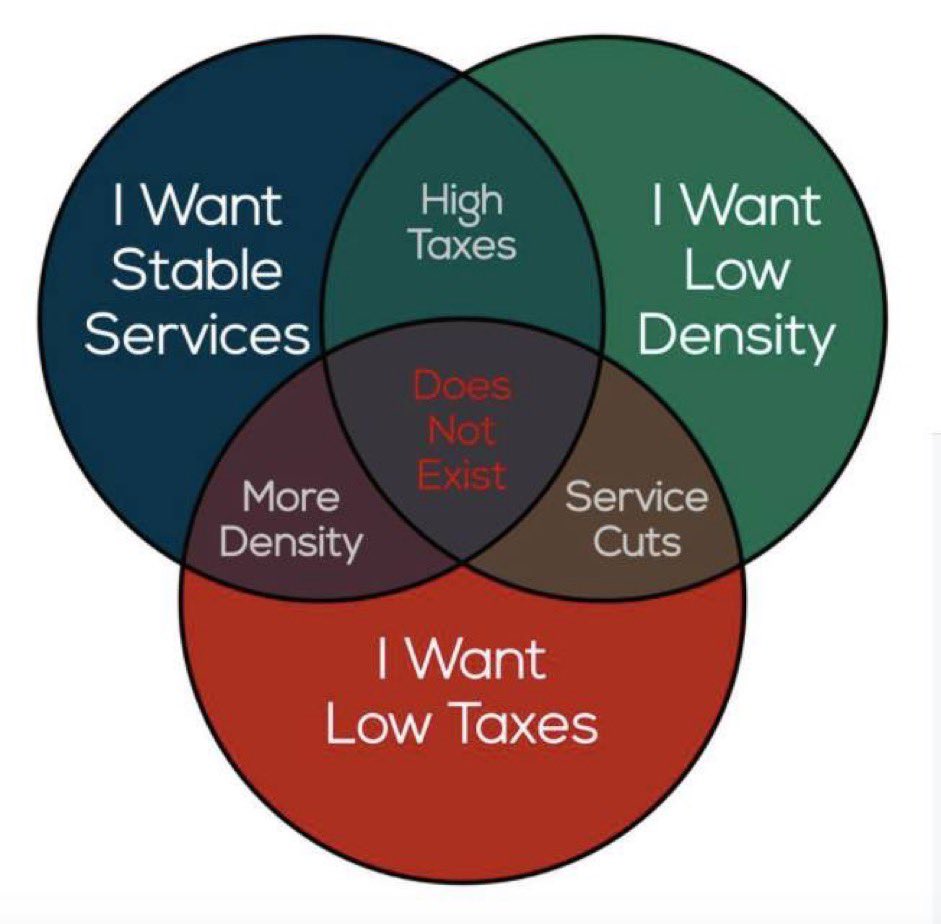
Also, since it’s budget season, reposting this:
First impressions on Ron Howard’s ‘EDEN’:
“The most vicious, black-hearted film Ron Howard has ever made”
“Ron Howard's darkest, bleakest film to date”
“Howard’s film is able to feel both pessimistic and optimistic at the same time”
Nope, not here. Downtown Toronto has a remarkable and growing population of over 375,000 people - in just 17 sq km (a third of the population of all of Saskatchewan).
And one of the reasons new residential developments in the core no longer include parking is because over 80% of residents walk, cycle or take transit as their main form of transportation. That’s part of the joy of urban life!
The problem is cars from elsewhere, not people.
More people living and working and walking in the city is good.
And there is lots of room for more people. Cars are the problem.
There is no more room for more cars. Especially the new supersized pick up trucks. Leave those monstrosities at home.
@LeslievilleBIA Don't even get me started on this City's inability to select and stick with one streetscape design standard. These two developments were constructed in tandem, on opposite sides of Logan. Spot the difference. Fun fact, the raised planters on the left are outperforming the others.
Toronto has a pretty complicated system for assessing and collecting property taxes. In my opinion, this system may be one of the key reasons that the city struggles so much with planning and development. Let me explain why.
In January, property owners receive their first tax bill, the "interim tax bill", which isn't based on current year assessed taxes (because those have not been calculated yet) but rather on 50% of their prior year taxes.
This first bill is divided into 3 installments, due in March, April, and May.
Then in May or June, property owners receive their second tax bill, the "final tax bill" based on the latest assessed property value multiplied by tax rates which are calculated anew each year based on the approved municipal budget. This bill is divided into installments which are due in July, August, September.
(It's worth noting here that MPAC, a nonprofit corporation that handles property assessments for the province of Ontario, hasn't updated its general assessment roll since 2016, ostensibly due to service interruptions during the Covid-19 pandemic. 2024 tax bills are now being calculated using assessments from 8 years ago!)
To me, the most surprising thing about this whole system is the idea of floating property tax rates. When I lived in Washington DC, property tax rates were set by Council and rarely changed. When assessments went up, tax revenue went up. And when new buildings were built, tax revenue went up without a politicians needing to advocate for increases to the budget. The city was therefore very, very motivated to update assessments every single year.
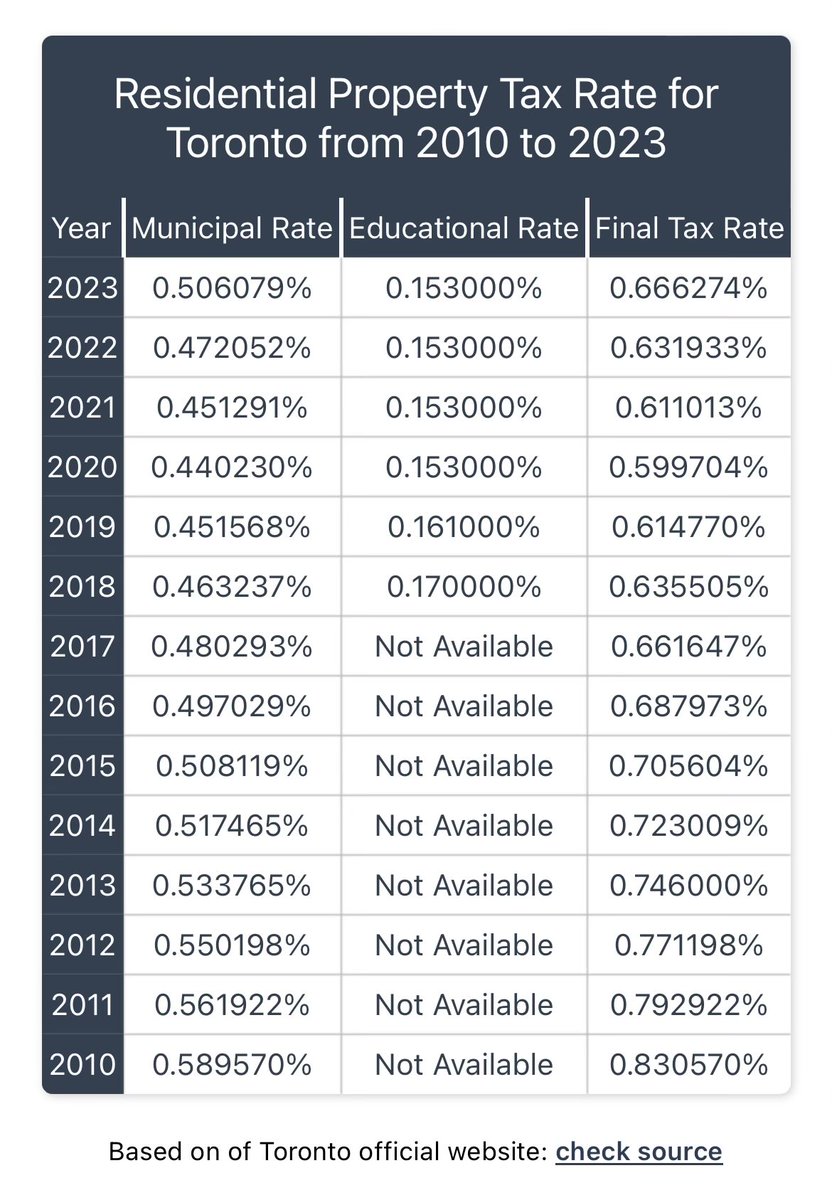
Here in Toronto, Council passes a budget with a property tax revenue target, and then they divide budgeted revenue by the total value of assessed property to obtain a tax rate. This means that when assessments generally increase, there is no automatic increase to tax revenue. When new buildings are built, there is no automatic increase to tax revenue. Unless the Council and the bureaucracy ask for more money, growth doesn't directly lead to tax revenue.
Over the last several years, this has actually led to decreasing tax rates as the city has grown. Just look at this table, it's really something!
I'm sure this mechanism is written down as law somewhere, but it seems like this creates an obvious and sharp municipal disincentive against economic growth; if new projects require a bunch of municipal review and coordination, and don't increase the tax base without going through a full budget cycle, then you can see why local government has a hard time seeing the value of development.
Perhaps it's time to rethink revenue collection in Ontario, and give cities the appropriate incentives to encourage more growth and economic opportunity.
I appreciate the massive effort needed to get Toronto back on track. But we need to shift from incrementalism to bold action:
- Bold zoning reforms + maximization of public lands for abundant housing
- Going all-in on transit + cycling to make these the modes of choice
(1/2)
This. We need to have a broader discussion about amenity space requirements. They make housing more expensive, reduce the amount of housing that gets built, and (imo) serve as a substitute for true public spaces like community centres, parks, libraries, etc. (1/2)
I have a single mom, a new Canadian from India with a 12yr old son. They arrived here, and beaten by her new husband fled him and his family. Now alone. they have no food. Looking for #IndianFood#IndianCanadian#yeg
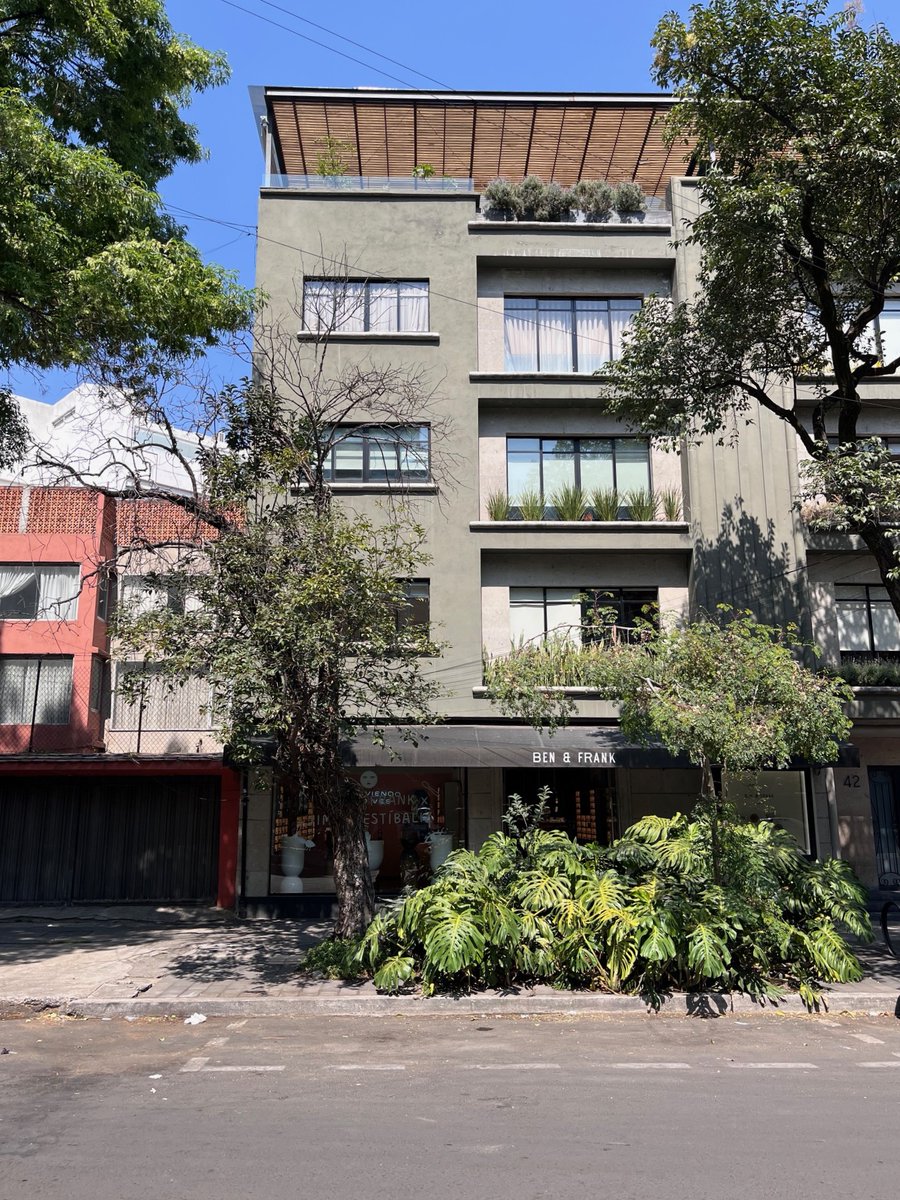
I am obsessed with Mexico City's messy urbanism, incredibly diverse architecture, and its embrace of all forms of density - which all contribute to the vibrancy and vitality of this city. Urban planners have lots of lessons to learn at all scales of development 🧵