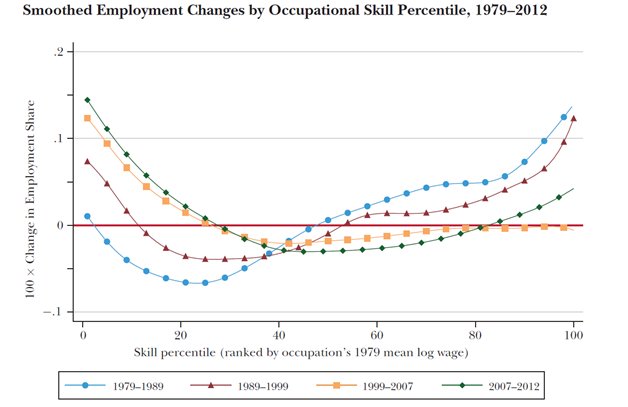
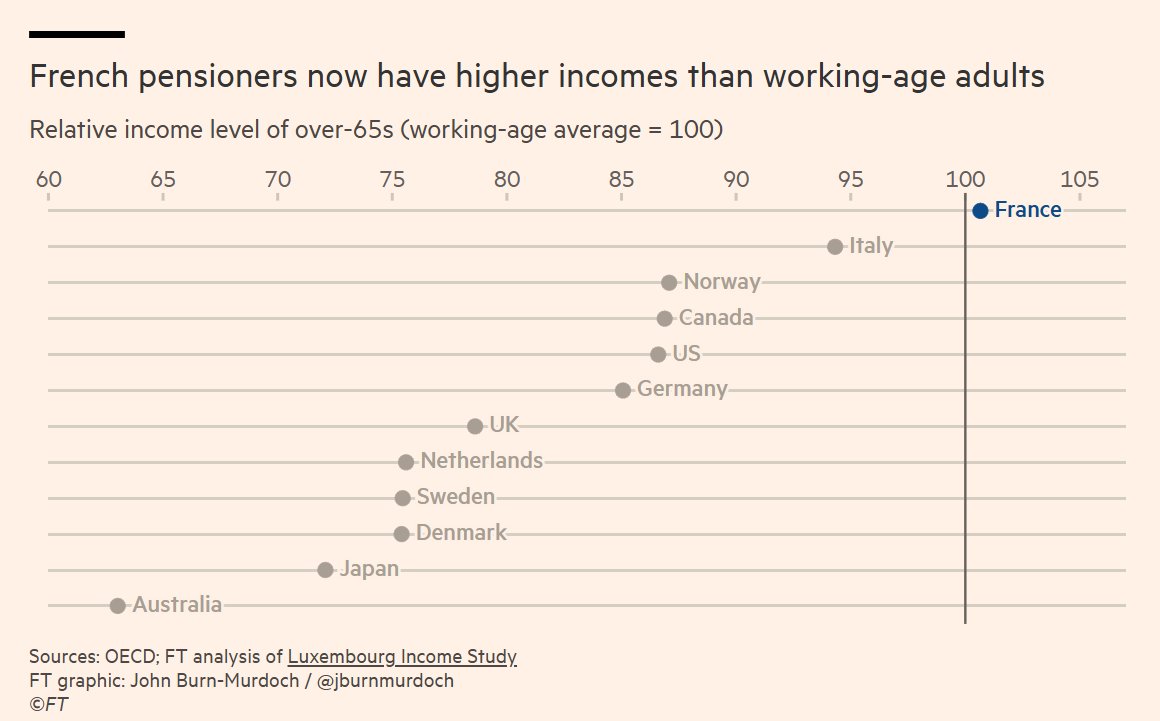
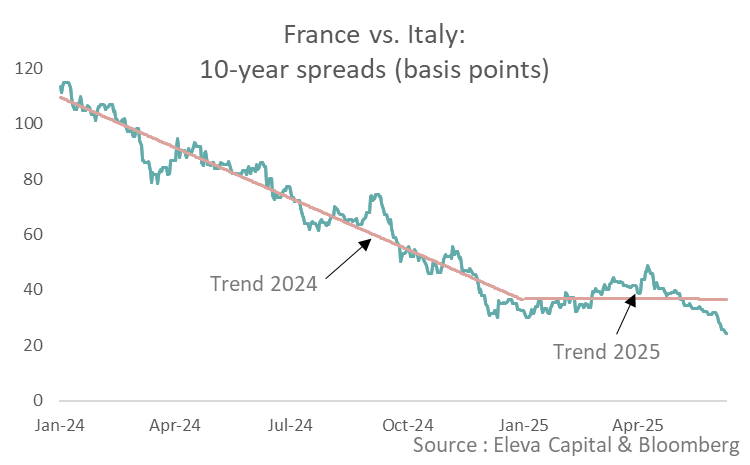
1/ Quelques graphs parlants sur l’ampleur de la polarisation de l’emploi (hausse des emplois hautement (1) et faiblement (2) qualifiés, baisse des emplois moyennement (3) qualifiés) dans les pays OCDE depuis 10-20 ans (sources OCDE et David Autor). Thread à dérouler ⤵️
Sans vouloir rentrer ici dans les querelles de personnes, je suis effectivement frappé de voir que c’est souvent la presse économique qui a le traitement le plus complet et objectif des sujets liés au climat : @LesEchos et @LaTribune en France, le @FinancialTimes au Royaume-Uni.
The lifecycle of a pure math theorem:
- 1997: my PhD advisor asks me to work on one of his conjectures
- 2000: I solve the simplest case and dream of generalizing my approach
- 2003: after years of struggle, I come to the conclusion that my approach *cannot* generalize
- 2006: after reading a paper by Daan Krammer, I have a lighting bulb moment and realize that my approach works in full generality *up to equivalence of categories*... this enables me to solve my advisor's conjecture... I then use it as an ingredient in the proof of a much older and more famous conjecture (the "K(π,1) conjecture for finite complex reflection groups")
- 2007: I submit my article for publication
- 2009: referee #1 gives up
- 2010: 2 more referees have now given up, complaining that the paper is too hard to read
- 2012: referee #4 is finally able to produce a report, the revision work starts
- 2014: the paper is accepted for publication
- 2015: the paper is published
- 2007-2025: because the older conjecture overshadows the lesser known conjecture by my advisor, and because my paper is too difficult, virtually no-one asks any question about the "lighting bulb" categorical idea at the core of the proof
- Jan 22, 2026: I received an inbound email from a mathematician from another hemisphere, inquiring about the categorical aspects
- Jan 26, 2026: I have my first ever videocall discussing the specifics of this core component of my proof
Taxe Zucman : "Le problème, ce n’est pas son effet sur Mistral, mais le fait qu’il n’y ait pas beaucoup plus de Mistral en France !", nous dit @a_bergeaud https://t.co/HKVFK6MhPq
La Cour publie son rapport annuel sur la situation et les perspectives des #FinancesPubliques, afin d'éclairer le débat public en amont de la préparation des textes financiers qui seront présentés au Parlement à l’automne.
🔗 Pour en savoir plus ➡️ https://t.co/6MCB8eVTJJ
A thread on the state of macroeconomics, based on https://t.co/WBc3ctD2Dy
Macroeconomics is the subject of many criticisms. From the journalists, that macroeconomists are not good at predicting the future, or that macroeconomists too often disagree. From other economists, that modern macroeconomic models are heavy on techniques, unwieldy and ugly.
My own view is more positive.
To get some of the criticisms out of the way: Not being able to predict the future is due to the nature of the beast. To take the usual example: Movements in the stock market are and should be mostly unpredictable. That macroeconomists disagree: This is largely due to the complexity of the world, and to free entry in the macroeconomic pontification business. That the models are heavy on techniques: There is nothing wrong with techniques, so long as they help understand complex phenomena.
I would argue that, in fact, over the last 50 years, macroeconomics has made much progress, and can at last be considered a mature field. The definition of a mature field is a field in which most researchers agree on a core view of the economy, explore various extensions, but do so within a common intellectual framework. I believe that, after five decades of fights and tensions, convergence has largely taken place, we are close to being there.
I see the core as based on two principles. In terms of methods. That, to the extent possible, behavior should be derived from micro foundations. Being understood not as strict adherence to neoclassical postulates, but allowing for example for behavioral deviations from it, be it for the formation of expectations, or the motives for saving. Then, in terms of content. That there is a number of distortions essential to understanding macroeconomic fluctuations, one of them being nominal rigidities and the implied effect on the role of demand in those fluctuations.
This general view has come to be known as the New Keynesian approach. The analytical core is a set of three equations, known as the New Keynesian model, characterizing the behavior of demand, the behavior of inflation, and the role of monetary policy. This core has played a central role in redefining monetary policy. The extensions are nearly infinite, from the implications of heterogeneity in incomplete markets, to the relevance of liquidity constraints, to the importance of myopia, to search and matching models of the labor market. These models have been used to analyse the global financial crisis, the pandemic inflation, the Greek debt crisis, etc. They are sometimes heavy, sometimes too much of a black box, but they have proven useful in thinking about the nature and the effects of the shocks, and the role of policy.
Not everything is perfect, and the linked paper lists my reservations. But, on net, I believe the field is in good shape.
Ma plus grosse vidéo! Les preuves de l'évolution. Au programme: anatomie comparative, développement, génétique, paléontologie et d'autres curiosités.
https://t.co/MFzIVofV1A
https://t.co/MFzIVofV1A
https://t.co/MFzIVofV1A
People who write about degrowth implicitly seem to assume that a Western median income could be achievable by all. But they do not realize that the Western median is at the 90-91st global percentile and if you want to bring everybody to that level you would have to let the current world GDP increase 2.5 times.
La Cour des comptes publie son premier rapport de l’année consacré à la situation des #FinancesPubliques.
Pour la deuxième année consécutive, le #déficit public s’est aggravé en 2024 pour atteindre près de 175 Md€, soit 6 points de PIB.
⬇️ 1/3
Le niveau des élèves français en maths et en sciences est en dessous de la moyenne de l'OCDE mais cesse de chuter, selon une étude internationale https://t.co/L6WjsZN7Lz via @franceinfo
Félicitations aux lauréates du Prix de thèse de la Cour ! 👏
Remis par le Premier président @pierremoscovici, ce prix récompense les auteurs de thèses qui contribuent à améliorer les connaissances en finances publiques, gestion publique ou évaluation des politiques publiques. 🧐
L’ENSAE Paris est ravie d’accueillir ce soir @pierremoscovici pour un échange sur le rôle de la @Courdescomptes, le déficit public ou encore la place de l’économie française dans le monde. Une rencontre organisée à l’initiative de l’association étudiante @AgoraEnsae !
#PLFG|📣Le Haut Conseil des finances publiques a publié son avis sur le projet de loi de finances de fin de gestion pour l’année 2024.
Pour lire l’avis ➡ https://t.co/jSPOGWFYhy
Pour lire un résumé ⬇
1/4🧶
#HCFP#FinancesPubliques
La seule utilisation tolérée de l’ia en Europe sera la rédaction de lettres de motivation et de devoirs maison par les étudiants. Autant me pendre tout de suite
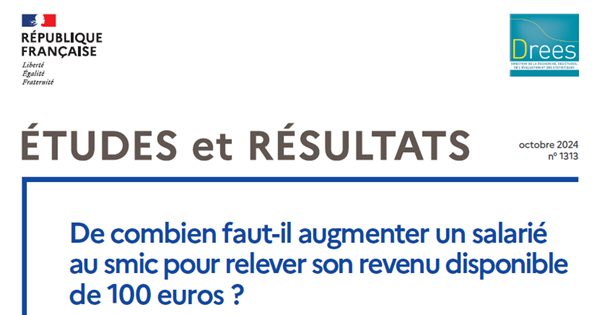
Étude @DREESanteSocial : quand un salarié est augmenté, le revenu disponible de son foyer et le coût du travail de l’employeur augmentent aussi, mais ces 3 hausses sont d’ampleur (parfois très) différente.
Tout savoir sur le gain au travail en FR. (1/4)
https://t.co/TiE7lsd97w
#PSMT|📣Le Haut Conseil des finances publiques a publié son avis sur le plan budgétaire structurel à moyen terme pour la période 2025-2028.
Pour lire l’avis ➡ https://t.co/rLVMnmEAjf
Pour lire un résumé ⬇
1/4🧶
#HCFP#FinancesPubliques
#PLF|📣Le Haut Conseil des finances publiques a publié son avis sur les projets de loi de finances et de financement de la sécurité sociale pour l’année 2025.
Pour lire l’avis ➡ https://t.co/56wXD4uI2k
Pour lire un résumé ⬇
1/4🧶
#HCFP#FinancesPubliques